
 By
By I reckon the honest thing to do is tell you who I am before I tell you what I cooked.
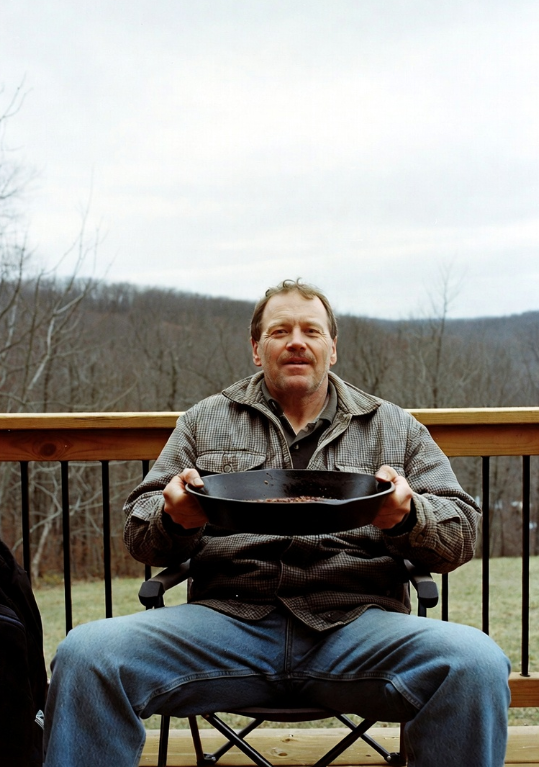
My name is Craig Hensley. I’m forty-seven years old—forty-eight on Wednesday, which is a fact I’d just as soon let pass quietly, but Connie has already bought a cake and told Clay, so it’s not going to pass quietly. I live in Lexington, Kentucky, in a house on the east side of town with my wife Connie and our youngest boy, Clay, who is fifteen years old and approximately the size of a refrigerator. I work construction—I’m a foreman, which sounds like a promotion but mostly means I’m the one who has to explain to the younger guys why you can’t frame a wall that way and then take it apart and do it myself when they don’t believe me. My back has been complaining since about 2010 and has been getting louder every year since, like a man in the next room who starts out grumbling and eventually just starts shouting.
I grew up in Evarts, Kentucky, in Harlan County, deep in the coal country of eastern Kentucky. If you’ve never been to Harlan County, the short version is this: it’s mountain country, it’s mining country, and it’s the kind of place that gets into your blood and stays there whether you want it to or not. I’ve been in Lexington for twelve years now, and there are still mornings when I wake up and the first thing I feel is the absence of the ridgeline outside the window. Some people are from a place. I am of a place. There’s a difference, and I feel it every day.
My daddy was a coal miner for thirty-four years. His daddy before him. I went in myself at eighteen, right out of high school, and worked underground for seventeen years until the mine closed in 2003 and took everything that Harlan County had left to give. But that’s a long story and I’m not going to tell all of it today. What I will tell you is that the thing I remember most about growing up in that company house in Evarts isn’t the cold—and Lord it was cold, a potbelly stove burning coal in the front room and nowhere near enough heat getting to the back bedrooms—and it isn’t the noise from the mines, and it isn’t the way everything was covered in a fine black dust that settled on every surface and got into everything. What I remember most is the smell coming out of my mother’s kitchen.
Betty Hensley is seventy-six years old. She still lives in Evarts, alone in that company house since my daddy passed in 2008, and she still cooks the same way she cooked when there were eight of us at that table. She grows a garden on the hillside behind the house every summer. She cans enough vegetables to last the winter. She makes soup beans every Monday without fail—has done it my entire life, will probably do it until they put her in the ground, which I am not willing to think about. She made fried chicken that was so good people drove from three counties over to eat it at church suppers. Stack cake for every funeral, every wedding, every homecoming. She doesn’t follow recipes. She follows her mother, who followed her mother before her, and the knowledge has never been written down anywhere. It lives in Betty’s hands and in my memory and in the memories of my brothers and sisters, and that is not enough. That is not nearly enough.
So that’s what I’m doing here. I’m forty-seven years old—forty-eight on Wednesday—and I am trying to write it down before it’s gone. The recipes. The way the house smelled. What it meant to sit at that table. I don’t have a mission statement. I have a cast iron skillet and a list of things in my head that exist nowhere else on earth, and if I don’t get them on paper, they’re going to disappear the way things in Harlan County disappear: quietly, without anyone noticing until it’s too late.
I want to start with the chicken.
Not Betty’s fried chicken—that’s a whole undertaking that I am not ready to attempt on paper yet, because I have made that chicken maybe forty times and I still can’t get it right, and writing down a recipe I can’t replicate feels dishonest. I want to start with a roast chicken, which is the thing I made last Sunday when Connie was at work and Clay was out somewhere doing whatever fifteen-year-olds do when you give them a Sunday afternoon, and the house was quiet in a way that houses only get quiet on winter afternoons when the light is going early and there’s nothing outside but grey sky and bare trees.
I had a whole chicken from the grocery store. I had potatoes and carrots and an onion and some butter and a lemon that Connie had bought for something she never got around to making. I had a roasting pan that we’ve had so long I can’t remember where it came from. And I had this thought, standing in the kitchen at about two in the afternoon, that what I wanted more than anything was for the house to smell like something.
That sounds like a small thing. It isn’t. When you grow up in a house where your mother is always cooking—soup beans simmering all day Monday, cornbread going into the oven at five, chicken frying on a Saturday, biscuits on Sunday morning—you learn to measure safety by smell. The house smells like food means the house is warm. The house smells like food means somebody is home. The house smells like food means everything is going to be all right, or at least survivable. I’m fifty years out of that company house and I still feel it in my chest when I walk into a kitchen that smells like something cooking low and slow.
My own house doesn’t smell like that enough. That’s the truth of it. We eat well—Connie cooks a few nights a week, and I’ve been cooking more since my back started limiting what I can do on a job site—but it’s mostly quick things, weeknight things, the kind of food that gets a family fed but doesn’t fill a house. I wanted to fill the house. I wanted Clay to come home from wherever he was and walk in the front door and smell something and know, without being told, that supper was going to be good.
So I made a roast chicken.
It is not a complicated thing. You rub the bird with butter and salt and pepper and whatever else you’ve got in the cabinet—I used garlic powder and paprika and dried thyme, because that’s what I had—and you stuff the cavity with a lemon and some garlic cloves and you lay it on top of your vegetables and you put it in a hot oven and you let it go. That’s the whole thing. The oven does the work. You just have to be patient enough to let it.
I am not, by nature, a patient man. Forty-seven years of evidence on this. But I have learned—slowly, the way I learn most things, which is through making the same mistake enough times that it finally sticks—that some food does not tolerate impatience. Soup beans cooked too fast are chalky and thin. Biscuits handled too much are tough. A roast chicken pulled out too early is going to be pink at the bone, and nobody at my table is eating pink chicken.
I let it go for an hour and fifteen minutes. I checked the temperature—my daddy would have called that a Yankee habit, checking temperature instead of just knowing, but I’ve poisoned myself exactly once in my cooking life and once was sufficient—and it was right where it needed to be, and I let it rest for ten minutes because that is the one thing I have learned for certain about meat: let it rest. Don’t carve it the second it comes out of the oven like you can’t wait ten minutes. Wait the ten minutes. The juice stays in the meat instead of running out onto the cutting board. This is not my wisdom. This is just physics.
Clay came home at five-thirty. I heard him in the entryway—the boots hitting the floor, the backpack dropping, the particular sound of a teenage boy moving through a space—and then I heard him stop. And then he came to the kitchen doorway and looked at the bird on the counter and the pan of vegetables still in the oven and said, “What’s that smell?”
“Supper,” I said.
He sat down at the table without being asked. That is not something that happens every day in this house, I will tell you that for free.
Connie got home at six. She walked in the door and she stopped the same way Clay had stopped, and she looked at me standing at the counter with a carving fork, and she said, “Is that a whole chicken?”
“It is,” I said.
She set down her purse and came into the kitchen and looked at the bird and the vegetables and the pan drippings I was fixing to make into a simple pan sauce, and she said, “Well.” That’s all she said. Just well. But the way she said it—Connie has ways of saying things that carry more information than the word itself warrants—meant something. It meant: this is more than I expected. It meant: this is what I needed tonight. It meant: thank you, even though she didn’t say thank you because Connie and I don’t narrate everything we feel at each other. Never have. It’s not our way.
We ate at the kitchen table, the three of us—Travis has his own place now, he’s twenty-two and working for a landscaping company; Amber is up at UK studying nursing, which makes her the first Hensley to ever go to college, and I intend to mention that every single time I write anything here, because I am proud of that girl in a way I cannot adequately express—and the chicken was good. Not Betty’s fried chicken good. That is a standard I may never reach. But it was honest food, hot and filling and made from scratch, and it smelled like a house that somebody cared about.
After supper, Clay helped me clean up without being asked, which was the second miracle of the evening. I don’t know what got into him. Maybe it was the chicken. Maybe that’s what food does when you make it right: it makes people want to show up for each other. I learned that in Betty’s kitchen in Evarts, watching her feed eight people three times a day on a miner’s salary, and I’m only now beginning to understand what she was really doing. She was holding us together. Every pot on that stove was an act of love, and she never said so, because she didn’t have to. The soup beans said it. The cornbread said it. The fried chicken said it louder than anything.
I’m going to try to say it too. This is me trying.
I’m not ready to tackle Betty’s fried chicken—not yet, maybe not ever—but Clay helping with the dishes without being asked told me something: we were ready to try. A big salad felt right for that next step. Something with layers, something you build piece by piece the way you build a family back together—honest ingredients laid out in the open where everybody can see them. This Southwestern Chicken Cobb Salad with Jalapeno Buttermilk Ranch is that kind of meal: real food, no pretense, enough heat to remind you you’re alive. Here’s how I made it.
Southwestern Chicken Cobb Salad with Jalapeno Buttermilk Ranch
Prep Time: 1 hr | Cook Time: 15 min | Total Time: 1 hr 15 min | Servings: 6
Ingredients
- 1 tablespoon balsamic vinegar
- 1 tablespoon olive oil
- 3 minced garlic cloves
- 1 teaspoon adobo from canned chipotles in adobo
- 1 teaspoon oregano
- 1 teaspoon paprika
- 1 teaspoon cumin
- Kosher salt and black pepper, to taste
- 2 boneless, skinless chicken breasts
- 1/2 cup good-quality mayonnaise
- 1/2 cup sour cream
- 1/4 cup buttermilk
- 2 tablespoons chopped pickled jalapenos plus 2 teaspoons pickling juice, or to taste
- 1/4 cup fresh minced cilantro
- 1 1/2 teaspoons fresh minced dill (or 1/2 teaspoon dried dill)
- 1 bunch minced chives
- 2 cloves garlic
- Kosher salt and black pepper, to taste
- 2 heads romaine lettuce
- 1/2 cup black beans
- 2 ears grilled corn
- 3 hard boiled eggs, sliced
- 6-8 cherry tomatoes
- 1 small avocado, peeled, pitted, and thinly sliced
- 6 slices bacon, cooked and crumbled
- 2 ounces cheddar jack cheese
- 1/2 cup tortilla strips
Instructions
- Marinate the chicken. In a large sealable plastic bag, combine the balsamic vinegar, olive oil, garlic, adobo, oregano, paprika, cumin, and salt and pepper for the chicken marinade. Mix well and add in the chicken breasts. Seal the bag and work the marinade around the chicken. Refrigerate for 30 minutes or until ready to cook.
- Make the ranch dressing. As the chicken marinates, combine the dressing ingredients in the bowl of a food processor or in a large bowl, and pulse or mix until even. Taste and adjust jalapeno and seasonings as desired. Transfer to a large container, cover, and refrigerate until ready to serve.
- Grill the chicken. Heat the grill pan over medium-high heat. Remove the chicken from the marinade, allowing excess to drip off. Place on the grill pan and reduce the heat to medium. Cook for 5 minutes, flip, and cook for an additional 5-7 minutes, or until no pink remains inside. Set the chicken aside to cool slightly.
- Assemble and serve. Assemble the salad ingredients in rows over the chopped romaine lettuce. Slice the chicken and place over the salad. Serve immediately with the ranch dressing.
Nutrition (per serving)
Nutrition information not available for this recipe.