
 By
By I sat at the kitchen table this week. For the first time since March 3rd. I sat in my chair — not Marcus's chair, never Marcus's chair, his chair is empty and will remain empty until the day I set a plate there on his anniversary and wrap it for whoever is hungry — but my chair, my spot, the place I have sat for eighteen years of dinners and ten years before that in other kitchens at other tables, always the same position, always facing the stove, always where I can see everything because a cook who cannot see her kitchen is a cook who has lost control, and I have lost enough.
Calvin sat across from me. I made fried chicken. The first fried chicken since Marcus died. The chicken was harder than the mac and cheese because the mac and cheese was Marcus's dream but the fried chicken was Marcus's life — every birthday, every celebration, every ordinary Tuesday that he asked for it and I said yes. The chicken in the oil sounded the same. The sizzle was the same. The temperature was the same — 350 degrees, the number that lives in my bones. But the eating was different because the boy who ate the most chicken was not there, and the absence was louder than the sizzle, louder than the oil, louder than anything in the kitchen.
I ate two pieces. Calvin ate three. We did not talk during dinner. After dinner Calvin said: the chicken was good. And I said: it was. And that was the whole conversation, and it was enough, because the conversation was not about the chicken. The conversation was about the woman who made it and the man who watched her make it and the fact that she is back at the stove, not fully, not the way she was, but back, the way a person comes back from a long illness — thinner, weaker, changed, but vertical. Vertical is a victory.
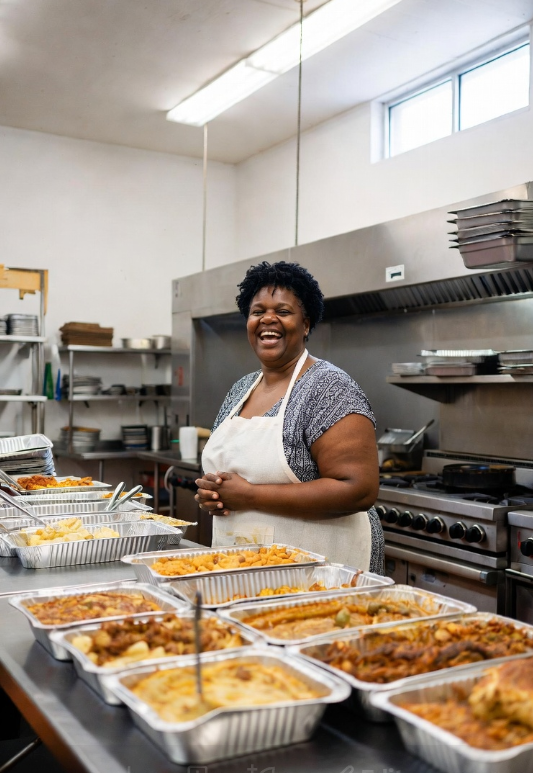
The church women came to the house Saturday. Not to bring food — to visit. Sister Mable, Sister Terri, Sister Johnson, Sister Davis. They sat in my living room and told me about the church kitchen, about the meals they have been cooking, about the Wednesday suppers and the shut-in deliveries and the work that has continued in my absence. They did not ask when I was coming back. They told me the kitchen was mine whenever I wanted it. And then Sister Terri said something that broke me open: she said, Mother Simms, the kitchen misses you. And I thought: yes. The kitchen misses me. And I miss the kitchen. And the missing is a bridge, and bridges are for crossing.
I have not crossed yet. But I can see the other side.
The recipe I’m leaving here is the one I made that night — the fried chicken I have been making for nearly thirty years, the one Marcus requested more than any other, the one Calvin ate three pieces of in silence while I ate two. I wrote it down the way I actually make it, not the way a cookbook would tell you to, because this chicken was never about a cookbook. It was about a cast iron skillet, 350 degrees, and knowing in your hands when the crust is right. If you are someone who is finding your way back to a kitchen that feels different than it used to, I hope this chicken does for you what it did for me: reminds you that your hands still know what to do, even when the rest of you is not so sure.
Southern Fried Chicken
Prep Time: 20 min (plus 4 hrs brine) | Cook Time: 35 min | Total Time: 55 min active | Servings: 4–6
Ingredients
- 3 to 4 lbs bone-in, skin-on chicken pieces (thighs, drumsticks, and breasts)
- 2 cups buttermilk
- 1 tablespoon hot sauce
- 2 teaspoons kosher salt, divided
- 2 cups all-purpose flour
- 1 teaspoon garlic powder
- 1 teaspoon onion powder
- 1 teaspoon smoked paprika
- 1/2 teaspoon cayenne pepper
- 1/2 teaspoon black pepper
- 1/2 teaspoon dried thyme
- Vegetable oil or lard, enough to fill a heavy skillet 1 inch deep (about 3 to 4 cups)
Instructions
- Brine the chicken. In a large bowl, whisk together the buttermilk, hot sauce, and 1 teaspoon of the salt. Add the chicken pieces, turn to coat, cover, and refrigerate for at least 4 hours or overnight. The longer it sits, the more tender it will be.
- Make the dredge. In a shallow dish, combine the flour, garlic powder, onion powder, smoked paprika, cayenne, black pepper, thyme, and the remaining 1 teaspoon salt. Whisk until evenly mixed.
- Dredge the chicken. Remove each piece from the buttermilk, letting the excess drip off. Press firmly into the seasoned flour on all sides. Set on a wire rack and let rest for 10 minutes so the coating can set. Do not skip this rest — it keeps the crust from sliding off in the oil.
- Heat the oil. Pour oil into a cast iron skillet or heavy-bottomed pot to a depth of about 1 inch. Heat over medium to medium-high until it reaches 350 degrees F. Use a thermometer. The temperature matters. Keep it there.
- Fry in batches. Lay the chicken pieces in the hot oil skin-side down, being careful not to crowd the pan. Fry for 12 to 15 minutes per side, turning once, until the crust is deep golden brown and the internal temperature reaches 165 degrees F. Thicker pieces like breasts will take longer than drumsticks — watch each piece, not the clock.
- Drain and rest. Transfer the finished chicken to a clean wire rack set over a baking sheet. Do not rest it on paper towels; the steam will soften the bottom crust. Let it rest for at least 5 minutes before serving.
- Serve. Serve as it is. It does not need a sauce. It does not need an explanation. It just needs to be eaten.
Nutrition (per serving)
Calories: 480 | Protein: 38g | Fat: 24g | Carbs: 26g | Fiber: 1g | Sodium: 620mg