I talked to Appa about his cholesterol. It went exactly as well as you'd expect.
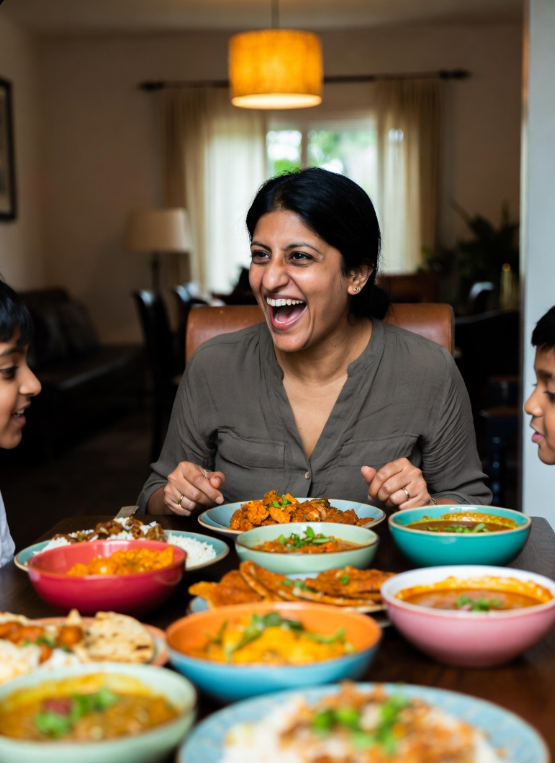
Setup: Sunday dinner at the parents' house. Amma's usual spread. I waited until Appa had finished eating (you never deliver medical advice to a man who hasn't been fed — this is basic Indian pharmacology). He was leaning back in his chair with that post-meal satisfaction, and I said, casually, "Appa, when was your last physical?"
The look he gave me could have curdled the yogurt in the raita.
"I'm fine," he said.
"When was your last physical?"
"I don't need a physical. I feel fine."
"Appa, you're sixty-six. You eat ghee like it's a food group. I'm a pharmacist. Let me —"
"You are my daughter, not my doctor."
Amma, from the kitchen, not looking up from the dishes: "Listen to your daughter, Venkatesh."
Appa went silent. When Amma deploys Appa's full first name, the conversation is over and she has won. It's the nuclear option. I've seen it used maybe ten times in my life, and each time, Appa folds like a man who has learned, over forty years of marriage, that some battles aren't worth fighting.
He agreed to see his doctor. He agreed to get bloodwork. He did not agree to reduce his ghee intake, which he described as "an unreasonable demand" and which Amma rolled her eyes at in a way that suggested this battle has been ongoing since approximately 1985.
Small victory. I'll take it.
In better news: Arvind called to say he's enrolled in the contractor's license prep course. He starts in November. He sounded nervous and excited, which is the right combination for someone about to change their life. I told him I'd quiz him on the material if he wanted. He said, "You're going to make flashcards, aren't you, Akka?" I am absolutely going to make flashcards.
Dinner at home tonight: Raj requested khichdi, which is the Gujarati comfort food — rice and dal cooked together into a soft, mild porridge. His mother makes it with ghee and pickle on the side. I've learned to make it his way, which is different from the Tamil version (we add more spices and vegetables). Making someone's comfort food the way their mother makes it is an act of love. Not as dramatic as a three-day wedding, but more sustainable.
Raj ate two bowls and looked at me like I'd handed him his childhood. "Just like Mom's," he said. The highest compliment a married man can give. The most dangerous words a married man can say. I chose to take it as intended.
Khichdi isn’t the recipe I was planning to share this week, but watching Raj finish his second bowl with that look on his face—the one that means home—reminded me that the most useful thing I can cook isn’t always the most impressive. This slow cooker version takes the same spirit of simplicity and lets it run even lower and slower, which is exactly the right energy for a weeknight when someone you love needs feeding. Here’s how I make it.
Slow Cooker Indian Spiced Lentils
Prep Time: 15 min | Cook Time: 4 hrs (low) | Total Time: 4 hrs 15 min | Servings: 4
Ingredients
- 1 cup yellow moong dal (split yellow lentils), rinsed well
- 1/2 cup basmati rice, rinsed
- 4 cups water or low-sodium vegetable broth
- 1 tablespoon ghee (plus more for serving)
- 1 teaspoon cumin seeds
- 1/2 teaspoon turmeric powder
- 1/2 teaspoon ground coriander
- 1/4 teaspoon asafoetida (hing)
- 1 small yellow onion, finely diced
- 2 cloves garlic, minced
- 1 teaspoon fresh ginger, grated
- 1 green chili, slit lengthwise (optional)
- 1 medium tomato, diced
- 1 teaspoon salt, plus more to taste
- Fresh cilantro, chopped, for garnish
- Lemon wedges and pickle (achaar), for serving
Instructions
- Bloom the spices. In a small skillet over medium heat, warm the ghee. Add cumin seeds and let them sizzle for 30 seconds until fragrant. Add the onion and cook 4–5 minutes until softened and golden at the edges. Stir in garlic, ginger, and green chili; cook 1 minute more. Add turmeric, coriander, and asafoetida, stir to coat, then add diced tomato. Cook 2 minutes until the tomato breaks down slightly.
- Load the slow cooker. Transfer the spiced onion mixture to the slow cooker. Add the rinsed moong dal, rice, water or broth, and salt. Stir to combine everything evenly.
- Cook low and slow. Cover and cook on LOW for 4 hours, or on HIGH for 2 hours, until the dal and rice are completely soft and have melded into a thick, porridge-like consistency. Stir once halfway through if you can; if not, it’ll be fine.
- Adjust and finish. Remove the lid and stir vigorously — the khichdi should be creamy and soft, not stiff. If it’s thicker than you’d like, stir in 1/4 to 1/2 cup of hot water until it reaches your preferred consistency. Taste and adjust salt.
- Serve. Ladle into bowls. Finish each bowl with a small knob of ghee melted on top, a scatter of fresh cilantro, a squeeze of lemon, and achaar on the side. Serve immediately.
Nutrition (per serving)
Calories: 285 | Protein: 13g | Fat: 5g | Carbs: 47g | Fiber: 9g | Sodium: 420mg
About the cook who shared this
Priya Krishnamurthy
Week 29 of Priya’s 30-year story
· Edison, New Jersey
Priya is a pharmacist, wife, and mom of two in Edison, New Jersey — the town she grew up in, surrounded by the sights and smells of her mother's South Indian kitchen. These days, she splits her time between the hospital pharmacy, school pickups, and her own kitchen, where she cooks nearly every night. Her style is a blend of the Tamil recipes her mother taught her and the American comfort food her kids actually want to eat. She writes about the beautiful mess of balancing two cultures on one plate — and she wants you to know that ordering pizza is also an act of love.
