
 By
By Twenty-two weeks. Nora moves differently than Liam did at this stage—more lateral, like she's rearranging a room, where Liam was more direct. I notice this and don't know what to make of it except that she's her own person already and I'm receiving the first information. When I tell this to Sean he puts his hand on my stomach and waits. She usually moves for him within about thirty seconds. She already knows him somehow. They already know each other.
I took Liam to see Meghan's kids on Saturday and Liam and Aidan—who is seven months now, sitting unassisted, looking at everything—were on the floor together and Liam brought Aidan a board book and said "baby book" and handed it to him and then sat next to him with his own book and they looked at their respective books for about ten minutes in the parallel companionship of small people who don't need conversation. Meghan and I watched from the couch with coffee.
"He's going to be a good big brother," Meghan said. I said I thought so. She said Cormac's brother had been a different story—she said this with a look that conveyed a full paragraph—and I said we'd done our best with Liam and hoped for the best. She said "he's a good one." He is. He really is.
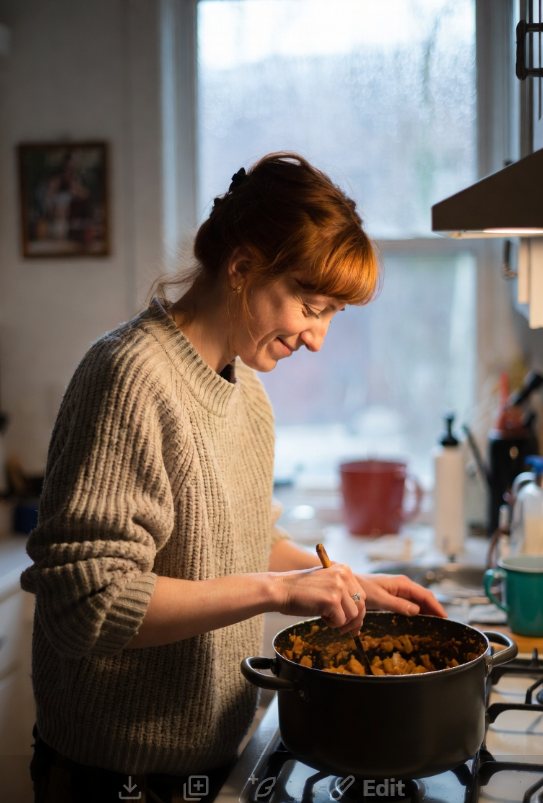
Made minestrone on Sunday with November vegetables: kale, white beans, canned tomatoes, parmesan rind. Liam ate two bowls. Nora kicked twice during the first bowl, which I'm logging as an endorsement.
The minestrone I described is really just a state of mind — Sunday, November light, something simmering without much intervention from me. This slow-cooker beef and barley soup is cut from the same cloth: you put it together in the morning, it does its own patient work, and by dinner the whole house smells like something permanent and good. It’s the kind of pot that makes a toddler eat two bowls and, if you’re twenty-two weeks along, makes the baby register an opinion.
Slow-Cooker Beef and Barley Soup
Prep Time: 20 min | Cook Time: 8 hrs | Total Time: 8 hrs 20 min | Servings: 6
Ingredients
- 1 1/2 lbs beef stew meat, cut into 1-inch cubes
- 1 tablespoon olive oil
- 1 teaspoon kosher salt, plus more to taste
- 1/2 teaspoon black pepper
- 1 medium yellow onion, diced
- 3 cloves garlic, minced
- 3 medium carrots, sliced into rounds
- 3 stalks celery, sliced
- 1 can (14.5 oz) diced tomatoes, with juices
- 3/4 cup pearl barley, rinsed
- 6 cups low-sodium beef broth
- 1 tablespoon Worcestershire sauce
- 1 teaspoon dried thyme
- 2 bay leaves
- Fresh parsley, chopped, for serving
Instructions
- Sear the beef. Heat olive oil in a large skillet over medium-high heat. Season beef cubes with salt and pepper. Working in batches, sear beef on all sides until browned, about 2–3 minutes per side. Transfer to the slow cooker. (This step is optional but builds flavor worth the extra pan.)
- Add vegetables and aromatics. To the slow cooker, add the onion, garlic, carrots, celery, and diced tomatoes with their juices. Stir to distribute around the beef.
- Add broth and seasonings. Pour in the beef broth. Add the rinsed barley, Worcestershire sauce, thyme, and bay leaves. Stir gently to combine.
- Cook low and slow. Cover and cook on LOW for 7–8 hours, or on HIGH for 4–5 hours, until the beef is fork-tender and the barley is fully cooked and has thickened the broth slightly.
- Finish and serve. Remove and discard the bay leaves. Taste and adjust salt and pepper as needed. Ladle into bowls and top with fresh parsley.
Nutrition (per serving)
Calories: 340 | Protein: 28g | Fat: 10g | Carbs: 32g | Fiber: 6g | Sodium: 620mg