
 By
By Fourth of July. I worked the holiday — banking hours. The ER had the usual fireworks-related parade. I made ginataang manok at home Sunday and ate it on the balcony in the eight PM light.
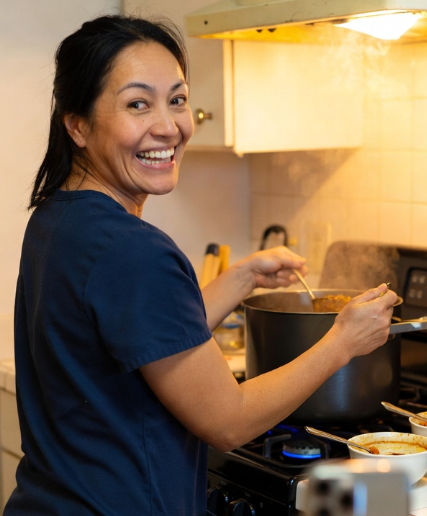
Lourdes is 74. She is in the kitchen. She is luminous. Angela came over Saturday with the kids. We cooked. We argued about pancit proportions — she uses more soy, I use more calamansi. We are both wrong, according to Lourdes.
I made pancit Sunday. The long-life noodle. The Filipino default. The dish you make when you do not know what to make.
The blog post on pancit got picked up by a Filipino-American newsletter. Traffic doubled for two days. The traffic was the surprise.
I went to bed Sunday at nine. I slept for ten hours. The sleeping was the inheritance.
I taught a Saturday morning Kain Na class on basic adobo proportions for new cooks. Eleven people in the kitchen. Half of them had never cooked Filipino food before. By eleven AM the kitchen smelled the way it should smell. By noon they were all eating. The eating was the lesson landing.
The light was good Saturday morning. I sat on the porch with a cup of coffee and watched the inlet for forty minutes. The watching was the small therapy. The therapy was free.
Angela texted me a photo of the kids. I texted back a heart. The exchange took thirty seconds. The thirty seconds was the keeping.
I took inventory of the freezer Sunday. The freezer had: twelve quarts of broth, eight pounds of adobo in vacuum bags, six pounds of sinigang base, fourteen lumpia trays at fifty rolls each, three pounds of marinated beef for caldereta, and a small bag of pandan leaves Tita Nening had sent me. The inventory was the proof of preparation. The preparation was the proof of love.
The Anchorage sky was the Anchorage sky. The mountains were the mountains. The inlet was the inlet. The geography was the geography.
The salmon in the freezer is from August. Joseph's catch. The bag is labeled in his handwriting — "for Grace." I will use it next week.
The Filipino Community newsletter announced a fundraiser for typhoon relief in Samar. I committed to making three hundred lumpia. The number is the number. The number has always been the number. Three hundred is what I make. The math has stopped surprising me.
The neighbors invited us over for a small dinner Thursday. They are an Iñupiaq family — Aana and her grandson Joe. We ate caribou stew and rice. I brought lumpia. The kitchens of Anchorage have always been the small UN. The food is the proof.
I drove home Tuesday evening and the sun set at three forty-five and the highway was already iced at the bridges and the radio was on a station I did not recognize and I did not change it.
Pete and I had a long phone conversation Tuesday. We talked about the family — his and mine. The talking was the keeping.
Auntie Norma called Sunday afternoon. She is now seventy-nine. She wanted a recipe. I gave it to her. She wanted to know how my week was. I told her, briefly. She told me about her week. The exchange took eighteen minutes. The eighteen minutes was the keeping.
The grocery store had no calamansi. I substituted lime. The substitution was acceptable. The acceptable is the working version of perfect.
A reader from New Jersey wrote in about her grandmother's adobo, which used pineapple. I had never heard of pineapple in adobo. I tried it. It was strange. It was also good. The strange and the good are not opposites.
The freezer inventory I took Sunday — twelve quarts of broth, vacuum-sealed adobo, sinigang base, three hundred lumpia waiting to be made — reminded me that the real work of feeding people happens long before anyone sits down to eat. This slow-cooked pork roast belongs to that same logic: you start it early, you tend it quietly, and by the time the people you love arrive, the kitchen already smells the way it should smell. Lourdes would approve of the patience required. Angela would approve of the pork.
Slow-Cooked Pork Roast Dinner
Prep Time: 20 minutes | Cook Time: 8 hours | Total Time: 8 hours 20 minutes | Servings: 6
Ingredients
- 3 to 4 lbs bone-in pork shoulder roast
- 1 teaspoon salt
- 1/2 teaspoon black pepper
- 1 teaspoon garlic powder
- 1 teaspoon onion powder
- 1/2 teaspoon smoked paprika
- 2 tablespoons vegetable oil
- 1 large onion, sliced into rings
- 4 cloves garlic, smashed
- 3 medium carrots, cut into 2-inch pieces
- 3 medium Yukon Gold potatoes, quartered
- 1 cup low-sodium chicken or pork broth
- 2 tablespoons soy sauce
- 1 tablespoon Worcestershire sauce
- 1 tablespoon apple cider vinegar
- 2 sprigs fresh thyme (or 1/2 teaspoon dried)
- 1 bay leaf
Instructions
- Season the roast. Pat the pork shoulder dry with paper towels. Combine salt, pepper, garlic powder, onion powder, and smoked paprika in a small bowl and rub the mixture evenly over all sides of the roast.
- Sear for color. Heat vegetable oil in a large heavy skillet over medium-high heat. Sear the pork roast on all sides, 3 to 4 minutes per side, until a deep brown crust forms. This step builds flavor — do not rush it.
- Layer the slow cooker. Place the sliced onion and smashed garlic on the bottom of a 6-quart slow cooker. Nestle the seared pork roast on top.
- Add vegetables and liquid. Arrange the carrots and potatoes around the roast. In a small bowl, whisk together the broth, soy sauce, Worcestershire sauce, and apple cider vinegar. Pour the mixture over the roast and vegetables. Tuck in the thyme sprigs and bay leaf.
- Cook low and slow. Cover and cook on LOW for 7 to 8 hours, or on HIGH for 4 to 5 hours, until the pork is fork-tender and pulls apart easily from the bone.
- Rest and serve. Transfer the pork to a cutting board and let it rest for 10 minutes before slicing or pulling. Remove the bay leaf and thyme stems. Serve the pork with the vegetables and spoon the cooking juices over everything as a light pan sauce.
Nutrition (per serving)
Calories: 420 | Protein: 38g | Fat: 18g | Carbs: 22g | Fiber: 3g | Sodium: 580mg