
 By
By I drove to Grinnell the next day. COVID or not. Masks or not. Six feet or not. My mother has cancer and I am going to sit at her kitchen table and hold her hand and the virus can have its opinions but it cannot have this visit. Some things override everything. A daughter and a dying mother is one of those things.
She looked the same. That's the cruelest part — she looked like Marlene, the same Marlene who made cinnamon rolls last week and directed my pie crust from across the room and drank Roger's too-strong tea without complaint. The cancer was inside, invisible, doing its work in silence while the outside of her remained Marlene: upright, sharp-eyed, offering food to anyone who entered the house. She made me coffee. She offered a roll. She sat across the table and said, "We need to talk about the plan."
The plan: treatment — not a cure, the doctors said months — but treatment that might slow it, might buy time, might extend the timeline from months to more months. Marlene was practical about it. She discussed chemotherapy the way she discussed canning schedules — what needs to happen, when, what the side effects are, how to manage them. She was not in denial. She was in management. Marlene Weber manages everything, including her own dying, and the management will be efficient and the timeline will be adhered to and the kitchen will remain stocked because cancer does not excuse a bare pantry.
Roger sat in his chair and said nothing. The nothing was enormous. Roger's silence has always been large but this silence filled the room, the house, the space between his chair and her chair, and the silence said what Roger couldn't: I cannot lose you. I have already lost the farm. I cannot lose you. And Marlene, who heard the silence the way she heard everything Roger didn't say, put her hand on his arm and said, "The garden needs water, Roger." He went to water the garden. He watered the garden for forty-five minutes. The garden didn't need forty-five minutes of water. Roger needed forty-five minutes of watering.
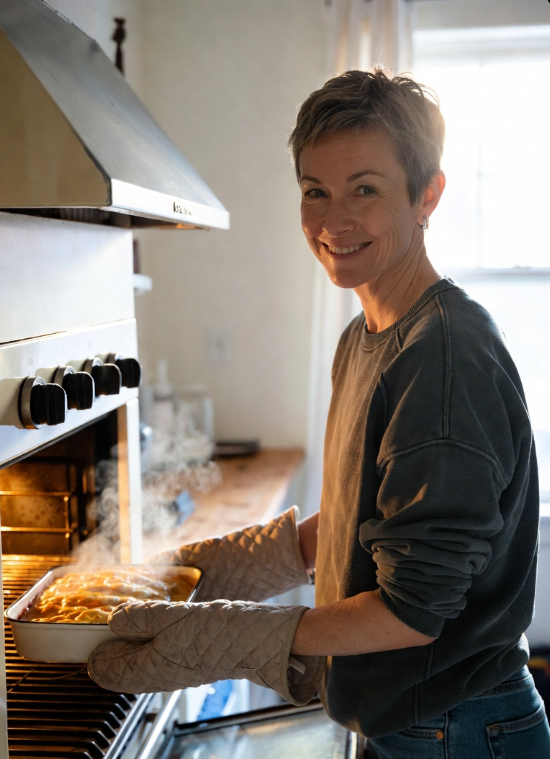
I stayed the weekend. I cooked everything — soups for the freezer, casseroles for the week, bread for the counter. I filled the kitchen the way you fill a lifeboat: with everything that might be needed for the journey, as much as it can hold, more than it can hold, because the journey is uncertain and the supplies must be abundant and the woman who taught me to provision is the one I'm provisioning for.
I made three pans of this that weekend — one for the counter, two wrapped tight for the freezer — because Marlene taught me that a stocked kitchen is an act of faith, a declaration that there will be more days ahead that require feeding. Lasagna was the right choice: it layers, it holds, it keeps. It’s the kind of food that says I was here long after you’ve driven the two hours home. If you’re ever filling someone else’s freezer for a hard season, start here.
Slow-Cooked Lasagna
Prep Time: 30 minutes | Cook Time: 4 hours | Total Time: 4 hours 30 minutes | Servings: 10
Ingredients
- 1 lb ground beef (85/15)
- 1/2 lb mild Italian sausage, casings removed
- 1 medium yellow onion, diced
- 4 cloves garlic, minced
- 1 jar (24 oz) marinara sauce
- 1 can (14.5 oz) diced tomatoes, undrained
- 1 tsp Italian seasoning
- 1/2 tsp crushed red pepper flakes (optional)
- Salt and black pepper to taste
- 12 lasagna noodles, uncooked, broken into thirds
- 1 container (15 oz) ricotta cheese
- 1 large egg
- 2 1/2 cups shredded mozzarella cheese, divided
- 1/2 cup grated Parmesan cheese, divided
- 2 tbsp fresh flat-leaf parsley, chopped
Instructions
- Brown the meat. In a large skillet over medium-high heat, cook the ground beef and sausage together, breaking it up as it cooks, until no pink remains, about 8 minutes. Add the onion and cook 3 more minutes until softened. Add the garlic and cook 1 minute more. Drain excess fat.
- Build the sauce. Stir the marinara, diced tomatoes, Italian seasoning, and red pepper flakes into the meat mixture. Season with salt and pepper. Simmer on low for 5 minutes, then remove from heat.
- Mix the ricotta layer. In a medium bowl, combine the ricotta, egg, 1 cup of the mozzarella, 1/4 cup of the Parmesan, and the parsley. Stir until smooth.
- Layer the slow cooker. Spray a 6-quart slow cooker with nonstick cooking spray. Spread 1 cup of meat sauce on the bottom. Add a layer of broken uncooked noodles, overlapping slightly. Dollop half the ricotta mixture over the noodles and spread gently. Add another layer of meat sauce. Repeat: noodles, remaining ricotta, more sauce. Finish with a final layer of noodles and the remaining meat sauce.
- Top with cheese. Scatter the remaining 1 1/2 cups mozzarella and 1/4 cup Parmesan evenly over the top.
- Cook low and slow. Cover and cook on LOW for 3 1/2 to 4 hours, until the noodles are tender and the edges are bubbling. Do not lift the lid during the first 3 hours.
- Rest before serving. Turn off the heat and let the lasagna rest, lid slightly ajar, for 20–30 minutes before scooping. This helps it set and slice more cleanly.
- To freeze. Let cool completely. Portion into freezer-safe containers or wrap individual slices tightly in plastic wrap and foil. Freeze up to 3 months. Reheat from frozen at 350°F covered with foil for 45 minutes, or thaw overnight and reheat at 350°F for 25 minutes.
Nutrition (per serving)
Calories: 430 | Protein: 29g | Fat: 19g | Carbs: 36g | Fiber: 3g | Sodium: 740mg