The virus is closer. Cases in Washington state. Cases in California. The news is accelerating — numbers, maps, projections. I watch with a nurse's eye and a caregiver's terror.
I've restricted visitors. Only family. Only healthy. Hand washing at the door. No one with a cough, a fever, a sniffle. The house that was already a hospital is now a sealed hospital, and the sealing feels both necessary and cruel — Paul needs people, needs voices, needs the presence of the living world, and the living world now carries a virus that could kill him faster than the ALS.
Elsa understands. She washes her hands until they crack. She changes clothes before entering. She reads to Paul in a mask — a surgical mask, procured from the hospital supply store, the kind I wore for thirty-three years. The reading through the mask muffles her voice but Paul doesn't mind. He hears the words. The words are enough.
The hospice team continues. Margaret comes in mask and gloves now. The protective equipment that was unremarkable in the hospital is surreal in the living room, where Margaret sits beside Paul's wheelchair in full PPE and checks his vitals and the scene looks like a pandemic movie set except it's my house and my husband and my living room.
Paul's breathing: thirty-eight percent. The ventilator is working at near-maximum. The non-invasive support is reaching its limit. Beyond this limit is the tracheostomy that Paul refused, the permanent ventilator that Paul chose not to have. The limit is approaching.
I baked bread on Saturday. The promise. The limpa. The smell. Paul's eyes found the kitchen the way they always do when the bread bakes. The bread is his compass. The smell tells him which direction the kitchen is, which direction I am, which direction home is.
I made a February dinner for myself: chicken and wild rice casserole. The Minnesota classic. The comfort food. The meal that requires cream of mushroom soup from a can and that I eat without apology and without an audience because Paul can't see my culinary compromises and what he doesn't know won't hurt him.
The virus. The numbers. The closing in.
But the bread bakes. And the eyes find the kitchen. And the promise holds.
Still holding. Still here.
The chicken and wild rice was already spoken for in the story — that Minnesota classic, the one with the cream of mushroom soup, eaten without an audience. But on the nights that followed, when I still needed to feed myself and the casserole dish felt like too much for one person in a sealed house, I turned to something simpler: a skillet, a chicken breast, and a raspberry sauce that came together faster than I could talk myself out of cooking at all. It felt like a small act of dignity — making something that looked intentional, even when everything else felt like it was narrowing. This is the recipe I kept coming back to that February, because it asked very little of me and gave back more than it should have.
Skillet Chicken with Raspberry Sauce
Prep Time: 10 min | Cook Time: 20 min | Total Time: 30 min | Servings: 2
Ingredients
- 2 boneless, skinless chicken breasts (about 6 oz each), pounded to even thickness
- 1/2 teaspoon salt
- 1/4 teaspoon black pepper
- 1/4 teaspoon garlic powder
- 1 tablespoon olive oil
- 1 tablespoon unsalted butter
- 1 small shallot, finely minced
- 1/3 cup chicken broth
- 3 tablespoons raspberry preserves
- 1 tablespoon balsamic vinegar
- 1/2 teaspoon fresh thyme leaves (or 1/4 teaspoon dried)
- Fresh raspberries and chopped parsley, for garnish (optional)
Instructions
- Season the chicken. Pat chicken breasts dry with paper towels. Season both sides evenly with salt, pepper, and garlic powder.
- Sear the chicken. Heat olive oil in a large skillet over medium-high heat until shimmering. Add chicken and cook without moving it for 5–6 minutes, until golden brown on the bottom. Flip and cook another 5–6 minutes, until the internal temperature reaches 165°F. Transfer to a plate and tent loosely with foil.
- Build the sauce. Reduce heat to medium. Add butter to the same skillet. Once melted, add the minced shallot and cook, stirring, for 1–2 minutes until softened and fragrant.
- Deglaze and simmer. Pour in the chicken broth, scraping up any browned bits from the bottom of the pan. Stir in the raspberry preserves, balsamic vinegar, and thyme. Simmer for 3–4 minutes, stirring occasionally, until the sauce has reduced slightly and coats the back of a spoon.
- Finish and serve. Return the chicken to the skillet, spooning sauce over the top. Cook for 1 minute to rewarm. Serve immediately, garnished with fresh raspberries and parsley if desired.
Nutrition (per serving)
Calories: 340 | Protein: 38g | Fat: 13g | Carbs: 16g | Fiber: 0g | Sodium: 480mg
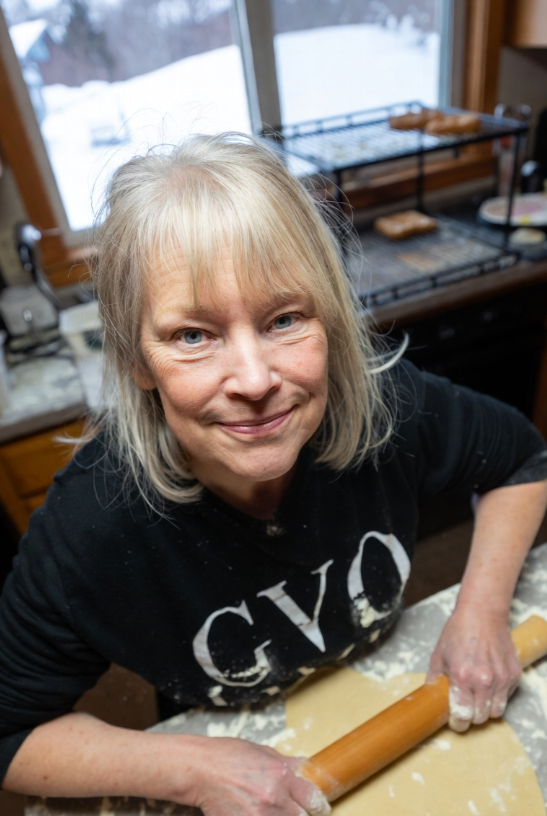
About the cook who shared this
Linda Johansson
Week 202 of Linda’s 30-year story
· Duluth, Minnesota
Linda is a sixty-three-year-old retired nurse from Duluth, Minnesota, living alone in the house where she raised her children and said goodbye to her husband. She lost Paul to ALS in 2020 after two years of watching the kindest man she'd ever known lose everything but his dignity. She cooks Scandinavian comfort food and Minnesota hotdish and the pot roast Paul loved, and she sets two places at the table out of habit because it makes her feel less alone. Every recipe she writes is a person she's loved.
