
 By
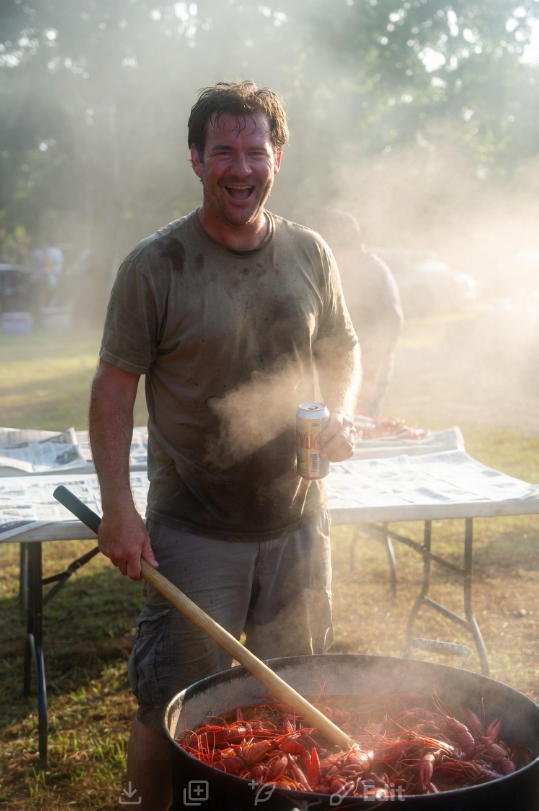
By Last Sunday I dumped forty pounds of crawfish on a newspaper-covered table in my driveway in Baton Rouge, and my youngest boy Rémy — he’s four years old, going on forty — stood next to the propane burner on his step stool and watched the water come to a boil like it was the most important thing he’d ever seen. Maybe it was. In this family, it might be.
“Papa, why do we put the lemons in?” he asked, right when the steam started rising.
“Because your Papaw Joey said so,” I told him.
He nodded like that was the most complete answer in the world. And cher, for us, it is.
My name is Tommy Beaumont. I’m thirty-three years old, I’m an electrician, I live in Baton Rouge with my wife Danielle and our three kids — Luc, who’s ten and just carried a thirty-pound sack of live crawfish without complaining, which tells you everything you need to know about that boy; Colette, who’s seven and can peel a crawfish faster than her brother and will not let him forget it; and Rémy, my little bayou philosopher on his step stool. I was born in Thibodaux, Louisiana, in Lafourche Parish, deep in Cajun country, and I have been eating food cooked the right way since before I had teeth to chew it with.
I’m not a chef. I’m not a food blogger, whatever that is. I’m a man who learned to cook from his daddy, who learned from his mama, who learned from her mama, who — if you go back far enough — got off a boat from Nova Scotia in the 1760s with nothing but a cast-iron pot and 250 years’ worth of stubbornness. The Cajuns didn’t survive being expelled from their homeland, scattered across a continent, and dropped into the Louisiana swamps by being the kind of people who give up on a recipe halfway through. We finish what we start. We stir the roux until it’s done, even if it takes forty-five minutes, even if your arm is dead, even if the kids are screaming. You don’t walk away from a roux. You don’t walk away from your people either.
My daddy, Joey Beaumont, was a commercial fisherman. He worked the bayous and the Gulf his whole life — shrimp, crawfish, redfish, whatever the water offered. He was a big loud laughing man who smelled like diesel and brown bayou water and the best thing you ever ate. He could cook anything that came out of the water, and he did, constantly, for anybody who showed up at the door. The yellow cottage on Bayou Lafourche where I grew up had a screened porch where we ate dinner most nights, and the dinner was almost always something Joey pulled from the water that morning. That’s not nostalgia talking. That was just Tuesday.
Joey taught me to make a roux when I was maybe eight years old. Not a pale roux, not a quick roux, not the kind you make in fifteen minutes and call it good enough. A real Cajun roux — dark, the color of chocolate, stirred without stopping, a patience test dressed up as a cooking technique. He handed me a wooden spoon and said, “You stop stirring, you start over.” I didn’t stop. I haven’t stopped since.
The recipe I want to give you today is étouffée. Shrimp étouffée. My mama’s étouffée, to be specific — Marie-Claire Boudreaux Beaumont, who is the daughter of a sugarcane farmer and the best cook I have ever known, and I say that knowing full well that Joey would argue the point from wherever he is right now, loud and grinning.
I want to tell you why this recipe, why today, why first.
In August of 2005, four months after Danielle and I got married, Hurricane Katrina came ashore and flooded our house in Chalmette to the roofline. We got out with nothing. No clothes. No furniture. No wedding photos. We showed up at my mama’s door in Thibodaux soaking wet, and Danielle was pregnant — we’d found out the week before the storm — and we stood in Marie-Claire’s kitchen and I told my wife we’d start over. I said it like I believed it. I didn’t, not fully, but I said it anyway because what else do you say?
What my mama said was: “Sit down. I’m making étouffée.”
We didn’t have much. We were nine people in a house built for five. FEMA assistance was slow and short and maddening. The whole Gulf Coast was broken open, and we were one small family in one small cottage trying to figure out what came next. But Marie-Claire had butter, and she had shrimp from the freezer, and she had the holy trinity — onion, celery, bell pepper — and she had the roux. She always had the roux.
She made the étouffée and we ate it off paper plates because all the real plates were somewhere under six feet of water in Chalmette. I don’t remember most of what was said that night. I remember the food. I remember that my hands stopped shaking while I was eating. I remember Danielle, eight weeks pregnant and homeless, cleaning her plate and asking if there was more. I remember thinking: we’re going to be all right. Not because of anything I’d done or anything FEMA was going to do. Because of this. Because this is still here. The food is still here. The people who know how to make it are still here.
That’s what étouffée means to me. That’s what Cajun food means, period. It’s not just supper. It’s the thing you reach for when everything else is gone. It’s the constant. It’s the thread.
Joey died two years ago — February 3, 2014. Liver cancer, from decades of fishing water that the oil companies had poisoned. He was sixty-one. He lost sixty pounds and his big booming laugh went quiet, and the last thing he said to me was in Cajun French: C’est bon, cher. It’s good, dear. I have those words tattooed on my left forearm. I look at them every time I cook.
The bayou that raised him — that raised me — is disappearing. Coastal erosion is eating Louisiana at a rate that makes your stomach drop if you look at the maps. The commercial fishing life that Joey lived may not exist for my kids’ kids. The Cajun French I grew up speaking, that beautiful rough patois that doesn’t exist in any textbook, is spoken by fewer people every decade. Some days I feel like I’m holding a sand castle while the tide comes in.
So I cook. I cook the real stuff, the way it was made, with the time it takes and the butter it requires and the roux you can’t rush. I cook because Joey cooked. I cook because Marie-Claire still cooks, in the yellow cottage on Bayou Lafourche, even though she says it doesn’t taste the same without Joey to eat it. I cook because Rémy is standing on a step stool watching water boil and asking why we put the lemons in, and I want him to know the answer goes back further than me, further than Joey, further than anyone whose name I can remember.
The étouffée I’m giving you today is Marie-Claire’s recipe, with some small adjustments I’ve made over the years that she knows about and tolerates because she raised me to be opinionated and can’t complain now that it worked. It starts with a butter roux — not as dark as a gumbo roux, more of a blonde, a peanut butter color, maybe eight to ten minutes of stirring. Then the holy trinity. Then stock. Then shrimp, and you don’t cook them long because shrimp will tell you when they’re done and you should listen.
You serve it over white rice. Long grain, cooked plain, nothing added. The étouffée does the talking. The rice listens.
You make this on a weeknight when the family needs feeding and the world needs to slow down for an hour. You make this on a Sunday when company’s coming and you want them to understand who you are without having to explain it. You make this when somebody you love is going through something hard and you need to hand them a bowl and say: I’m here. It’s going to be all right. Sit down and eat.
Welcome to my table, cher. I’m glad you’re here. Laissez les bons temps rouler.
That bowl I just described to you — the one you hand somebody when words aren’t enough — this is it. This is the recipe my mama made on paper plates after Katrina took everything we owned except the cast iron and each other, because some things you carry with you no matter what. I’ve made it a hundred times since, and every time I do, I feel her standing next to me at the stove, reminding me not to rush the roux. Here’s how you make it.
Shrimp Étouffée — The Recipe My Mama Made on Paper Plates After We Lost Everything
Prep Time: 20 minutes | Cook Time: 35 minutes | Total Time: 55 minutes | Servings: 6
Ingredients
- 2 lbs medium shrimp, peeled and deveined (fresh Gulf shrimp if you can get them — frozen will work, just thaw them proper)
- 1/2 cup unsalted butter (1 stick — don’t look at me like that, this is étouffée)
- 1/4 cup all-purpose flour
- 1 cup yellow onion, finely diced
- 1/2 cup celery, finely diced
- 1/2 cup green bell pepper, finely diced
- 4 cloves garlic, minced
- 1 1/2 cups shrimp stock (make it from the shells, or use good seafood stock — chicken broth in a pinch, but only in a pinch)
- 1/2 cup water
- 1 1/2 tsp Cajun seasoning (Slap Ya Mama or Tony Chachere’s — and yes, you can make your own if you want to)
- 1/2 tsp black pepper
- 1/4 tsp cayenne pepper (more if you mean it)
- 1/2 tsp salt, plus more to taste
- 1 tsp Worcestershire sauce
- 3 green onions, thinly sliced
- 2 tbsp fresh flat-leaf parsley, chopped
- Cooked long-grain white rice, for serving
Instructions
- Season the shrimp. Toss your peeled, deveined shrimp with about half the Cajun seasoning in a bowl and set aside in the refrigerator while you build the base. Cold shrimp go in the pot. That’s the rule.
- Start the roux. Melt the butter in a heavy-bottomed Dutch oven or deep skillet over medium heat. Once it’s melted and just starting to foam, add the flour all at once and stir immediately with a wooden spoon. Keep stirring. Don’t stop. You’re cooking this roux to a light peanut butter color — 8 to 10 minutes over medium heat, constant motion. This is not the dark chocolate roux of a gumbo. This is its younger, more approachable cousin. Still requires your full attention.
- Add the holy trinity. Once your roux is the right color, add the onion, celery, and bell pepper all at once. It will sizzle dramatically and smell like the best thing that has ever happened in your kitchen. Stir to coat everything in the roux and cook for 6 to 8 minutes, until the vegetables are soft and the onion is translucent.
- Add garlic and seasoning. Add the minced garlic and cook for one more minute, stirring. Add the remaining Cajun seasoning, the black pepper, the cayenne, the salt, and the Worcestershire sauce. Stir to combine.
- Build the sauce. Pour in the shrimp stock and water, stirring constantly to work out any lumps. Bring to a gentle simmer over medium-low heat and cook for 10 to 12 minutes, stirring occasionally, until the sauce thickens to the consistency of a good gravy — it should coat the back of your spoon. Taste it. Adjust salt and cayenne now, before the shrimp go in.
- Add the shrimp. Nestle the seasoned shrimp into the sauce in a single layer as best you can. Cook over medium-low heat for 4 to 5 minutes, stirring gently, until the shrimp are pink, curled, and just cooked through. Do not overcook. Shrimp will tell you when they’re done: they turn pink, they curl up, and they firm up slightly. That’s it. That’s the moment. Pull them off the heat.
- Finish and rest. Stir in the sliced green onions and half the parsley. Turn off the heat and let the étouffée rest for 3 to 4 minutes. This is not optional. This is where the flavors finish talking to each other.
- Serve. Spoon over a mound of hot white rice in a bowl — not a plate, a bowl, because étouffée has gravy and gravy needs walls. Garnish with the remaining parsley. Set a bottle of Crystal hot sauce on the table and let people make their own decisions. That’s what freedom is.
Nutrition (per serving)
Calories: 310 | Protein: 27g | Fat: 16g | Carbs: 12g | Fiber: 1g | Sodium: 870mg