
 By
By Break-up week. The streets full of slush. The dogs all muddy. Pete and I worked the night shift Friday. We talked between codes about the kids — his daughter's wedding planning, my sister's pregnancy. The talking was the keeping.
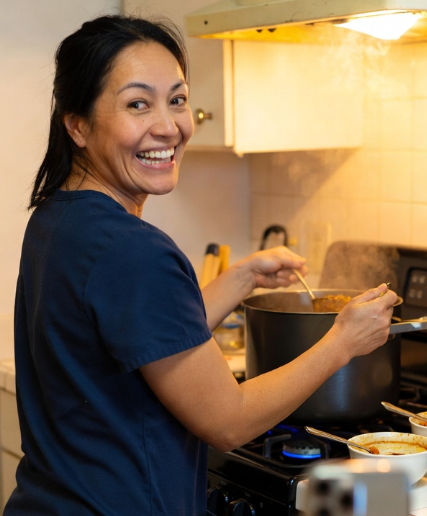
Lourdes is 74. She is in the kitchen. She is luminous.
I made sinigang Sunday. The sour was the right register for the body this week. The tamarind was sharp.
I wrote the blog post Friday night at the kitchen table while Reyna napped on the couch. The post was short. The post was honest.
I stood at the counter eating leftovers in my pajamas. The standing was the small luxury. The luxury was the having of leftovers at all.
Auntie Norma called Sunday afternoon. She is now seventy-nine. She wanted a recipe. I gave it to her. She wanted to know how my week was. I told her, briefly. She told me about her week. The exchange took eighteen minutes. The eighteen minutes was the keeping.
The neighbors invited us over for a small dinner Thursday. They are an Iñupiaq family — Aana and her grandson Joe. We ate caribou stew and rice. I brought lumpia. The kitchens of Anchorage have always been the small UN. The food is the proof.
I taught a Saturday morning Kain Na class on basic adobo proportions for new cooks. Eleven people in the kitchen. Half of them had never cooked Filipino food before. By eleven AM the kitchen smelled the way it should smell. By noon they were all eating. The eating was the lesson landing.
A reader from New Jersey wrote in about her grandmother's adobo, which used pineapple. I had never heard of pineapple in adobo. I tried it. It was strange. It was also good. The strange and the good are not opposites.
I took inventory of the freezer Sunday. The freezer had: twelve quarts of broth, eight pounds of adobo in vacuum bags, six pounds of sinigang base, fourteen lumpia trays at fifty rolls each, three pounds of marinated beef for caldereta, and a small bag of pandan leaves Tita Nening had sent me. The inventory was the proof of preparation. The preparation was the proof of love.
The therapy session this month was about pacing. Dr. Reeves said, "Grace. The pacing is the love for the future self." I am working on the pacing. The pacing is harder than the loving.
I read a chapter of a novel before bed each night this week. The novel was about a Filipina nurse in California. The novel was good. The novel was, in some way, my own life adjacent.
I took a walk on the coastal trail Saturday. The light was good. The body was tired but moving.
A blog reader sent me a photograph of her grandmother's wooden mortar and pestle, used since 1962. The photograph was holy. I wrote her back. The writing back is the work.
Angela texted me a photo of the kids. I texted back a heart. The exchange took thirty seconds. The thirty seconds was the keeping.
The Anchorage sky was the Anchorage sky. The mountains were the mountains. The inlet was the inlet. The geography was the geography.
I read three chapters of the novel Saturday night before sleep. The novel was about a Filipina nurse in California. The nurse was being undone by her work. I knew the unraveling. I had lived the unraveling. I read on. The reading was the witnessing.
The Filipino Community newsletter announced the Saturday gathering. I will be on lumpia duty. I am always on lumpia duty.
I made sinigang because the week asked for sour, and the tamarind delivered. But Auntie Norma called wanting a recipe she could actually find scallops for in her New Jersey grocery, and I thought: ceviche. The acid does the same work—it cuts, it clarifies, it tells the body where it is. This scallop ceviche is what I gave her, adapted from the version I’ve been making since the years before Anchorage, when citrus was easier to come by than tamarind. The strange and the good are not opposites, and sometimes the cure for a heavy week is something cold and bright and finished in a bowl in ten minutes.
Scallop Ceviche
Prep Time: 15 min | Cook Time: 0 min (25 min cure) | Total Time: 40 min | Servings: 4
Ingredients
- 1 lb fresh bay scallops (or sea scallops, quartered), side muscle removed
- 1/2 cup fresh lime juice (about 6 limes)
- 1/4 cup fresh lemon juice (about 2 lemons)
- 1 small red onion, finely diced
- 1 jalapeño, seeded and minced
- 1 roma tomato, seeded and finely diced
- 1/4 cup fresh cilantro leaves, roughly chopped
- 1 tablespoon olive oil
- 3/4 teaspoon kosher salt, plus more to taste
- 1/4 teaspoon freshly ground black pepper
- 1 small avocado, diced, for serving
- Tortilla chips or tostadas, for serving
Instructions
- Cure the scallops. Place scallops in a non-reactive bowl (glass or ceramic). Pour the lime juice and lemon juice over them, making sure all the scallops are submerged. Cover and refrigerate for 20–25 minutes, until the scallops are opaque and “cooked” through the acid. They should feel firm, not mushy.
- Drain and season. Drain about half the citrus liquid from the bowl, leaving just enough to keep the scallops moist. Add the red onion, jalapeño, tomato, cilantro, olive oil, salt, and pepper. Stir gently to combine.
- Taste and adjust. Taste for salt and acid. Add a small squeeze of fresh lime if you want it sharper. Let it rest another 5 minutes for the flavors to come together.
- Serve. Spoon into small bowls or glasses. Top with diced avocado. Serve immediately with tortilla chips or tostadas on the side.
Nutrition (per serving)
Calories: 185 | Protein: 19g | Fat: 8g | Carbs: 11g | Fiber: 3g | Sodium: 480mg