The early reviews are coming in. Sarah Chen forwards them as they arrive, and each one makes me feel simultaneously exposed and validated.
A food writer for a national magazine: "Patel writes about sambar the way other writers write about Proust's madeleine — as a portal to everything that matters."
A book reviewer for a South Asian publication: "'Enough' is not just a cookbook. It's a love letter to a mother written in turmeric and tamarind. Every daughter of immigrants will recognize herself in these pages."
A blog reviewer (my favorite): "I made the sambar from page 43. It took me three hours and it tasted like someone else's mother, which is to say: it tasted like comfort in a language I didn't speak but understood."
Someone made the sambar. A stranger, in a kitchen I'll never see, opened my book and made my mother's sambar. The recipe traveled. The generous pinch (or the very generous pinch, as Amma insists) traveled from Chennai to Edison to a bookshelf to a stranger's pot.
This is what I wanted. This is the entire point. The preservation made public. The recipes set free.
Amma doesn't understand the reviews — not because of the disease but because she's never cared about reviews. "They liked the book?" she asked. "Yes, Amma." "Did they make the sambar?" "Someone did." "Was it right?" "She said it tasted like someone else's mother." Amma thought about this. "That's correct. It SHOULD taste like someone else's mother. The recipe doesn't belong to me. It belongs to everyone who makes it."
The recipe doesn't belong to me. It belongs to everyone who makes it.
I'm putting this on the paperback edition.
I made dosa. The milestone dosa. The tradition dosa. From the wet grinder, from the fermentation, from the hands that are mine and hers and Anaya's and eventually Rohan's.
The book is in the world. The sambar is in other people's pots. The recipe belongs to everyone.
Enough. Finally, truly, enough.
The dosa is made, the book is in the world, and Amma’s sambar is simmering in a stranger’s pot somewhere I’ll never visit. There’s something about potatoes—humble, universal, belonging to every kitchen on earth—that feels right for this moment. These savory potato skins are my way of honoring that truth Amma handed me: a recipe doesn’t belong to the person who writes it down. It belongs to whoever scoops out the filling, crisps the shell, and sets it on the table for someone they love.
Savory Potato Skins
Prep Time: 20 minutes | Cook Time: 1 hour 15 minutes | Total Time: 1 hour 35 minutes | Servings: 8
Ingredients
- 4 large russet potatoes
- 2 tablespoons olive oil
- 1/2 teaspoon salt
- 1/4 teaspoon black pepper
- 1/4 teaspoon garlic powder
- 1/4 teaspoon smoked paprika
- 6 slices bacon, cooked and crumbled
- 1 1/2 cups shredded cheddar cheese
- 1/2 cup sour cream, for serving
- 3 green onions, thinly sliced
Instructions
- Bake the potatoes. Preheat oven to 400°F. Scrub potatoes clean, prick each several times with a fork, and bake directly on the oven rack for 50–60 minutes until tender when pierced with a knife. Let cool for 10 minutes.
- Scoop and season. Slice each potato in half lengthwise. Scoop out the flesh, leaving about 1/4 inch of potato attached to the skin. Reserve the scooped flesh for another use. Brush the insides and outsides of each skin with olive oil and season with salt, pepper, garlic powder, and smoked paprika.
- Crisp the skins. Place the potato skins cut-side up on a baking sheet. Bake at 400°F for 10–12 minutes until the edges are golden and crisp.
- Fill and melt. Remove from oven. Fill each skin with crumbled bacon and shredded cheddar cheese. Return to the oven for 3–5 minutes until the cheese is melted and bubbly.
- Serve. Top with a dollop of sour cream and a scattering of sliced green onions. Serve warm.
Nutrition (per serving)
Calories: 245 | Protein: 11g | Fat: 14g | Carbs: 20g | Fiber: 2g | Sodium: 420mg
About the cook who shared this
Priya Krishnamurthy
Week 337 of Priya’s 30-year story
· Edison, New Jersey
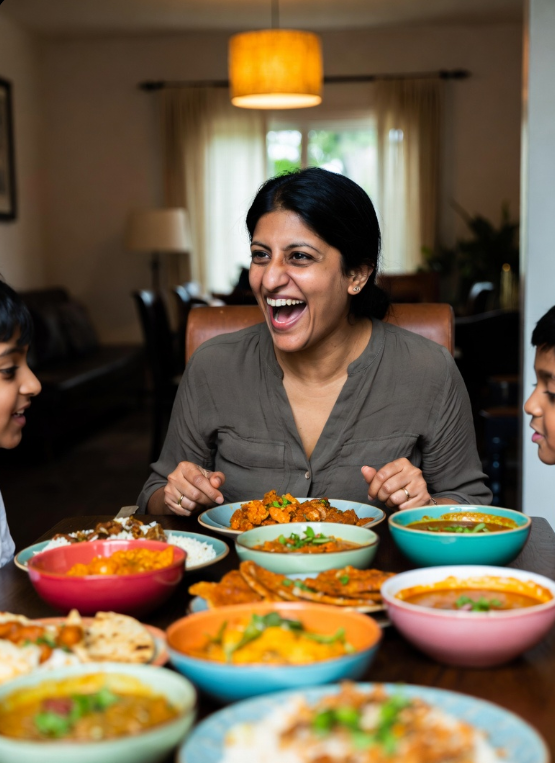
Priya is a pharmacist, wife, and mom of two in Edison, New Jersey — the town she grew up in, surrounded by the sights and smells of her mother's South Indian kitchen. These days, she splits her time between the hospital pharmacy, school pickups, and her own kitchen, where she cooks nearly every night. Her style is a blend of the Tamil recipes her mother taught her and the American comfort food her kids actually want to eat. She writes about the beautiful mess of balancing two cultures on one plate — and she wants you to know that ordering pizza is also an act of love.
