
 By
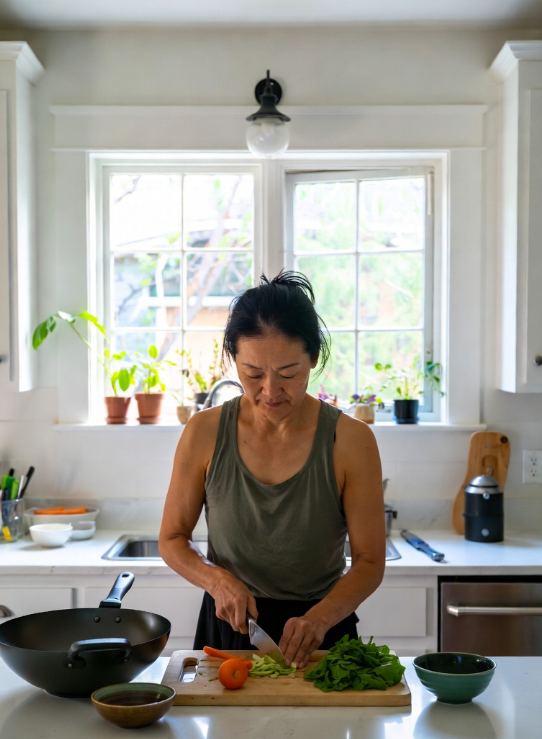
By December. The third December in this apartment. The tree goes up (small, tabletop, Miya's tradition). The matcha shortbread goes into the oven (my tradition). The kuromame starts soaking (Fumiko's tradition). Three traditions, three origins, one December, one kitchen. The December kitchen is the fullest version of my kitchen — every shelf used, every burner occupied, every tradition activated, the kitchen at maximum capacity, the way a heart is at maximum capacity when it holds grief and love and work and children and the anxiety and the medication and the yoga and the writing and the miso soup, all at once, all the time.
I made matcha shortbread for the neighbors, for the school, for the yoga studio, for Brian and Lisa (who are getting married in the spring — the invitation arrived, elegant, cream-colored, and I RSVPed yes without hesitation, because hesitation is for the first year of divorce and I am three years past the first year and the hesitation has been replaced by genuine goodwill). The shortbread was green and buttery and the giving was the December practice, the annual distribution of love in cookie form.
Miya is writing a Christmas list that includes "a trip to Japan (someday)" — the parenthetical is hers, the acknowledgment that the trip is not this Christmas but is on the list, is part of the record, is officially requested. The request is noted. The fund is growing. The someday is getting closer. The someday is three years away. Three years is the length of my time in this apartment. Three years is the length of the book-writing process. Three years is the length of Miya's Japanese school education so far. Three years is a lot of miso soup. Three years is exactly the right amount of time.
The nukazuke bed has survived its first six months and is now producing pickles with a depth of flavor that the early months could not achieve. The bed is maturing. I am maturing. The miso in the pantry is maturing. Everything in this kitchen is fermenting, aging, deepening, the way everything in a life ages and deepens when you tend it daily, when you stir the bed every morning, when you make the soup every morning, when you show up every morning and do the thing that needs doing. The doing is the tending. The tending is the living. The living is the kitchen.
The matcha shortbread gets all my attention in early December, but it’s the rosette cookies — lacy and golden and impossibly delicate — that I keep coming back to when I want something that looks like the season feels: intricate, handmade, worth the effort. Making them requires the same kind of daily-practice patience the story is always circling back to: you heat the oil, you dip the iron, you count the seconds, and you let the thing release when it’s ready. You cannot rush a rosette. You can only tend it.
Rosette Cookies
Prep Time: 15 min | Cook Time: 30 min | Total Time: 45 min | Servings: 36 cookies
Ingredients
- 2 large eggs
- 1 tablespoon granulated sugar
- 1/4 teaspoon salt
- 1 cup whole milk
- 1 cup all-purpose flour
- 1 teaspoon vanilla extract
- Vegetable oil, for frying (about 3 to 4 cups)
- Powdered sugar, for dusting
Instructions
- Make the batter. In a medium bowl, whisk together the eggs, granulated sugar, and salt until combined. Add the milk and vanilla extract and whisk until smooth. Sift in the flour and whisk again until the batter is completely lump-free. Let the batter rest for 10 minutes.
- Heat the oil. Pour oil into a deep, heavy-bottomed saucepan or Dutch oven to a depth of about 3 inches. Heat over medium-high heat until the oil reaches 375°F. Clip a candy or fry thermometer to the side of the pot to monitor the temperature throughout cooking.
- Heat the rosette iron. Submerge the rosette iron mold in the hot oil for about 2 minutes, until the iron is thoroughly heated. A cold iron will cause the batter to slip off rather than cling and crisp.
- Dip and fry. Lift the hot iron out of the oil, letting any excess oil drip back into the pot. Dip the iron into the batter, submerging it about 3/4 of the way — do not let the batter go over the top edge of the mold. Immediately lower the coated iron back into the hot oil. After about 20 to 30 seconds, the rosette will release from the iron on its own or with a gentle nudge from a fork. Continue frying for another 15 to 20 seconds until the rosette is golden and crisp.
- Drain and repeat. Use a slotted spoon or spider strainer to transfer finished rosettes to a wire rack set over a baking sheet lined with paper towels. Return the iron to the oil for at least 30 seconds to reheat before dipping into batter again. Repeat with remaining batter, monitoring oil temperature and adjusting heat as needed to maintain 375°F.
- Dust and serve. Once the rosettes have cooled completely, dust generously with powdered sugar just before serving or packaging. Store in an airtight container at room temperature for up to 5 days.
Nutrition (per serving)
Calories: 48 | Protein: 1g | Fat: 2g | Carbs: 6g | Fiber: 0g | Sodium: 22mg