
 By
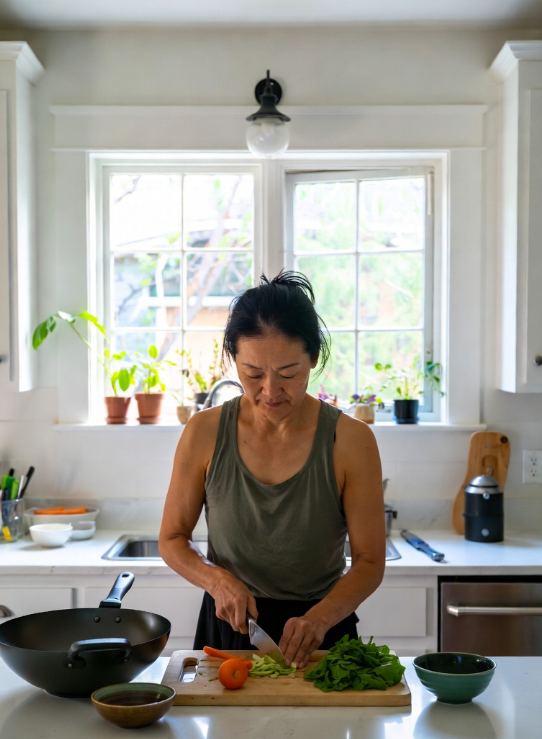
By Mid-June. The summer cooking project with Miya: this year's theme is "Obaachan's Greatest Hits Perfected." Not new recipes, not international fusion, but a return to Fumiko's core recipes — the ten dishes that define the inheritance — cooked with Miya as the lead chef and me as the sous chef. The reversal is deliberate: she leads, I follow. She reads the recipe card, I chop what she tells me to chop. She controls the heat, I hand her the ingredients. The role reversal is the teaching completed. The teaching is no longer teaching — it is collaboration, and the collaboration is between equals, and the equals are a mother and a daughter standing side by side in a kitchen, making a dead woman's food, the dead woman present in every instruction on every card.
Week one of the project: miso soup. Miya made it from start to finish, from kombu to bowl, with me watching, not helping, the hands-in-pockets parenting that is the hardest and most necessary form of teaching. Her dashi was clear and golden. Her miso dissolved perfectly. She served it in one of the three ceramic bowls I gave her at Christmas — the bowls that are now hers, that sit on her shelf, that she talks to sometimes when she thinks I'm not listening. The soup was excellent. Not good. Not good-for-her-age. Excellent. The word is earned. The word is the standard. The standard is Fumiko's. The standard has been met.
I wrote a blog post about the role reversal — about the day your child becomes the chef and you become the audience, about the specific joy and grief of watching your daughter make your grandmother's miso soup better than you made it at her age, about the way the chain does not just hold but improves, each generation better than the last, the way each year's dashi is better than last year's. The improvement is the inheritance. The inheritance is the improvement. The two are the same.
After that first week — watching Miya stand alone at the stove and make Fumiko’s miso soup from start to finish without a single correction needed — I wanted to cook something myself that required the same kind of patience: low heat, long time, nothing rushed. A pot roast is not miso soup, but it asks the same thing of you: presence, attention, and the willingness to let the process do its work. I made this rosemary pot roast the following Sunday, alone in the kitchen while Miya was at a friend’s house, and I thought the whole time about how the best cooking is always a form of waiting for something you already trust is coming.
Rosemary Pot Roast
Prep Time: 20 minutes | Cook Time: 3 hours 30 minutes | Total Time: 3 hours 50 minutes | Servings: 6
Ingredients
- 3 to 3 1/2 lbs boneless beef chuck roast
- 1 1/2 tsp kosher salt, plus more to taste
- 1/2 tsp freshly ground black pepper
- 2 tbsp olive oil
- 1 large yellow onion, roughly chopped
- 4 cloves garlic, smashed
- 2 medium carrots, cut into 2-inch pieces
- 3 stalks celery, cut into 2-inch pieces
- 2 tbsp tomato paste
- 1 cup dry red wine
- 2 cups low-sodium beef broth
- 3 sprigs fresh rosemary
- 2 sprigs fresh thyme
- 2 bay leaves
- 1 lb baby potatoes, halved
Instructions
- Preheat and season. Preheat your oven to 325°F (163°C). Pat the chuck roast dry with paper towels and season all sides generously with salt and pepper.
- Sear the roast. Heat olive oil in a large Dutch oven over medium-high heat until shimmering. Add the roast and sear without moving it for 4 to 5 minutes per side, until a deep brown crust forms. Transfer the roast to a plate and set aside.
- Build the base. Reduce heat to medium. Add the onion, carrots, and celery to the same pot and cook, stirring occasionally, for 5 minutes until softened. Add the garlic and tomato paste and stir for 1 minute until the paste darkens slightly and becomes fragrant.
- Deglaze. Pour in the red wine and scrape up any browned bits from the bottom of the pot. Let it simmer for 2 to 3 minutes until the wine reduces by about half.
- Add liquid and aromatics. Pour in the beef broth. Add the rosemary sprigs, thyme sprigs, and bay leaves. Nestle the seared roast back into the pot — it should be about halfway submerged in liquid. Bring to a gentle simmer.
- Braise. Cover the Dutch oven tightly and transfer to the preheated oven. Cook for 2 hours 30 minutes, checking occasionally to ensure liquid remains at a gentle simmer.
- Add potatoes. After 2 hours 30 minutes, carefully add the halved baby potatoes around the roast. Re-cover and return to the oven for an additional 45 to 60 minutes, until the potatoes are tender and the meat pulls apart easily with a fork.
- Rest and serve. Remove and discard the rosemary sprigs, thyme sprigs, and bay leaves. Transfer the roast to a cutting board and let it rest for 10 minutes before slicing or pulling apart. Taste the braising liquid and adjust seasoning. Serve the meat with the vegetables and spoonfuls of the rich pan juices.
Nutrition (per serving)
Calories: 480 | Protein: 42g | Fat: 22g | Carbs: 20g | Fiber: 3g | Sodium: 620mg