
 By
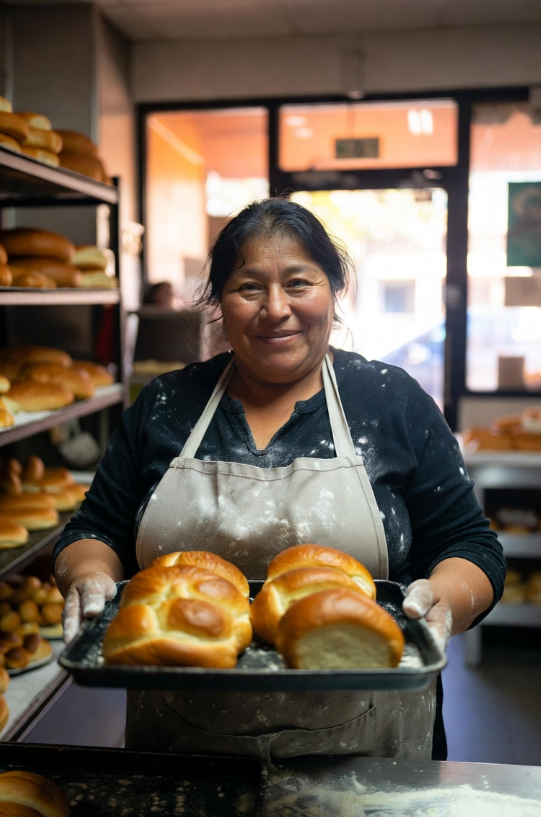
By The newspaper story came out. \"Panadería Rosa: One Woman's Tribute to Her Mother's Kitchen\" — that was the headline, and underneath it was a photograph of me standing in front of the bakery with flour on my apron and a look on my face that I didn't know I had, a look that the reporter later described as "fierce tenderness," which sounds like something from a novel but which I think just means I was trying not to cry while holding a concha.
The phone rang all day after the story published. Orders for conchas, for cakes, for catering. People who had never heard of us drove across town to try our bread. The line on Saturday morning went out the door and down the sidewalk, and Graciela and Maricela and I worked the front while Sofia — my eleven-year-old, my girl with Rosa's hands — ran the kitchen. She ran the kitchen. An eleven-year-old ran a bakery kitchen on the busiest day of our existence, and everything came out perfect, and I thought: I am looking at the future. The future has flour on its nose and is yelling at me to get more sugar from the back.
Luis cut the article out of the newspaper and framed it. He hung it in the bakery next to my naturalization certificate and the photo of Rosa, and when I saw it there — the certificate, the photo, the article, all in a row on the wall behind the register — I had to go to the bathroom and sit on the floor for five minutes because the wall told a story I had never seen laid out so clearly: immigrant, citizen, baker. Three words. Thirty-eight years. Everything.
Carmen called to say she saw the article and cried. Fernando called from Guadalajara — someone sent him a photo of the page — and said, "Rosa would be so proud." Eduardo called from Juárez. Lucia called. Even Beatriz, who never calls, called. The family WhatsApp group exploded with messages and emojis and photographs of people holding up the newspaper, and for one day I was the famous one, the Delgado who made it, and I felt the weight of that and the glory of it and the guilt of it because making it means you left, and leaving means you survived something that the ones who stayed are still surviving.
I called Rosa. Carmen had already told her about the article. Rosa said, "Read it to me." So I did. I sat on the bakery floor after closing, surrounded by crumbs and the smell of bread, and I read the article to my mother over the phone, and when I got to the part about the bakery being named for her, she said, "I know." And when I got to the part about her recipes being the foundation of the menu, she said, "I know." And when I got to the part about me crossing the border with nothing but fear and stubbornness and my mother's recipes in my head, she said nothing. She just breathed. And I listened to her breathe and it was enough.
I made Rosa's flour tortillas this week — not for the bakery, just for home, just for my family. I made them the way she taught me: three cups of flour, a teaspoon of salt, a tablespoon of baking powder, a tablespoon of lard, warm water added slowly until the dough feels like an earlobe (Rosa's instruction, and yes, I know how strange that sounds, but she was right — the perfect tortilla dough has the exact softness of an earlobe, and if you don't believe me, touch your ear and then touch the dough and tell me I'm wrong). I rolled them on the counter and cooked them on the comal until they puffed and the brown spots appeared and the kitchen smelled like Anapra and I was eleven years old again, watching Rosa's hands, learning the rhythm that would carry me across a bridge and into a bakery with her name on the door.
Isabella read the article three times. She came to me after the third reading and said, "Mom, you're a hero." I said: "I'm a baker." She said: "Same thing." She is thirteen and she is right and she is wrong and she is my daughter and I love her so much it feels like drowning in the best possible way.
Isabella’s words stayed with me all evening — same thing — and I realized the only answer I had was to make the tortillas again, this time writing down what my hands already knew by heart. Rosa taught me that baking is how we say the things we can’t quite say out loud, and these tortillas are my most honest sentence. Here is how I make them.
Rosa’s Flour Tortillas
Prep Time: 15 min | Cook Time: 20 min | Total Time: 35 min | Servings: 12 tortillas
Ingredients
- 3 cups all-purpose flour, plus more for dusting
- 1 teaspoon fine salt
- 1 tablespoon baking powder
- 1 tablespoon lard (or vegetable shortening)
- 3/4 to 1 cup warm water (about 110°F), added slowly
Instructions
- Combine the dry ingredients. In a large bowl, whisk together the flour, salt, and baking powder until evenly mixed.
- Work in the lard. Add the lard and use your fingertips to rub it into the flour until the mixture resembles coarse crumbs with no visible chunks of fat remaining.
- Add the water slowly. Pour in warm water a little at a time, stirring with your hand or a fork after each addition. Stop adding water when the dough just comes together — it should feel soft and smooth, like an earlobe. Knead gently in the bowl for 1 to 2 minutes until cohesive.
- Rest the dough. Cover the bowl with a clean kitchen towel and let the dough rest at room temperature for 10 minutes. This relaxes the gluten and makes rolling much easier.
- Divide and roll. Divide the dough into 12 equal balls. On a lightly floured surface, use a rolling pin to roll each ball into a thin round, about 8 inches in diameter. Rotate the dough a quarter turn between each pass of the rolling pin to keep it even.
- Cook on the comal. Heat a dry comal, cast iron skillet, or heavy griddle over medium-high heat until hot. Cook each tortilla for 30 to 45 seconds per side, until small brown spots appear and the tortilla puffs slightly in places. Adjust heat as needed — if spots appear too fast, lower the heat.
- Keep warm. Stack cooked tortillas in a clean kitchen towel or a tortilla warmer as you go. They will stay soft and pliable as they rest together.
Nutrition (per serving)
Calories: 128 | Protein: 3g | Fat: 2g | Carbs: 24g | Fiber: 1g | Sodium: 198mg