
 By
By Panadería Rosa Juárez opened on October 7, 2025.
I will try to write about this the way I tried to write about Luis Jr.'s graduation and Isabella's pinning and Luis Jr.'s wedding and every moment in my life when the size of what was happening exceeded the capacity of my words. I will try. I will fail. I will try anyway, because trying is what Rosa did, and trying is what the bakery does, and trying is the only thing I know how to do with moments that are too big for a woman who thinks in flour.
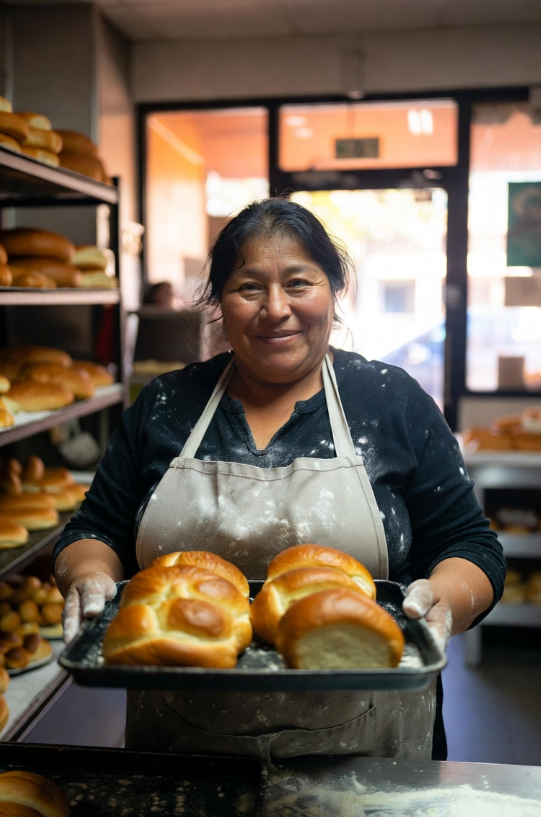
The building. Four blocks from where Rosa grew up. Four blocks from the house Alejandro built. Four blocks from the place where I was born and Javier was killed and Rosa made tortillas for forty years. The sign: PANADERíA ROSA. The same font. The same name. The door: open. The ovens: on. The conchas: golden, in the display case, Rosa's recipe, made by Lupita's hands, in Rosa's neighborhood, at 4 AM, the way Rosa would have done it, the way I do it, the way Sofia does it, the way the recipe insists it be done: early, dark, alone with the flour.
I cut the ribbon. Scissors in one hand. Concha in the other. (The concha was not planned — I was holding it from the display case, tasting, checking Lupita's work, and the tasting became the holding and the holding became the ribbon-cutting and the concha was in the photograph, which is the most honest photograph of me that has ever been taken: a woman cutting a ribbon with a concha in her hand, because the concha is the tool, and the tool is the recipe, and the recipe is the woman, and the woman is the ribbon, and the ribbon is being cut, and the cutting is the opening, and the opening is Rosa.)
The first customers were women. Women on their way to the maquiladoras. The same maquiladoras where Rosa sewed jeans for twenty years, for wages that wouldn't buy lunch in the country where the clothes would be sold. The women walked in at 5 AM, the way maquiladora women walk — quickly, purposefully, with the urgency of people who cannot be late because late costs money and money is the thing they have the least of and need the most. They bought coffee. They bought conchas. They ate standing at the counter because there was no time to sit, because sitting is a luxury and luxuries are for after the shift, and before the shift is for standing and eating and the particular nourishment that comes from a concha bought at a bakery named for a woman who walked this same road.
I stood behind the counter and watched the women eat and I thought: Rosa. You walked this road. You walked past this spot every morning at dawn, on your way to the maquiladora, with flour under your fingernails and a tiredness that never fully lifted. And now there is a place here. A place with your name. A place where the women who walk your road can stop and buy bread and coffee before their shifts. A place that smells like your kitchen. A place that serves your recipes. A place that exists because your daughter crossed a bridge and made a promise and kept the promise for nine years and the nine years became a bakery and the bakery is here, in Anapra, where you are, where you have always been, where your name belongs.
I cried. Not on the bathroom floor. Standing. At the counter. In the bakery. In front of the women. In front of Lupita. In front of Sofia, who had crossed the bridge for the opening and who stood next to me and put her arm around me and said nothing, because nothing needed to be said, because the bakery was saying everything, and everything was: Rosa. Rosa. Rosa.
After the ribbon was cut and the women had gone to their shifts and Sofia had crossed back over the bridge and the bakery was quiet again, I went home and I baked. Not conchas—I was too full of conchas, too full of everything—but muffins, because muffins are what I make when I need my hands to do something my heart cannot. These rhubarb muffins were Rosa’s kind of baking: tart and honest and a little unglamorous, made from something that grows stubborn and bright even in hard soil. I make them now every October 7th, before dawn, the way the opening was: early, dark, alone with the flour.
Rhubarb Muffins
Prep Time: 15 minutes | Cook Time: 22 minutes | Total Time: 37 minutes | Servings: 12 muffins
Ingredients
- 1 1/2 cups all-purpose flour
- 3/4 cup granulated sugar, plus 1 tablespoon for topping
- 1 teaspoon baking powder
- 1/2 teaspoon baking soda
- 1/2 teaspoon ground cinnamon
- 1/4 teaspoon salt
- 1 large egg
- 3/4 cup buttermilk
- 1/3 cup vegetable oil
- 1 teaspoon pure vanilla extract
- 1 1/2 cups fresh or frozen rhubarb, chopped into 1/2-inch pieces
Instructions
- Preheat the oven. Heat your oven to 375°F (190°C). Grease a standard 12-cup muffin tin or line with paper liners.
- Mix the dry ingredients. In a large bowl, whisk together the flour, 3/4 cup sugar, baking powder, baking soda, cinnamon, and salt until evenly combined.
- Mix the wet ingredients. In a separate bowl, whisk the egg, buttermilk, vegetable oil, and vanilla extract until smooth.
- Combine. Pour the wet ingredients into the dry ingredients and stir with a spatula until just combined—do not overmix. The batter will be thick and a little lumpy, which is exactly right.
- Fold in the rhubarb. Gently fold the chopped rhubarb into the batter until distributed evenly.
- Fill the tin. Divide the batter evenly among the 12 muffin cups, filling each about 3/4 full. Sprinkle the tops with the remaining 1 tablespoon of sugar.
- Bake. Bake for 20–22 minutes, until the tops are golden and a toothpick inserted in the center comes out clean.
- Cool. Let the muffins rest in the tin for 5 minutes, then transfer to a wire rack. Serve warm or at room temperature.
Nutrition (per serving)
Calories: 195 | Protein: 3g | Fat: 7g | Carbs: 31g | Fiber: 1g | Sodium: 145mg