
 By
By Mid-April. I received an email from a literary agent — not Sarah, my agent, but another agent who had read the newsletter and wanted to discuss its potential. "Have you considered turning the newsletter into a book?" The question was flattering and premature — the newsletter is eight weeks old, the newsletter is an infant, the newsletter has not yet learned to walk, and already someone wants to publish its baby pictures. I said: "Maybe someday. Right now I want to let it grow." The letting-grow is the patience. The patience is the dashi. The dashi is the newsletter. Everything returns to dashi.
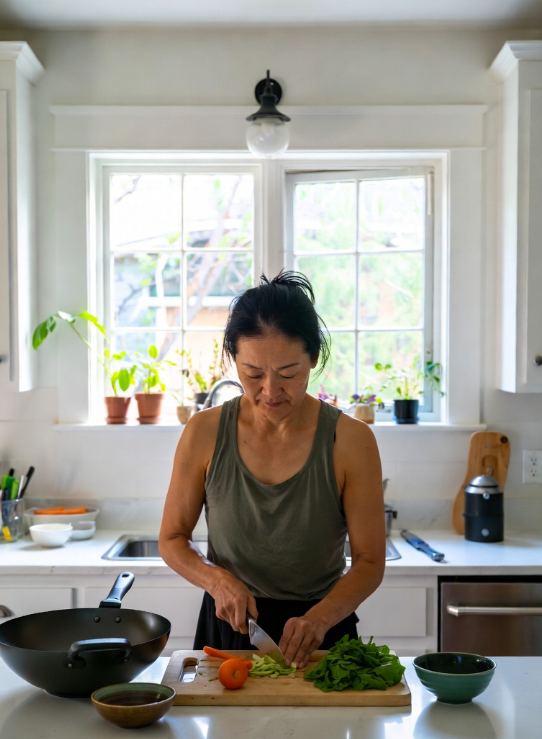
I made takenoko gohan — bamboo shoot rice, the April dish, the spring celebration. The bamboo shoots from the farmers market, the fresh ones, the ones you have to peel and blanch and slice. The labor is the tribute. The tribute is the season. The season does not accept shortcuts. The season demands the fresh bamboo shoot, peeled by hand, in the kitchen, at five AM, the way Fumiko demanded: full effort, full attention, full presence.
The second book proofs are done. Two Kitchens will be in bookstores in five months. The first book continues to sell, two years after publication, the steady-seller that food memoirs can be when they find their audience and the audience keeps sharing them. The first book has sold — I don't know the exact number, Sarah tracks this — modestly but sustainably, the shiso growth, the not-flashy-but-persistent sales that are the economic equivalent of my practice: not dramatic, not viral, just there, week after week, a reader here, a reader there, the hand-to-hand that builds a career.
I have been approached by a Portland food organization to give a talk — a public lecture, fifty people, about Japanese-American food and identity. The talk is not a cooking class (though I will demo dashi). The talk is a talk — me, standing at a podium, speaking into a microphone, the blog voice but louder, the newsletter voice but to a room. The public-speaking is the next thing. The next thing is always terrifying. The terrifying is always worth it.
Rhubarb shows up in April the same way bamboo shoots do—briefly, insistently, demanding to be met on its own terms. I made these custard bars the evening after I finished the takenoko gohan, still in the same mode of attention the bamboo had asked of me: full effort, full presence, no shortcuts. The custard has to set slowly, the rhubarb has to soften without collapsing, and the whole thing rewards exactly the kind of patience I was writing about—the dashi patience, the letting-grow patience, the terrifying-because-worth-it patience that I keep returning to whether I’m talking about the newsletter, the second book, or a spring afternoon in my kitchen.
Rhubarb Custard Bars
Prep Time: 20 min | Cook Time: 55 min | Total Time: 1 hr 15 min (plus cooling) | Servings: 16 bars
Ingredients
- Crust
- 2 cups all-purpose flour
- 1/4 cup granulated sugar
- 1/2 teaspoon salt
- 1 cup (2 sticks) cold unsalted butter, cut into small cubes
- Rhubarb Custard Filling
- 2 cups fresh rhubarb, sliced 1/4-inch thick (about 3–4 stalks)
- 2 cups granulated sugar
- 1/2 cup all-purpose flour
- 1 cup heavy cream
- 3 large eggs, beaten
- 1 teaspoon pure vanilla extract
- Topping (optional)
- Powdered sugar, for dusting
Instructions
- Preheat & prepare the pan. Preheat your oven to 350°F. Grease a 9x13-inch baking pan and line it with parchment, leaving an overhang on two sides for easy lifting.
- Make the shortbread crust. In a large bowl, whisk together the flour, sugar, and salt. Work in the cold butter with your fingertips or a pastry cutter until the mixture resembles coarse crumbs with pea-sized bits of butter throughout. Press firmly and evenly into the bottom of the prepared pan.
- Par-bake the crust. Bake for 18–20 minutes, until the edges are just beginning to turn lightly golden. Remove from the oven and let cool for 5 minutes while you prepare the filling.
- Mix the custard filling. In a large bowl, whisk together the sugar and flour. Add the heavy cream, beaten eggs, and vanilla extract, whisking until smooth and fully combined. Fold in the sliced rhubarb.
- Fill and bake. Pour the rhubarb custard mixture evenly over the warm par-baked crust. Return to the oven and bake for 35–40 minutes, until the custard is just set at the center—it should tremble slightly but not slosh when you nudge the pan.
- Cool completely before cutting. Allow the bars to cool in the pan at room temperature for at least 1 hour, then refrigerate for 1 more hour. Lift out using the parchment overhang, dust with powdered sugar, and cut into 16 bars.
Nutrition (per serving)
Calories: 310 | Protein: 4g | Fat: 16g | Carbs: 40g | Fiber: 1g | Sodium: 105mg