
 By
By The book edits are coming back from Sarah. The editor's notes are precise and kind — the combination that makes a good editor, the ability to see what's wrong without destroying what's right. The floor chapter needs "more sensory detail." I add the feel of the linoleum — cold, smooth, the texture of defeat. The adobo chapter needs "a clearer through-line from the recipe to the recovery." I rewrite the paragraph where the garlic hits the oil and the sizzle is the sound of coming back to life. The sinigang chapter needs "less clinical language." I'm a nurse. Clinical language is my native tongue. The un-clinical-ing is the hardest part of the revision, the translation from chart-speak to human-speak, from the professional to the personal, from "patient presented with" to "I sat on the floor."
The revisions are improving the book. The improving is not comfortable — the comfort of the first draft was the privacy, the writing-for-myself, the words that no one else would read. The revision is the public version, the version that someone else will hold, the version that must make sense to a person who doesn't know my kitchen, who hasn't met Lourdes, who doesn't know what Datu Puti smells like. The revision is the translation from private to public. The translation is the book's real work.
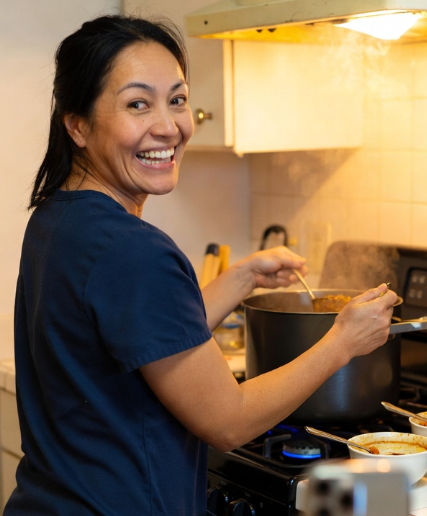
I made chicken adobo while revising — the recipe from Chapter One, the recipe I've made hundreds of times, the recipe that the book describes and that the kitchen produces simultaneously. The adobo in the pot and the adobo on the page. The same thing. Always the same thing.
The adobo in the pot and the adobo on the page had asked everything of me that afternoon — the garlic, the vinegar, the memory of Lourdes, the rewriting of the paragraph until it finally breathed right. By evening, I needed something that didn’t mean anything, a recipe with no chapter attached, no through-line to find, no clinical language to un-clinical. These Ranch Burgers are that recipe for me: fast, satisfying, assembled rather than tended, the kitchen equivalent of a blank page after a hard draft. Some nights, the most restorative thing you can cook is something that doesn’t require you to remember anything at all.
Ranch Burgers
Prep Time: 10 minutes | Cook Time: 15 minutes | Total Time: 25 minutes | Servings: 4
Ingredients
- 1 1/2 lbs ground beef (80/20 blend)
- 1 packet (1 oz) dry ranch seasoning mix
- 1/4 cup breadcrumbs
- 1 large egg
- 1 tablespoon Worcestershire sauce
- 4 burger buns, toasted
- 4 slices cheddar cheese (optional)
- Toppings: lettuce, tomato slices, red onion, pickles, mayonnaise or ranch dressing
Instructions
- Combine the mix. In a large bowl, combine the ground beef, ranch seasoning packet, breadcrumbs, egg, and Worcestershire sauce. Mix gently with your hands until just combined — do not overwork the meat.
- Form the patties. Divide the mixture into 4 equal portions and shape each into a patty about 3/4 inch thick. Press a slight indent into the center of each patty with your thumb to prevent puffing during cooking.
- Cook the burgers. Heat a cast-iron skillet or grill pan over medium-high heat. Cook patties for 4—5 minutes per side for medium doneness, or until internal temperature reaches 160°F. If adding cheese, place a slice on each patty during the last minute of cooking and cover briefly to melt.
- Toast the buns. While the burgers rest for 2 minutes, toast the buns cut-side down in the same skillet for 30—60 seconds until golden.
- Assemble and serve. Layer each bun with your preferred toppings — lettuce, tomato, onion, and pickles work well — then add the patty and a drizzle of ranch dressing or mayonnaise. Serve immediately.
Nutrition (per serving)
Calories: 510 | Protein: 32g | Fat: 24g | Carbs: 36g | Fiber: 1g | Sodium: 870mg