
 By
By Year three. The cherry blossoms are back on Capitol Hill, and I walk through them with the ease of a woman who no longer needs to narrate her own transformation — it's just happening, the way seasons happen, the way rice cooks, the way kimchi ferments. The identity project continues but it's background now, running alongside everything else rather than consuming everything else. I am Korean. That sentence requires no explanation, no qualification, no footnote. I am Korean and I'm making kimchi jjigae and it's Monday and the cherry blossoms are pink and the world is ordinary and the ordinary is what I fought for.
Year three's intention, stated to Dr. Yoon: "The search." She didn't need me to elaborate. The search. The birth mother search. The thing I've been circling for two years, approaching and retreating, researching and postponing. Year three is the year I stop circling and start walking. Not running — walking. One step at a time, toward a woman I've never met, in a country I've now visited, whose name I don't know but whose hands I imagine every time I make kimchi.
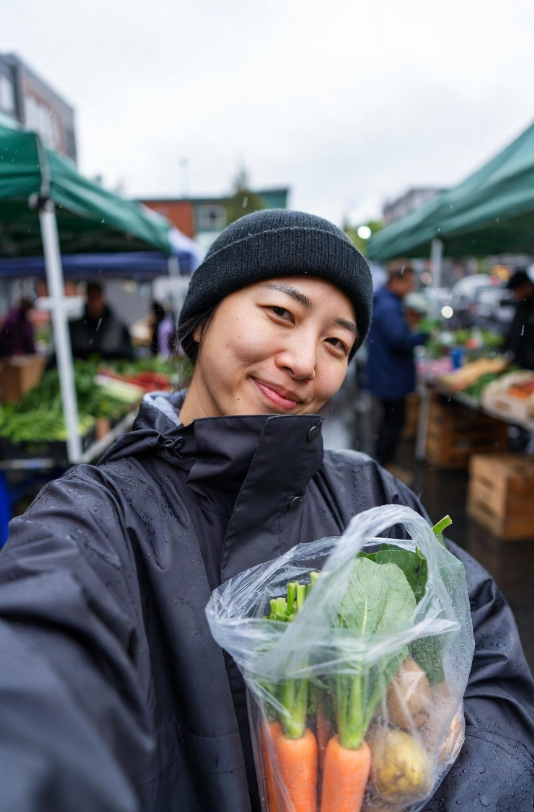
This week I made naengi-doenjang-guk — shepherd's purse soybean paste soup, a spring dish made with a wild herb called naengi that appears in Korean markets in early spring. The herb has a slightly bitter, earthy flavor that balances the deep funk of doenjang, and the soup is clean and green and tastes like the Korean countryside waking up from winter. I found naengi at H Mart — a small bag, carefully packaged, the leaves delicate and wild-looking — and the act of cooking with a seasonal Korean herb felt like progress of a specific kind: I'm no longer learning basic Korean dishes. I'm cooking seasonal, ingredient-driven Korean food, the kind that requires knowing what's available when and why it matters. That's intermediate-to-advanced Korean cooking. That's year three territory.
At work, the platform redesign is in full implementation. My days are a mix of coding, reviewing, and managing — the three-legged stool of a senior engineer's workday. I'm good at all three legs but love the coding leg most, because coding is the purest form of engineering: problem, solution, execution. The managing leg is growing on me, though. Watching Priya (who I mentored as a new hire and who is now a solid SDE I) ship her first major feature this week gave me a satisfaction that writing the feature myself wouldn't have. Teaching is a form of cooking: you provide the ingredients and the technique, and the person makes the dish, and the dish is theirs even though you showed them how.
Korean class continues in the intermediate track. My reading comprehension is solid now — I can read recipes, simple articles, and text messages in Korean without a dictionary (mostly). My spoken Korean is still behind my reading, which Hyunjung says is normal for adult learners: the eye learns faster than the tongue. But the tongue is catching up. I had a five-minute conversation entirely in Korean with Daniel after class this week — about food, naturally — and the conversation flowed. Not smoothly. Not gracefully. But it flowed, and the flowing felt like a river that used to be ice.
Saturday: Bellevue. Karen made her spring pasta — fresh vegetables, light cream sauce, the first warm-weather dish after months of stew and soup. I brought the naengi-doenjang-guk. Karen tried it and said, "This is herbal. It tastes like a garden." It does. It tastes like a Korean garden, a Korean spring, a Korean earth that's thawing, and the fact that Karen can taste the garden in the soup means she's developed a Korean palate — not fully, not expertly, but enough to taste the herb and name it accurately. Karen's Korean palate. Two years of eating my food. She tastes the garden now. That's a two-year education, delivered in small bowls, across a dining table in Bellevue, by a daughter who is proud of both her mothers and grateful for the one who eats her soup every Saturday and says, "This tastes like a garden."
The naengi-doenjang-guk is the heart of this week’s cooking — and if you can find shepherd’s purse at your local H Mart, please make it — but I know that’s a seasonal, specialty ingredient that not everyone will have access to right now. What everyone can find, year-round but especially glorious in spring, is the radish: crisp, peppery, a little sharp, and deeply rooted in Korean cooking in the same way naengi is. This radish salad carries that same garden energy Karen named at the dinner table — clean, bright, and tasting unmistakably of earth that’s been woken up by warmth. It’s a side dish I’ve been making alongside soups like this one, and it holds its own beautifully.
Radish Salad
Prep Time: 10 minutes | Cook Time: 0 minutes | Total Time: 10 minutes | Servings: 4
Ingredients
- 1 lb daikon radish (or red radishes), thinly sliced or julienned
- 1 teaspoon kosher salt
- 1 tablespoon rice vinegar
- 1 teaspoon sesame oil
- 1 teaspoon sugar
- 1/2 teaspoon gochugaru (Korean red pepper flakes), or to taste
- 1 clove garlic, minced
- 1 green onion, thinly sliced
- 1 teaspoon toasted sesame seeds
Instructions
- Salt the radish. Place the sliced or julienned radish in a bowl and toss with the kosher salt. Let sit for 5 minutes, then gently squeeze out any excess water and drain.
- Make the dressing. In a small bowl, whisk together the rice vinegar, sesame oil, sugar, gochugaru, and minced garlic until the sugar dissolves.
- Combine. Add the drained radish to the dressing and toss to coat evenly. Fold in the sliced green onion.
- Finish and serve. Transfer to a serving plate and sprinkle with toasted sesame seeds. Serve immediately as a banchan (side dish) or alongside a bowl of soup.
Nutrition (per serving)
Calories: 45 | Protein: 1g | Fat: 2g | Carbs: 7g | Fiber: 2g | Sodium: 310mg