Five weeks until the due date. Brianna is uncomfortable in the way all nine-months-pregnant women are uncomfortable — nothing fits, nothing is positioned correctly, sleep is a myth involving seventeen pillows and a body pillow that takes up half the bed. She shifts positions every twenty minutes through the night, each shift accompanied by a sound that is part sigh, part groan, part primal communication from a body that has reached its capacity. I do not complain about the sleep disruption because I am not the one growing a human being. But I am tired. We are both tired. The final stretch of pregnancy is an endurance event for everyone involved.
Aiden is two and a half and increasingly aware that something is happening. He asks about the baby daily. "When baby come?" he says. "Is baby a girl?" (We do not know. We continue not knowing.) "Can baby play ball?" (Not immediately.) He is excited in the abstract — the idea of a baby is appealing. The reality of a baby — the noise, the attention-diversion, the permanent restructuring of the household hierarchy — is going to hit him like a truck. I remember how Darius was when Marc was born — he cried for a week and tried to return the baby to the hospital. Aiden will adjust. All big siblings adjust. But the adjustment is a process, not an event.
Work continues. The line is my constant. When everything else shifts — the marriage, the pregnancy, the finances — the line stays the same. Six AM. Ten hours. Build. The Grand Cherokee does not change because my wife is about to have a baby. It does not care about my anxieties or my joy. It just needs to be built, correctly, every time. There is comfort in that consistency. I understand why my father gave thirty-one years to the line. It was not just the money or the benefits. It was the order. The predictability. The knowledge that no matter how chaotic your life is, the line will be there tomorrow, running, waiting, needing you.
I tried making cornbread this week. Not Mama's cornbread — I am not ready for that — but cornbread from a box. Jiffy mix. You add an egg and milk and stir and bake. I did this. The cornbread came out golden and crumbly and — fine. Just fine. But fine from a box is a starting point, not a destination, and I am starting to understand the difference. Mama's cornbread is made from scratch: cornmeal, flour, salt, baking powder, egg, buttermilk, butter. No sugar. Never sugar. The difference between box cornbread and Mama's cornbread is the difference between a photocopy and an original. Both are readable. Only one is art.
Sunday dinner was fried pork chops. Not smothered — fried. Mama dredges them in seasoned flour and fries them in a cast-iron skillet until the crust is dark and crunchy and the meat inside is juicy and white. She serves them with rice and gravy (pan gravy, made from the drippings with flour and milk) and green beans. It is simple. It is perfect. It is the kind of meal that makes you understand why people fight wars over territory: because the food you grew up with is worth defending.
Sunday’s fried pork chops reminded me that pork done right is one of the most satisfying things on a plate—and that I’m not there yet with Mama’s version, but I don’t have to be. On a Tuesday after ten hours on the line, with Brianna shifting positions on the couch and Aiden asking about the baby for the fourteenth time that evening, I needed something that used pork, used one pan, and didn’t require me to stand over a cast-iron skillet managing a crust. This orzo skillet is where I landed: it’s not Sunday dinner, but it’s real food, and some nights that’s exactly enough.
Quick and Easy Pork Mediterranean Orzo Skillet
Prep Time: 10 min | Cook Time: 25 min | Total Time: 35 min | Servings: 4
Ingredients
- 1 lb pork tenderloin, cut into 1-inch pieces (or boneless chicken breast)
- 1 cup orzo pasta, uncooked
- 1 can (14.5 oz) diced tomatoes, undrained
- 1 1/2 cups low-sodium chicken broth
- 1/2 cup kalamata olives, pitted and halved
- 1/2 cup crumbled feta cheese
- 1 small yellow onion, diced
- 3 cloves garlic, minced
- 1 tsp dried oregano
- 1/2 tsp dried basil
- 1/4 tsp crushed red pepper flakes (optional)
- 2 tbsp olive oil
- Salt and black pepper to taste
- Fresh parsley, chopped, for garnish
Instructions
- Season the pork. Pat pork pieces dry and season generously with salt, pepper, oregano, and basil. Set aside.
- Sear the pork. Heat olive oil in a large, deep skillet over medium-high heat. Add the pork in a single layer and cook 3–4 minutes, turning once, until browned on the outside. The pork does not need to be fully cooked through at this stage. Transfer to a plate and set aside.
- Soften the aromatics. Reduce heat to medium. Add the diced onion to the same skillet and cook 3–4 minutes until softened and translucent. Add the garlic and red pepper flakes and cook 1 minute more, stirring constantly so the garlic doesn’t burn.
- Toast the orzo. Add the dry orzo to the skillet and stir to coat in the oil and aromatics. Cook 1–2 minutes, stirring frequently, until the orzo is lightly golden.
- Build the braise. Pour in the diced tomatoes with their juices and the chicken broth. Stir well, scraping up any browned bits from the bottom of the pan. Bring to a gentle boil.
- Finish together. Return the seared pork to the skillet. Reduce heat to medium-low, cover, and simmer 12–15 minutes, stirring once or twice, until the orzo is tender and most of the liquid has been absorbed. If it looks dry before the orzo is done, add a splash of broth.
- Add the olives and rest. Stir in the kalamata olives. Taste and adjust salt and pepper. Remove from heat and let sit uncovered for 2 minutes to allow the orzo to settle.
- Serve. Spoon into bowls and top with crumbled feta and fresh parsley. Serve immediately.
Nutrition (per serving)
Calories: 430 | Protein: 34g | Fat: 14g | Carbs: 38g | Fiber: 3g | Sodium: 620mg
About the cook who shared this
DeShawn Carter
Week 73 of DeShawn’s 30-year story
· Detroit, Michigan
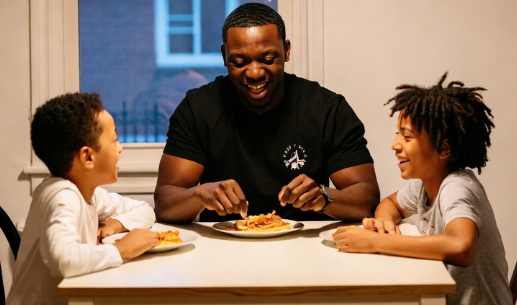
DeShawn is a thirty-six-year-old single dad, auto plant worker, and a man who didn't learn to cook until his wife left and his five-year-old asked, "Daddy, can you cook something?" He called his mama, who came over with two bags of groceries and spent six months teaching him the basics. Now he's the dad at the cookout who brings the ribs, the guy at the plant whose leftover gumbo starts fights, and living proof that it's never too late to learn.
