
 By
By Back to school, fall 2024. The last year of first-days for the Gutierrez children at public school: Sofia is a senior at Bel Air (her last year, her valedictory year, the year she will graduate and join the bakery full-time and the joining will be the graduation's true ceremony, more meaningful than the diploma). Diego is a sophomore (AP Chemistry, AP Calculus, computer science, the engineering track that will take him to UTEP in three years). Camila starts sixth grade — middle school, the bridge between childhood and adolescence, the year when Camila's voice will deepen with puberty and the deepening will add a new register to her instrument and Ms. Torres has already told me: "The voice is about to change. The change will be extraordinary."
Isabella is in her senior year of nursing school. 4.0. Unbroken. Eight semesters of perfect grades, and the perfection is not a number but a discipline, and the discipline is Rosa's gift to Isabella through Maria Elena through the bakery through the 4 AM mornings that taught Isabella that the first hour of the day is the most important and the most important hour must be spent on the most important work. Isabella's most important work: the babies. The NICU. The tiny ones. She will graduate in May 2025 and she will be a nurse and the nurse will be Rosa's legacy in a hospital, the way the bakery is Rosa's legacy on a street, and both legacies are the same legacy, which is: take care of the people who need you.
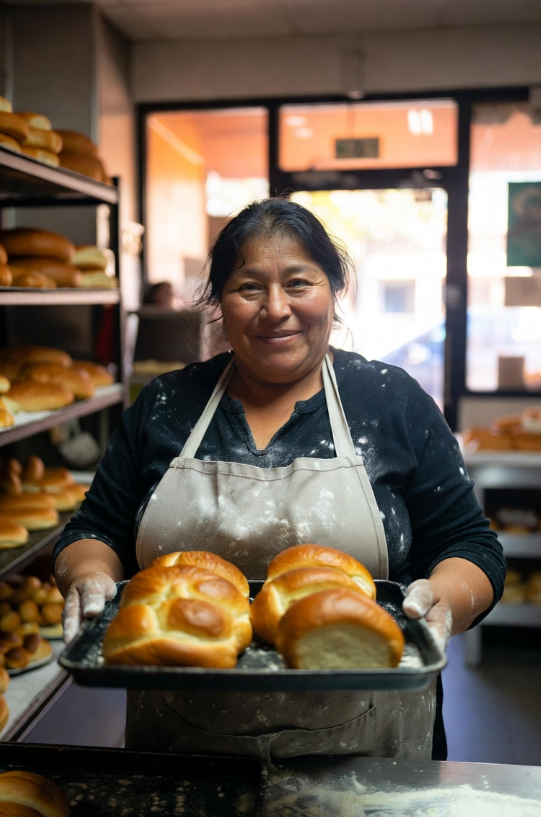
Lupita Delgado started training on September 1. She crosses the bridge every morning at 4 AM — the same time, the same bridge, the same direction (Juárez to El Paso) — and she arrives at the bakery at 4:30 and she works beside me and Sofia until noon. She is learning Rosa's recipes. She is learning the masa and the chile colorado and the concha shell pattern and the flan and the tortillas. She is learning with her hands, the way I learned from Rosa, the way Rosa learned from Consuelo. The hands learn. The brain follows. The brain will never be as fast as the hands, because the hands have been learning recipes for four generations, and the generational knowledge is in the dough, and the dough teaches faster than any cookbook.
I made first-day tamales. The tradition. Year seven of first-day tamales. The tamales that say: go to school and come back and eat. Lupita helped make them — her first tamales in the bakery, her first spread of masa on a corn husk under my supervision. Her hands were clumsy at first, then smoother, then rhythmic, and the rhythm came fast because Lupita's hands are Delgado hands, and Delgado hands know masa the way Gutierrez hands know flour, and the knowing is genetic, and the genetics are the recipe.
Watching Lupita’s hands find their rhythm on the corn husks that morning reminded me of something Rosa used to say: it doesn’t matter what the dough is made of, it matters that you let it teach you. The masa taught Lupita. The flour taught Sofia. And on evenings after first-day tamales, when the bakery is quiet and I want to practice that same lesson with whoever is standing beside me at the counter, I turn to this quiche crust—because there is no recipe that more honestly rewards a student’s hands, and no better proof that the knowing is in the doing, not the reading.
Quiche Crust Recipe
Prep Time: 15 minutes | Cook Time: 25 minutes | Total Time: 40 minutes (plus 30 minutes chilling) | Servings: 8
Ingredients
- 1 1/4 cups all-purpose flour, plus more for dusting
- 1/2 teaspoon fine sea salt
- 1/2 teaspoon granulated sugar
- 1/2 cup (1 stick) unsalted butter, cold, cut into 1/2-inch cubes
- 3 to 4 tablespoons ice water
- 1 egg yolk (optional, for a richer, more golden crust)
Instructions
- Combine dry ingredients. In a large bowl, whisk together the flour, salt, and sugar until evenly mixed.
- Cut in the butter. Add the cold butter cubes to the flour mixture. Using your fingertips or a pastry cutter, work the butter into the flour by pressing and smearing until the mixture resembles coarse, pea-sized crumbles. Work quickly—the goal is to keep the butter cold so the crust bakes up flaky.
- Add the water. Drizzle 3 tablespoons of ice water over the mixture (add the egg yolk here if using). Using a fork, toss and stir just until the dough begins to clump together. Add the fourth tablespoon of water only if the dough seems dry. Do not overwork.
- Form and chill. Turn the dough out onto a lightly floured surface and press it gently into a flat disk. Wrap tightly in plastic wrap and refrigerate for at least 30 minutes (or up to 2 days).
- Roll out the crust. On a lightly floured surface, roll the chilled dough from the center outward into a circle about 12 inches in diameter and 1/8 inch thick. Work in short, even strokes and rotate the dough a quarter turn after each roll to keep it round.
- Transfer to pan. Gently fold the dough in half, then in half again, and lift it into a 9-inch pie or tart pan. Unfold and ease it into the corners without stretching. Trim any overhang to 1 inch and fold it under, crimping the edge as desired.
- Blind bake. Preheat oven to 375°F. Line the crust with parchment paper and fill with pie weights or dried beans. Bake for 15 minutes, then remove the weights and parchment. Return to oven and bake another 8 to 10 minutes, until the bottom looks dry and just barely golden. Fill and bake according to your quiche filling recipe.
Nutrition (per serving)
Calories: 185 | Protein: 2g | Fat: 12g | Carbs: 17g | Fiber: 1g | Sodium: 148mg