
 By
By The State Fair in full swing — fried Oreos, the world's biggest cabbage, the carousel. Two trauma cases stayed with me through the weekend. I cooked through them.
Lourdes is 74. She is in the kitchen. She is luminous.
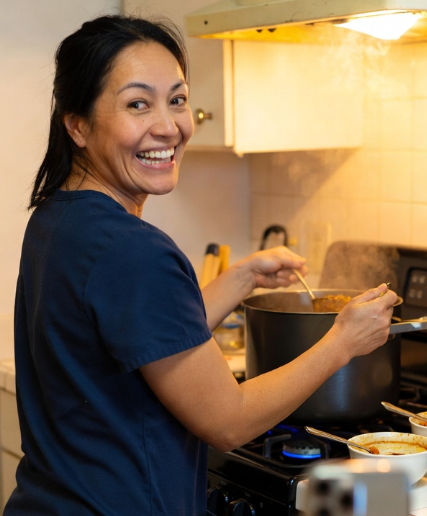
I made ginataang manok Sunday. The coconut chicken. The coconut milk forgives almost any cooking mistake.
The blog has four hundred subscribers now who get the posts via email. The subscribers are the loyal core. The loyal core is the chorus.
I stood at the counter eating leftovers in my pajamas. The standing was the small luxury. The luxury was the having of leftovers at all.
I made coffee at six AM. The coffee was the start. The start was always the same.
The Filipino Community newsletter announced a fundraiser for typhoon relief in Samar. I committed to making three hundred lumpia. The number is the number. The number has always been the number. Three hundred is what I make. The math has stopped surprising me.
I took inventory of the freezer Sunday. The freezer had: twelve quarts of broth, eight pounds of adobo in vacuum bags, six pounds of sinigang base, fourteen lumpia trays at fifty rolls each, three pounds of marinated beef for caldereta, and a small bag of pandan leaves Tita Nening had sent me. The inventory was the proof of preparation. The preparation was the proof of love.
The Filipino Community newsletter announced the Saturday gathering. I will be on lumpia duty. I am always on lumpia duty.
I had a long phone call with Dr. Reeves on Wednesday. We talked about pacing and rest and the way the body keeps a log of what it has carried. Dr. Reeves said, "Grace. The body remembers. The mind forgets. The cooking is the bridge." I wrote the line down. The line is now on a sticky note above the kitchen sink.
Auntie Norma called Sunday to ask if I had a recipe for a particular merienda from Iloilo. I did not. I said I would ask Lourdes. I asked Lourdes. Lourdes had it. The chain.
I read three chapters of the novel Saturday night before sleep. The novel was about a Filipina nurse in California. The nurse was being undone by her work. I knew the unraveling. I had lived the unraveling. I read on. The reading was the witnessing.
The Anchorage sky was the Anchorage sky. The mountains were the mountains. The inlet was the inlet. The geography was the geography.
I checked email at the kitchen table while the rice cooked. There were one hundred and twenty unread messages. I closed the laptop. The unread can wait.
I read a chapter of a novel before bed each night this week. The novel was about a Filipina nurse in California. The novel was good. The novel was, in some way, my own life adjacent.
I sat on the balcony in the cold for ten minutes Sunday night with a cup of broth in my hands. The cold was the cold. The broth was the broth. The body held both.
I taught a Saturday morning Kain Na class on basic adobo proportions for new cooks. Eleven people in the kitchen. Half of them had never cooked Filipino food before. By eleven AM the kitchen smelled the way it should smell. By noon they were all eating. The eating was the lesson landing.
The light was good Saturday morning. I sat on the porch with a cup of coffee and watched the inlet for forty minutes. The watching was the small therapy. The therapy was free.
Lourdes called me twice this week. The first call was about a church event. The second was about a recipe variation she had remembered from her childhood. The remembering was the gift.
The ginataang manok carried me through Sunday, but by Monday I needed something quieter — something that would not ask much of me and would still feel like I had made something real. This pumpkin and cauliflower garlic mash has become exactly that: a bowl of warm and soft for the nights when the body has already kept too much of a log, as Dr. Reeves would say. It does not demand the same attention as a pot of coconut chicken, but it lands in the chest the same way — steady, unhurried, enough.
Pumpkin & Cauliflower Garlic Mash
Prep Time: 10 minutes | Cook Time: 25 minutes | Total Time: 35 minutes | Servings: 4
Ingredients
- 2 cups pumpkin, peeled and cubed (about 1/2 a small sugar pumpkin or canned pumpkin puree)
- 1 small head cauliflower, cut into florets (about 4 cups)
- 4 cloves garlic, peeled
- 2 tablespoons unsalted butter
- 1/4 cup whole milk or cream, warmed
- 1/2 teaspoon kosher salt, plus more to taste
- 1/4 teaspoon black pepper
- 1/4 teaspoon smoked paprika (optional)
- Fresh chives or parsley, chopped, for garnish
Instructions
- Cook the vegetables. Bring a large pot of salted water to a boil. Add the pumpkin cubes and garlic cloves and cook for 10 minutes. Add the cauliflower florets and continue cooking for another 12–15 minutes, until all vegetables are completely tender and yield easily to a fork.
- Drain and dry. Drain the vegetables thoroughly in a colander. Return the empty pot to the stove over low heat and add the drained vegetables back in for 1–2 minutes, stirring gently, to allow any excess moisture to evaporate. This step keeps your mash from turning watery.
- Mash and enrich. Remove from heat. Add the butter and mash with a potato masher or pass through a ricer until smooth and creamy. Pour in the warm milk or cream a little at a time, stirring between additions, until you reach your preferred consistency.
- Season. Stir in the salt, pepper, and smoked paprika if using. Taste and adjust seasoning. The garlic will have mellowed into the mash — add a pinch more salt if it needs to come forward.
- Serve. Transfer to a warm bowl, make a small well in the center, and top with a pat of butter and a scatter of fresh chives or parsley. Serve immediately alongside roasted chicken, braised meats, or simply on its own with a cup of broth on the side.
Nutrition (per serving)
Calories: 135 | Protein: 4g | Fat: 7g | Carbs: 16g | Fiber: 4g | Sodium: 280mg