
 By
By Dad's fine. The cough was a cold. The cold passed in a week. The relief passed through me like weather — the storm and then the clearing, the held breath and then the exhale, the three days of cooking and praying and calling twice a day and then the Tuesday morning phone call where Mom said, "He's in the garden," and the two words "he's" and "garden" were the best two words in the English language and I hung up and sat on the kitchen floor and pressed my hands against the tile and breathed.
The pandemic has a rhythm now. Not a good rhythm, not a comfortable one, but a rhythm — the way a tractor has a rhythm when it's pulling through heavy soil, laboring but moving, slower than you want but forward. Kevin works. I work. The kids learn through screens. Groceries happen once a week, masked, strategic, a military operation of lists and sanitizer and the particular anxiety of standing in an aisle wondering if the air is safe. I come home and I wash the groceries and I wash my hands and I cook, because cooking is the thing that hasn't changed, the thing the virus can't get to, the sanctuary inside the sanctuary.
I made lasagna from scratch — not the quick weeknight version but the real one, the Sunday project. Homemade pasta (the skill acquired in February, now essential), bolognese sauce simmered for three hours, bechamel, ricotta, mozzarella, parmesan. Layered in the big pan, baked until bubbling, rested for twenty minutes because resting lasagna is as important as resting steak and nobody wants to hear that but it's true. The lasagna fed us for three days. Three days of pulling a pan from the refrigerator and cutting a square and reheating it and eating something that tastes like Sunday even though it's Tuesday. Pandemic lasagna. The lasagna of the lockdown. The dish that said: we are not fine but we are fed, and being fed is the floor below which this family will not fall.
Emma turned twelve on May third — the birthday that happened during lockdown, the birthday without a party, the birthday that was just us, five people in a house, singing happy birthday over a funfetti cake (box mix, cream cheese frosting, no apology) with twelve candles that Emma blew out with a wish she wouldn't share. I hope she wished for the world to open up. I hope she wished for her friends and her art club and the middle school hallways she'd organized with folders. I hope she wished for normal. Whatever normal is. Whatever normal was. Whatever normal will be when this is over, if it's ever over, if over is even a word that applies to something that feels like it might be the new shape of everything.
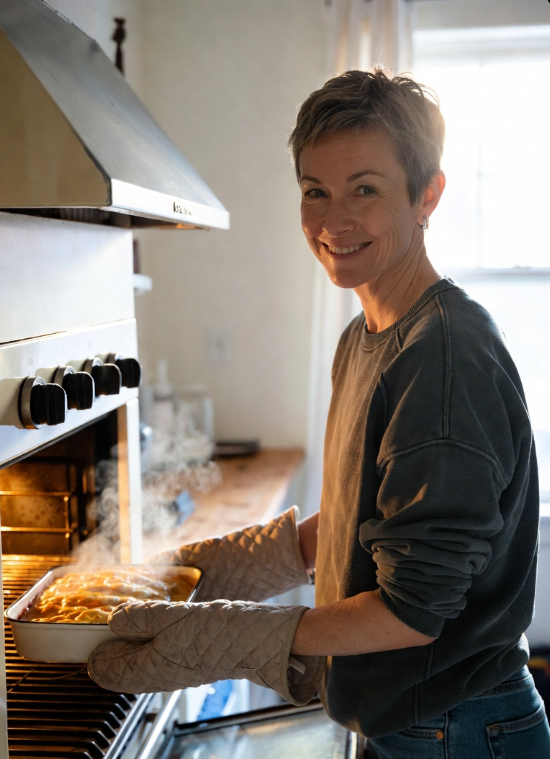
This is the lasagna. Not a lasagna — the lasagna, the one I made during the long weeks when cooking was the only thing I could control, the thing the virus couldn’t get to. I’ve made plenty of versions over the years, but this Potluck Lasagna is the one I come back to when I need something that feeds a crowd and keeps feeding them, day after day, square after square, reheated on a Tuesday and still tasting like it was made with intention. If you’re looking for the dish that says we are not fine but we are fed, this is it.
Potluck Lasagna
Prep Time: 30 min | Cook Time: 1 hr 15 min | Total Time: 1 hr 45 min | Servings: 12
Ingredients
- 1 lb ground beef
- 1/2 lb bulk Italian sausage
- 1 large onion, diced
- 4 garlic cloves, minced
- 1 can (28 oz) crushed tomatoes
- 1 can (15 oz) tomato sauce
- 2 tablespoons tomato paste
- 1 teaspoon dried basil
- 1 teaspoon dried oregano
- 1/2 teaspoon crushed red pepper flakes
- Salt and black pepper to taste
- 12 lasagna noodles, cooked and drained
- 2 cups whole-milk ricotta cheese
- 1 large egg
- 2 tablespoons fresh parsley, chopped
- 3 cups shredded mozzarella cheese, divided
- 1 cup grated Parmesan cheese, divided
Instructions
- Brown the meat. In a large skillet or Dutch oven over medium-high heat, cook the ground beef and Italian sausage together, breaking it up as it cooks, until no pink remains, about 8–10 minutes. Drain excess fat.
- Build the sauce. Add the diced onion to the meat and cook until softened, about 5 minutes. Stir in the garlic and cook 1 minute more. Add the crushed tomatoes, tomato sauce, tomato paste, basil, oregano, and red pepper flakes. Season with salt and pepper. Simmer uncovered over low heat for 25–30 minutes, stirring occasionally, until the sauce thickens and the flavors meld.
- Mix the ricotta filling. In a medium bowl, stir together the ricotta, egg, parsley, 1/2 teaspoon salt, and a few grinds of black pepper until well combined. Set aside.
- Preheat and prep. Preheat your oven to 375°F. Lightly grease a 9x13-inch baking dish.
- Layer the lasagna. Spread 1 cup of meat sauce across the bottom of the prepared dish. Lay 3 lasagna noodles over the sauce. Spread one-third of the ricotta mixture over the noodles, then top with one-third of the remaining meat sauce, 3/4 cup mozzarella, and a sprinkle of Parmesan. Repeat the layers (noodles, ricotta, meat sauce, mozzarella, Parmesan) two more times. Finish with the final 3 noodles, the last of the meat sauce, and the remaining mozzarella and Parmesan spread evenly across the top.
- Bake covered. Cover the dish tightly with aluminum foil (tent it slightly so it doesn’t stick to the cheese) and bake for 45 minutes.
- Bake uncovered. Remove the foil and bake an additional 20–25 minutes, until the cheese is golden and bubbly around the edges.
- Rest before cutting. Remove from the oven and let the lasagna rest, uncovered, for at least 20 minutes before slicing. This is non-negotiable — resting allows the layers to set so each square holds its shape. Cut into 12 portions and serve.
Nutrition (per serving)
Calories: 420 | Protein: 28g | Fat: 21g | Carbs: 30g | Fiber: 3g | Sodium: 680mg