
 By
By January 2020. A new decade. The word "decade" feels significant in a way that "year" does not — ten years, the length of my time in Portland, the length of a marriage, the length of a phase of life. I was twenty-three when I moved to Portland. I am thirty-four now. In the last decade I met Brian, married Brian, had Miya, lost Fumiko, started a blog, published two essays, outlined a book, and cooked approximately ten thousand meals. The decade is a container. The container is full. I am carrying it into the new decade with the question of what to keep and what to release, and the question is the heaviest thing in the container.
I made ozoni on New Year's morning. This year it was good. Not close — good. The dashi smelled like the ocean. The miso dissolved smoothly. The mochi puffed and browned. The toppings were precise. I drank it from the chipped bowl and the taste was right — not Fumiko-right, not Sacramento-right, but Portland-right, Jen-right, the soup that is mine now, evolved from hers, carrying her flavor in a different bowl in a different city. Last year I promised next year would be better. It was. The promise held. I will make the same promise for next year. The promises hold. The soup improves. The grief does not disappear. The soup improves anyway.
Miya ate her ozoni and said, "This is Obaachan soup but Mama style," and the description was so perfect, so exactly the thing I have been trying to articulate for a year — that the soup is Fumiko's and also mine, that the inheritance is also an invention, that the chain is also a creation — that I wrote it on a napkin and pinned it above the stove next to Lin's words. "Scared means it matters" and "Obaachan soup but Mama style." The wall above my stove is becoming a manifesto, written on napkins, in the handwriting of the women who see me clearly.
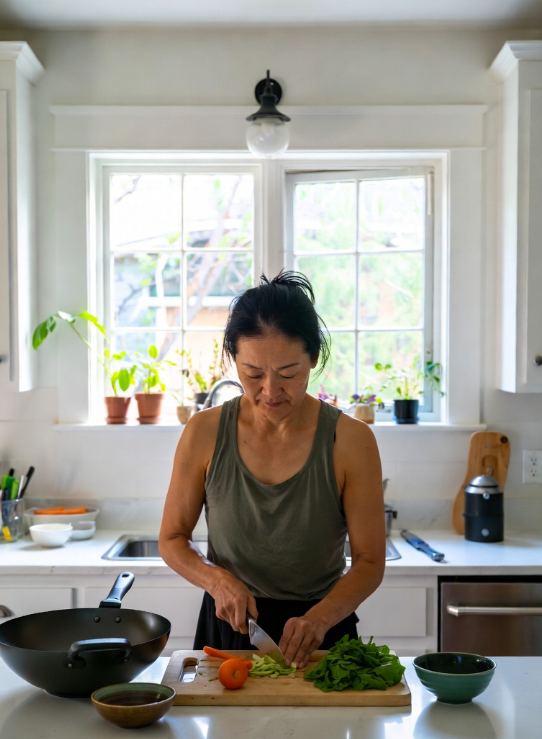
The blog starts the new decade with seven thousand readers. The book outline sits in a drawer, waiting. The second essay is scheduled for winter publication. The writing career — because it is a career now, I am saying the word, I am claiming it — is building itself brick by brick, post by post, essay by essay. I am a writer. I say it in the kitchen, out loud, to the chipped bowl: I am a writer. The bowl does not respond. The bowl holds the soup. The soup holds the meaning. The meaning holds me.
Ozoni is not in everyone’s pantry, and I know that — the mochi, the dashi, the particular miso my mother kept in a red container in the back of the fridge. But the soul of New Year’s morning soup is something any kitchen can reach for: something warm, something simple, something made with intention. This potato leek soup is what I turn to when I want that same feeling of carrying something forward — a bowl that asks nothing of you except that you be present for it. It is not Fumiko’s soup, and it is not trying to be. It is just honest and good, which, as it turns out, is enough.
Potato Leek Soup
Prep Time: 15 minutes | Cook Time: 35 minutes | Total Time: 50 minutes | Servings: 6
Ingredients
- 3 large leeks, white and light green parts only, halved lengthwise and sliced into half-moons
- 3 tablespoons unsalted butter
- 4 cloves garlic, minced
- 1 1/2 pounds Yukon Gold potatoes (about 4 medium), peeled and diced into 3/4-inch cubes
- 4 cups low-sodium chicken or vegetable broth
- 1 cup whole milk or half-and-half
- 1 teaspoon kosher salt, plus more to taste
- 1/2 teaspoon freshly ground black pepper
- 1/4 teaspoon dried thyme
- 1 bay leaf
- Fresh chives or flat-leaf parsley, chopped, for garnish
- Crusty bread or plain crackers, for serving (optional)
Instructions
- Clean the leeks. Place sliced leeks in a large bowl of cold water and swish them well to release any grit. Lift them out with your hands or a slotted spoon, leaving the dirt behind, and set aside to drain.
- Sweat the leeks. Melt butter in a large heavy-bottomed pot or Dutch oven over medium heat. Add the leeks and cook, stirring occasionally, for 8–10 minutes until very soft and wilted but not browned. Add the garlic and cook for 1 minute more until fragrant.
- Add potatoes and broth. Add the diced potatoes, broth, thyme, bay leaf, salt, and pepper. Stir to combine. Bring to a boil over medium-high heat, then reduce heat to medium-low, cover, and simmer for 20–22 minutes until the potatoes are completely tender and break apart easily with a spoon.
- Blend to your liking. Remove and discard the bay leaf. Use an immersion blender to partially blend the soup directly in the pot — a few long pulses will give you a creamy base with some chunks remaining. For a fully smooth soup, blend in batches in a countertop blender, venting the lid carefully. Either texture is correct.
- Finish with milk. Stir in the milk or half-and-half and return the pot to low heat for 3–5 minutes, stirring gently, until the soup is heated through. Taste and adjust salt and pepper as needed.
- Serve. Ladle into bowls and top with fresh chives or parsley. Serve with crusty bread alongside if you like something to hold onto.
Nutrition (per serving)
Calories: 210 | Protein: 5g | Fat: 8g | Carbs: 30g | Fiber: 3g | Sodium: 480mg