
 By
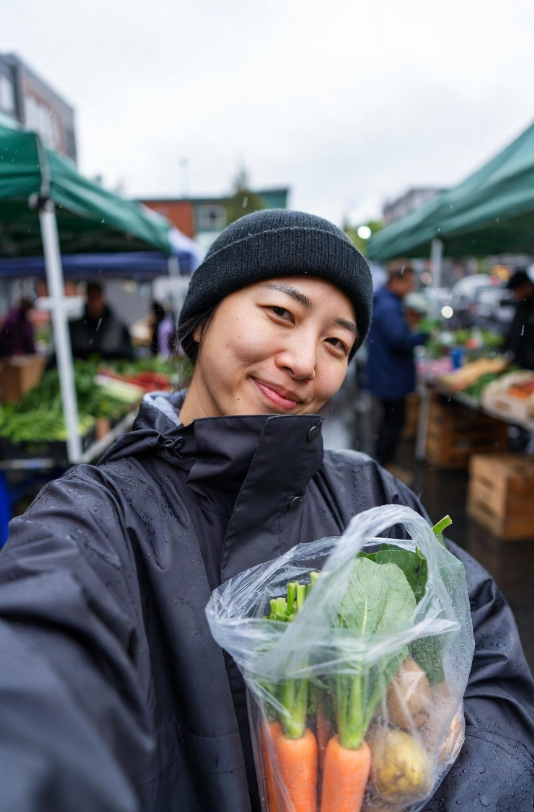
By March. Year three drawing to a close. The cherry blossoms are returning (always returning, the most reliable thing in Seattle) and with them the energy of spring — new growth, new possibility, the annual Seattle resurrection from gray to green. I've been energized this month in a way that feels different from previous springs. Not the frantic energy of year one (everything is new!) or the transformative energy of year two (Korea! DNA!). A calmer energy. The energy of someone who has built something and is ready to share it. Ready to step into rooms. Ready to be seen.
The Asian Americans in Tech meetup is next week. I've been thinking about what to wear, which is not something I normally think about (my wardrobe is an engineer's wardrobe: functional, dark, interchangeable). But this feels like an occasion — not a date, not a performance, but an entrance. The entrance of Stephanie Park into a room of people who might understand her, who might speak her language, who might eat kimchi without flinching. I'm wearing my Korean earrings — small gold hoops with a traditional Korean geometric pattern that I bought at a shop in Insadong during the Korea trip. The earrings are subtle. You'd only notice them if you knew what you were looking at. But I'll know. I'll feel the Korean gold against my neck and the knowing will be enough.
This week I made a dish that feels appropriate for the season: ssuk-guk — mugwort soup, a spring dish made with fresh mugwort (a Korean herb that appears briefly in spring, pungent and slightly bitter, used in tteok and soups). I couldn't find fresh mugwort in Seattle (it grows wild in Korea but is hard to source here), so I used dried mugwort from H Mart, which is less potent but still adds the characteristic herbal, slightly medicinal flavor. The soup is simple: anchovy-kelp broth, diced clams, the mugwort. It tastes like spring in Korea — earthy, green, alive — and making it in March, as the cherry blossoms return, felt like welcoming a season that understands me. Spring is the season of beginning. I began in spring (March 2016, the first scrambled eggs). I'm still beginning. I'm always beginning.
Dr. Yoon asked me about the meetup. She said, "What do you hope for?" I said, "Nothing specific. Everything general. The feeling of being in a room where nobody is the only Asian person. The possibility of connection. The possibility of being known." She said, "Being known is what you've been building toward. Three years of knowing yourself so that someone else can know you too." Three years. The three years of cooking and therapy and language and identity are the preparation for being known. The meetup is the test. Not because someone at the meetup will know me (probably not — it's a tech meetup, not a therapy session). But because I'll be in the room as myself — fully, Korean-ly, kimchi-stained-hands-ly, metal-chopsticks-ly, doenjang-jjigae-ly myself — and the being-there as myself is the knowing. I know me. I'm ready for someone else to know me too.
Saturday: Bellevue. I brought ssuk-guk. Karen tried it and said, "This is different. Herbal. Like medicine but good." Like medicine but good. That's the review for the whole three years. The Korean identity work: like medicine but good. The therapy: like medicine but good. The cooking: like medicine, and also good. The meetup is next week. I'm ready. I'm terrified. Go anyway.
The ssuk-guk I made that week was never going to be easy to replicate — dried mugwort from H Mart, anchovy broth from memory, a dish rooted in a spring I’d only just begun to claim as mine. But when I want to carry that same feeling into someone else’s kitchen — that earthy, green, quietly medicinal bowl that Karen called “like medicine but good” — I reach for Potato Fennel Soup. Fennel has that same aromatic, slightly unexpected quality: herbal, alive, a little bold, the kind of flavor that makes you pause and pay attention. It’s the soup I’d bring to the meetup if I were bringing soup — simple enough to share, interesting enough to start a conversation.
Potato Fennel Soup
Prep Time: 15 min | Cook Time: 30 min | Total Time: 45 min | Servings: 4–6
Ingredients
- 2 tablespoons olive oil
- 1 large fennel bulb, trimmed and diced (fronds reserved for garnish)
- 1 medium yellow onion, diced
- 3 cloves garlic, minced
- 1 1/2 lbs Yukon Gold potatoes, peeled and cut into 1-inch cubes
- 4 cups low-sodium vegetable or chicken broth
- 1 cup water
- 1/2 teaspoon kosher salt, plus more to taste
- 1/4 teaspoon white pepper
- 1/4 cup heavy cream or full-fat coconut milk (optional, for richness)
- Fresh fennel fronds and a drizzle of olive oil, to serve
Instructions
- Sauté the aromatics. Heat olive oil in a large heavy-bottomed pot over medium heat. Add the diced fennel and onion and cook, stirring occasionally, for 6–8 minutes until softened and just beginning to turn golden at the edges. Add the garlic and cook 1 minute more, until fragrant.
- Add potatoes and liquid. Add the cubed potatoes, broth, and water to the pot. Stir to combine and bring to a boil over medium-high heat.
- Simmer until tender. Reduce heat to medium-low, cover partially, and simmer for 20–25 minutes, until the potatoes are completely tender and break apart easily when pressed with a spoon.
- Blend to desired consistency. Use an immersion blender to blend the soup directly in the pot — fully for a silky, smooth texture, or partially for a chunky, rustic feel. Alternatively, carefully transfer in batches to a countertop blender.
- Finish and season. Stir in the heavy cream or coconut milk if using. Taste and adjust salt and white pepper. If the soup is too thick, add a splash of broth or water to loosen.
- Serve. Ladle into bowls and garnish with reserved fennel fronds and a light drizzle of olive oil. Serve warm with crusty bread or on its own.
Nutrition (per serving)
Calories: 190 | Protein: 4g | Fat: 8g | Carbs: 27g | Fiber: 4g | Sodium: 610mg