
 By
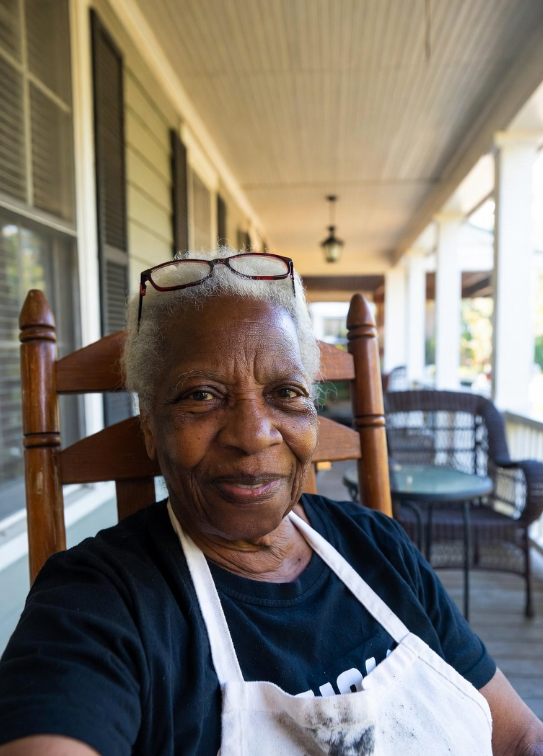
By The heat broke for exactly one day this week — Wednesday — and I opened every window in the house and let the breeze come through and it felt like a gift, like the weather saying, "Here, take a breath." Earl and I sat on the porch for three hours that evening, which is two hours longer than his lungs usually allow, and we watched the marsh turn gold and then purple and then dark, and we didn't talk much because after forty-two years of marriage, silence is a language.
Kayla is settling into Memorial. She comes over Tuesday evenings now — her regular day off — and we cook together and she tells me about the unit. The patients she's caring for. The codes she's witnessed. The ones who make it and the ones who don't. She's careful with the details, knows I don't need to hear the worst of it, but I can see it in her face — the weight of holding someone's life in your hands at twenty-two years old. That's a lot, baby. That's a whole lot.
She asked me this week how I handle loss. Not how I handled it — how I handle it. Present tense. Like it's something I'm still doing, which of course it is, because loss is not an event, it's a condition. You don't get over it. You get under it and you carry it and eventually it becomes part of your skeleton, something structural, something that holds you up instead of weighing you down.
I told her the truth. I said, "Baby, I cook. That's how I handle it. When your daddy died, I cooked. When Mama died, I cooked. When Willie James drowned and Daddy started drinking and the world fell apart, I went into the kitchen and I cooked. Because the kitchen is the one place where I can control the outcome. The stove does what I tell it. The food comes out the way I make it. Everything else in life is uncertain. The kitchen is sure."
She was quiet for a while. Then she said, "I think the hospital is my kitchen." And I understood exactly what she meant.
I taught her my she-crab soup this week. The real thing — crab meat and crab roe and cream and sherry and patience. It's a Lowcountry masterpiece, the kind of recipe that takes three generations to perfect, and I watched Kayla stir the pot with the same careful attention she gives her patients, and I thought: she's going to carry this forward. Not just the recipe. All of it.
Now go on and feed somebody.
She-crab soup is what we made that Tuesday, and I’ll share that recipe another time — but the soup I keep coming back to, the one I reach for when someone I love needs steadying, is this Potato Corn Chowder. It’s got that same quality the she-crab has: it’s patient, it’s rich, it doesn’t rush. Kayla had her second bowl standing up at the counter before she even realized she’d done it, and I thought, yes — that’s exactly what a good soup is supposed to do.
Potato Corn Chowder
Prep Time: 15 min | Cook Time: 35 min | Total Time: 50 min | Servings: 6
Ingredients
- 3 cups Yukon Gold potatoes, peeled and diced into 1/2-inch cubes
- 2 cups fresh or frozen corn kernels
- 1 medium yellow onion, diced
- 3 cloves garlic, minced
- 3 cups low-sodium chicken or vegetable broth
- 1 cup heavy cream
- 2 tablespoons unsalted butter
- 2 tablespoons all-purpose flour
- 1/2 teaspoon smoked paprika
- 1/2 teaspoon dried thyme
- 1 teaspoon kosher salt, plus more to taste
- 1/2 teaspoon freshly ground black pepper
- 2 tablespoons fresh chives or green onion, thinly sliced, for garnish
Instructions
- Soften the aromatics. In a large heavy-bottomed pot or Dutch oven, melt the butter over medium heat. Add the diced onion and cook, stirring occasionally, until softened and translucent, about 5 minutes. Add the garlic and cook 1 minute more until fragrant.
- Build the base. Sprinkle the flour over the onion and garlic, stirring to coat evenly. Cook for 1–2 minutes to remove the raw flour taste. The mixture will look pale and pasty — that’s right.
- Add the broth and potatoes. Slowly pour in the broth, whisking as you go to keep the mixture smooth. Add the diced potatoes, smoked paprika, thyme, salt, and pepper. Bring to a gentle boil, then reduce heat to medium-low.
- Simmer until tender. Cover and cook for 15–18 minutes, until the potatoes are fork-tender and beginning to break down slightly at the edges. Stir occasionally so nothing catches on the bottom.
- Add the corn and cream. Stir in the corn kernels and heavy cream. Return to a gentle simmer (do not boil after adding cream) and cook uncovered for 8–10 minutes, until the chowder has thickened to your liking.
- Taste and finish. Adjust salt and pepper as needed. For a thicker texture, use the back of a spoon or a potato masher to lightly crush some of the potato pieces right in the pot. Serve hot, topped with fresh chives.
Nutrition (per serving)
Calories: 278 | Protein: 5g | Fat: 15g | Carbs: 33g | Fiber: 3g | Sodium: 480mg