
 By
By The cottonwood seeds in the air. The annual snow-in-summer. A Code Blue Wednesday morning that we did not save. I stood in the parking lot for fifteen minutes before I got in my car.
Lourdes is 74. She is in the kitchen. She is luminous. Joseph called Saturday. He told me Lourdes calls him every day. He answers every day. The pattern has held for 6 years.
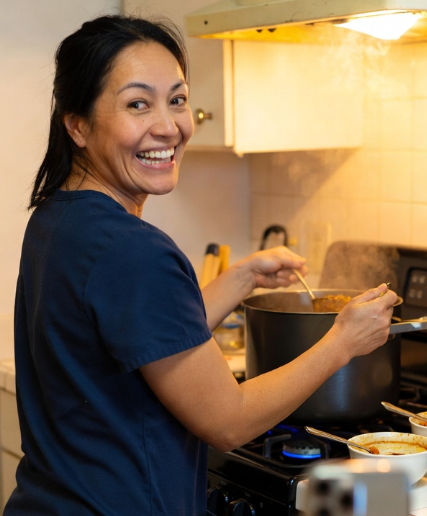
I made lumpia Saturday. Sixty rolls. I delivered some to Lourdes. The rest went into the freezer for the week.
I skipped the blog this week. Some weeks the kitchen is enough.
Angela came over Saturday with the kids. We cooked. We argued about pancit proportions — she uses more soy, I use more calamansi. We are both wrong, according to Lourdes.
I went to bed Sunday at nine. I slept for ten hours. The sleeping was the inheritance.
The Anchorage sky was the Anchorage sky. The mountains were the mountains. The inlet was the inlet. The geography was the geography.
I read three chapters of the novel Saturday night before sleep. The novel was about a Filipina nurse in California. The nurse was being undone by her work. I knew the unraveling. I had lived the unraveling. I read on. The reading was the witnessing.
I taught a Saturday morning Kain Na class on basic adobo proportions for new cooks. Eleven people in the kitchen. Half of them had never cooked Filipino food before. By eleven AM the kitchen smelled the way it should smell. By noon they were all eating. The eating was the lesson landing.
The Filipino Community newsletter announced a fundraiser for typhoon relief in Samar. I committed to making three hundred lumpia. The number is the number. The number has always been the number. Three hundred is what I make. The math has stopped surprising me.
The therapy session this month was about pacing. Dr. Reeves said, "Grace. The pacing is the love for the future self." I am working on the pacing. The pacing is harder than the loving.
Pete and I had a long phone conversation Tuesday. We talked about the family — his and mine. The talking was the keeping.
A reader from New Jersey wrote in about her grandmother's adobo, which used pineapple. I had never heard of pineapple in adobo. I tried it. It was strange. It was also good. The strange and the good are not opposites.
I read a chapter of a novel before bed each night this week. The novel was about a Filipina nurse in California. The novel was good. The novel was, in some way, my own life adjacent.
I had a long phone call with Dr. Reeves on Wednesday. We talked about pacing and rest and the way the body keeps a log of what it has carried. Dr. Reeves said, "Grace. The body remembers. The mind forgets. The cooking is the bridge." I wrote the line down. The line is now on a sticky note above the kitchen sink.
The neighbors invited us over for a small dinner Thursday. They are an Iñupiaq family — Aana and her grandson Joe. We ate caribou stew and rice. I brought lumpia. The kitchens of Anchorage have always been the small UN. The food is the proof.
Auntie Norma called Sunday to ask if I had a recipe for a particular merienda from Iloilo. I did not. I said I would ask Lourdes. I asked Lourdes. Lourdes had it. The chain.
I sat on the balcony in the cold for ten minutes Sunday night with a cup of broth in my hands. The cold was the cold. The broth was the broth. The body held both.
The reader from New Jersey who wrote in about her grandmother’s pineapple adobo stayed in my head all week — the way a small surprise does when it turns out to be true. I had always kept pineapple away from my savory cooking, the way you keep certain memories at arm’s length, and then I tried it, and it was strange, and it was good, and I had to sit with that for a few days. These Pineapple Beef Kabobs are where that sitting landed: the sweetness against the char, the give of the fruit next to the weight of the meat, the whole thing saying what some weeks say better than words — that the strange and the good are not opposites, and the table is always proof.
Pineapple Beef Kabobs
Prep Time: 20 min | Cook Time: 15 min | Total Time: 35 min | Servings: 4
Ingredients
- 1 1/2 lbs beef sirloin, cut into 1 1/2-inch cubes
- 2 cups fresh pineapple chunks (about 1-inch pieces)
- 1 large red bell pepper, cut into 1 1/2-inch pieces
- 1 large green bell pepper, cut into 1 1/2-inch pieces
- 1 medium red onion, cut into wedges
- 1/4 cup soy sauce
- 3 tablespoons pineapple juice (reserved from fresh pineapple or canned)
- 2 tablespoons brown sugar
- 2 tablespoons vegetable oil
- 3 cloves garlic, minced
- 1 teaspoon fresh ginger, grated
- 1/2 teaspoon black pepper
- 1/4 teaspoon red pepper flakes (optional)
- Metal or soaked wooden skewers
Instructions
- Make the marinade. Whisk together soy sauce, pineapple juice, brown sugar, vegetable oil, garlic, ginger, black pepper, and red pepper flakes in a medium bowl until the sugar dissolves.
- Marinate the beef. Add the beef cubes to the marinade, toss to coat, cover, and refrigerate for at least 30 minutes and up to 4 hours. The longer it sits, the deeper the flavor.
- Prepare the grill. Heat an outdoor grill or grill pan to medium-high heat. Lightly oil the grates.
- Thread the skewers. Alternate beef cubes, pineapple chunks, bell pepper pieces, and onion wedges on each skewer, leaving a little space between pieces so everything cooks evenly.
- Grill the kabobs. Place skewers on the grill and cook for 12—15 minutes total, turning every 3—4 minutes, until the beef reaches your preferred doneness and the pineapple and vegetables have lightly charred edges.
- Rest and serve. Remove from heat and let rest for 2—3 minutes before serving. Serve over steamed rice or alongside pancit if you have it.
Nutrition (per serving)
Calories: 380 | Protein: 36g | Fat: 14g | Carbs: 24g | Fiber: 2g | Sodium: 890mg