Karin called from Stockholm. We talk every Sunday now. Mamma's death made the sister-calls non-negotiable. Karin and Astrid and me. The three remaining girls. We hold each other up across the distance — Stockholm to Duluth to the Twin Cities, the triangle of us. We talk about the weather. We talk about the grandchildren. We talk about Mamma sometimes, but mostly we talk about whatever is in front of us. The whatever-is-in-front-of-us is the love.
Lena moved to Bozeman, Montana. She is a wildlife biologist now. She sends photos of bears. The photos are on the fridge. I worry. I do not say. The worry is the standard grandmotherly worry — bears, weather, men, distance. Lena is fine. Lena has always been fine. Lena is the most self-sufficient grandchild I have, and the most distant, and the one I worry about specifically because of both of those things.
Jakob got engaged. To a woman named Claire. They are both teachers. Jakob is twenty-eight. The wedding is in spring. I will bake the cake. The princess cake. The sacred cake. The cake of every Johansson wedding since I made it for my own wedding to Paul in 1988. I am sixty-something and I am still baking the cake. I will bake the cake at every Johansson wedding for as long as the hands work.
I cooked Watermelon salad this week. Watermelon, feta, mint, a squeeze of lime. The salad of August — cooling, salty, sweet, sharp.
Damiano Center, Thursday. New volunteer this week — a young woman named Sara, just out of college, looking lost and brave. I showed her how to ladle. She caught on quickly. She asked me how long I had been doing this. I said: "Long enough that I do not count." She laughed. She will be back. The good ones come back.
Paul's chair is at the head of the table. His glasses are on the shelf. The arrangement is permanent. The arrangement is the love. The arrangement has been remarked on, gently, by various people over the years — Anna, mostly, and well-meaning friends. The arrangement persists. I do not require justification for it. The chair is the chair.
It is enough. Paul is not here. Mamma is not here. Pappa is not here. Erik is not here. They are all here in the kitchen, in the smell, in the taste, in the wooden spoon and the bread pans and the marble slab. The dead are not where the body went. The dead are in the kitchen.
I have started, in the last few years, to think about what I will leave behind. Not in a morbid way. In a practical way. The recipes are written down. The notebook is on the counter. The kitchen is in good order. The house is in Anna's name (we did the legal work in 2032; the kids agreed; it was the practical thing). The grandchildren and great-grandchildren each have a few small specific things — a wooden spoon, a bread pan, a particular cast iron skillet — that I have already labeled with their names on small pieces of masking tape. Nobody knows about the masking tape labels. They will find them when they find them.
Paul used to say that the difference between a place and a home was that a home was a place where you knew, from any room, what was happening in any other room. I knew, from the kitchen, when he was reading in the living room. I knew, from the bedroom, when he was getting coffee in the kitchen. The Kenwood house is still that kind of home. From the kitchen I know that Sven is asleep on his bed in the dining room (the small specific snore). From the kitchen I know what time the radio in the living room is set to come on. The home is the body of knowledge of itself. I still live inside that body of knowledge, even though Paul is not the one creating most of the data anymore.
It is enough.
The watermelon salad was already on the table that week — cooling, salty, sweet, sharp — but the garden had more to give, and I found myself reaching for the zucchini the way I reach for most things now: practically, gratefully, without needing a reason beyond abundance. Pickled zucchini keeps. It sits in its jar on the counter and waits, the way a good kitchen always waits, the way the people you love leave something behind that does not go away. I made a jar for the table and I made a jar for Sara, the new volunteer — the good ones deserve to go home with something.
Pickled Zucchini
Prep Time: 15 min | Cook Time: 5 min | Total Time: 20 min + 1 hr chilling | Servings: 6
Ingredients
- 2 medium zucchini, thinly sliced into rounds or half-moons
- 1/2 small red onion, thinly sliced
- 1 cup white wine vinegar or apple cider vinegar
- 1/2 cup water
- 2 tablespoons granulated sugar
- 1 1/2 teaspoons kosher salt
- 1/2 teaspoon mustard seeds
- 1/4 teaspoon red pepper flakes (optional)
- 2 cloves garlic, smashed
- Fresh dill, 3–4 sprigs
Instructions
- Prepare the vegetables. Slice zucchini into thin rounds or half-moons, about 1/8 inch thick. Thinly slice the red onion. Layer zucchini, onion, garlic, and dill into a clean quart jar or heatproof container.
- Make the brine. In a small saucepan, combine vinegar, water, sugar, salt, mustard seeds, and red pepper flakes if using. Bring to a simmer over medium heat, stirring until sugar and salt are fully dissolved, about 3–5 minutes.
- Pour and cool. Carefully pour the hot brine over the vegetables in the jar, making sure the zucchini is fully submerged. Let cool to room temperature, uncovered, about 20 minutes.
- Chill and rest. Cover the jar and refrigerate for at least 1 hour before serving. The flavor deepens after a few hours. Pickles keep refrigerated for up to 1 week.
- Serve. Serve cold as a side salad, alongside grilled meats, on sandwiches, or straight from the jar as a bright, cooling bite on an August afternoon.
Nutrition (per serving)
Calories: 35 | Protein: 1g | Fat: 0g | Carbs: 7g | Fiber: 1g | Sodium: 390mg
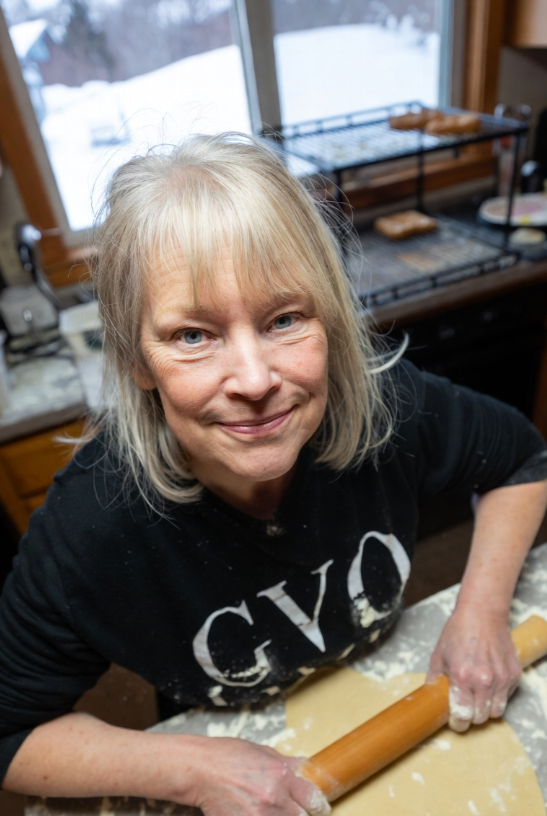
About the cook who shared this
Linda Johansson
Week 539 of Linda’s 30-year story
· Duluth, Minnesota
Linda is a sixty-three-year-old retired nurse from Duluth, Minnesota, living alone in the house where she raised her children and said goodbye to her husband. She lost Paul to ALS in 2020 after two years of watching the kindest man she'd ever known lose everything but his dignity. She cooks Scandinavian comfort food and Minnesota hotdish and the pot roast Paul loved, and she sets two places at the table out of habit because it makes her feel less alone. Every recipe she writes is a person she's loved.
