
 By
By The fireweed at full height in Hatcher Pass. A quiet shift Saturday — appendicitis, a fishhook in a thumb, a college student's alcohol. The quiet was the gift.
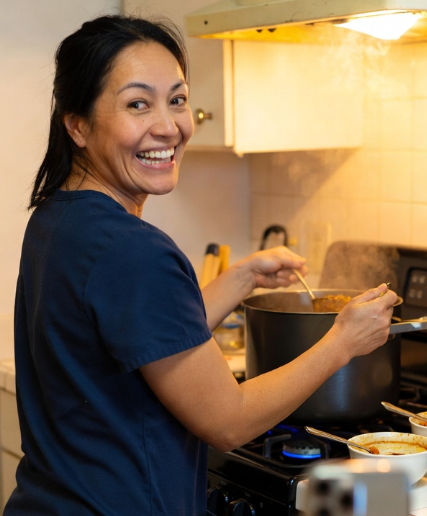
Lourdes is 74. She is in the kitchen. She is luminous. Angela came over Saturday with the kids. We cooked. We argued about pancit proportions — she uses more soy, I use more calamansi. We are both wrong, according to Lourdes.
I made kinilaw Saturday — the Filipino ceviche. Salmon, vinegar, ginger, chili. The fish was Joseph's.
The blog post on kinilaw got picked up by a Filipino-American newsletter. Traffic doubled for two days. The traffic was the surprise.
The kitchen window faced the inlet. The inlet was silver in the late light. The light was the inheritance.
I read a chapter of a novel before bed each night this week. The novel was about a Filipina nurse in California. The novel was good. The novel was, in some way, my own life adjacent.
The break room had cake Tuesday. Someone's birthday. We ate the cake. We did not ask whose birthday. The cake was the cake.
Lourdes called me twice this week. The first call was about a church event. The second was about a recipe variation she had remembered from her childhood. The remembering was the gift.
Angela texted me a photo of the kids. I texted back a heart. The exchange took thirty seconds. The thirty seconds was the keeping.
I made tea late at night. The tea was the small comfort. The comfort was the marker.
I had a long phone call with Dr. Reeves on Wednesday. We talked about pacing and rest and the way the body keeps a log of what it has carried. Dr. Reeves said, "Grace. The body remembers. The mind forgets. The cooking is the bridge." I wrote the line down. The line is now on a sticky note above the kitchen sink.
The Anchorage sky was the Anchorage sky. The mountains were the mountains. The inlet was the inlet. The geography was the geography.
Auntie Norma called Sunday afternoon. She is now seventy-nine. She wanted a recipe. I gave it to her. She wanted to know how my week was. I told her, briefly. She told me about her week. The exchange took eighteen minutes. The eighteen minutes was the keeping.
Auntie Norma called Sunday to ask if I had a recipe for a particular merienda from Iloilo. I did not. I said I would ask Lourdes. I asked Lourdes. Lourdes had it. The chain.
The neighbors invited us over for a small dinner Thursday. They are an Iñupiaq family — Aana and her grandson Joe. We ate caribou stew and rice. I brought lumpia. The kitchens of Anchorage have always been the small UN. The food is the proof.
The light was good Saturday morning. I sat on the porch with a cup of coffee and watched the inlet for forty minutes. The watching was the small therapy. The therapy was free.
I cleaned the kitchen Sunday afternoon. I wiped the stove. I scrubbed the sink. I reorganized the spice cabinet. The cleaning was the small reset. The reset was the marker. The marker said: the week is over, the next week begins, the kitchen is ready.
I took inventory of the freezer Sunday. The freezer had: twelve quarts of broth, eight pounds of adobo in vacuum bags, six pounds of sinigang base, fourteen lumpia trays at fifty rolls each, three pounds of marinated beef for caldereta, and a small bag of pandan leaves Tita Nening had sent me. The inventory was the proof of preparation. The preparation was the proof of love.
When I think about what kinilaw really is — the vinegar doing its quiet, patient work on the fish — I realize the instinct behind it lives in kitchens everywhere, just wearing different clothes. Lourdes taught me that the acid is the bridge between raw and ready, between now and later, between what the ingredient was and what it becomes. This pickled eggs and beets recipe works the same way: you prepare it, you leave it alone, and you trust the brine to do what brine does. It felt right to share it this week, the week Lourdes remembered a recipe from her childhood, the week the kitchen was the proof of preparation.
Pickled Eggs And Beets
Prep Time: 20 min | Cook Time: 15 min | Total Time: 8 hrs 35 min (includes overnight chill) | Servings: 8
Ingredients
- 12 large eggs, hard-boiled and peeled
- 2 cans (15 oz each) sliced beets, drained, liquid reserved
- 1 cup white vinegar
- 1/2 cup granulated sugar
- 1/2 cup water
- 1 teaspoon salt
- 1/2 teaspoon whole black peppercorns
- 1/2 teaspoon whole cloves
- 1 cinnamon stick
- 1 small yellow onion, thinly sliced into rings
Instructions
- Hard-boil the eggs. Place eggs in a large saucepan and cover with cold water by one inch. Bring to a boil over medium-high heat, then remove from heat, cover, and let sit for 12 minutes. Transfer to an ice bath immediately and let cool completely, then peel.
- Make the brine. In a medium saucepan, combine the reserved beet liquid, white vinegar, sugar, water, salt, peppercorns, cloves, and cinnamon stick. Bring to a boil over medium heat, stirring until sugar dissolves. Reduce heat and simmer for 5 minutes. Remove from heat and let cool for 10 minutes.
- Layer the jar. In a large glass jar or non-reactive container, layer the peeled eggs, drained beet slices, and onion rings, alternating as you go so the beets are distributed throughout.
- Pour the brine. Carefully pour the warm brine over the eggs and beets, making sure the liquid covers everything. If needed, press gently to submerge. Let cool to room temperature with the lid loosely set.
- Refrigerate and wait. Seal the jar and refrigerate for at least 8 hours before serving — overnight is better, and 24–48 hours is best. The eggs will turn a deep, beautiful ruby-pink all the way through. The brine does its work. Trust it.
- Serve. Slice eggs in half lengthwise and arrange on a platter with the beet slices and onion rings. Serve cold as a side dish, a snack, or alongside rice.
Nutrition (per serving)
Calories: 165 | Protein: 10g | Fat: 7g | Carbs: 16g | Fiber: 2g | Sodium: 410mg