
 By
By I started my "one new recipe a month" resolution. January's recipe: homemade bread. Not the no-knead kind, not the bread machine kind — real bread, yeast bread, the kind you knead by hand for ten minutes and then let rise and punch down and let rise again and shape and proof and bake, the kind that takes four hours and uses muscles in your forearms that haven't been used since the farm. I haven't made yeast bread since the farm kitchen. Marlene made it weekly. I let the tradition lapse because Des Moines has bakeries and bakeries have bread and the math didn't justify the time. But the resolution isn't about math. It's about hands.
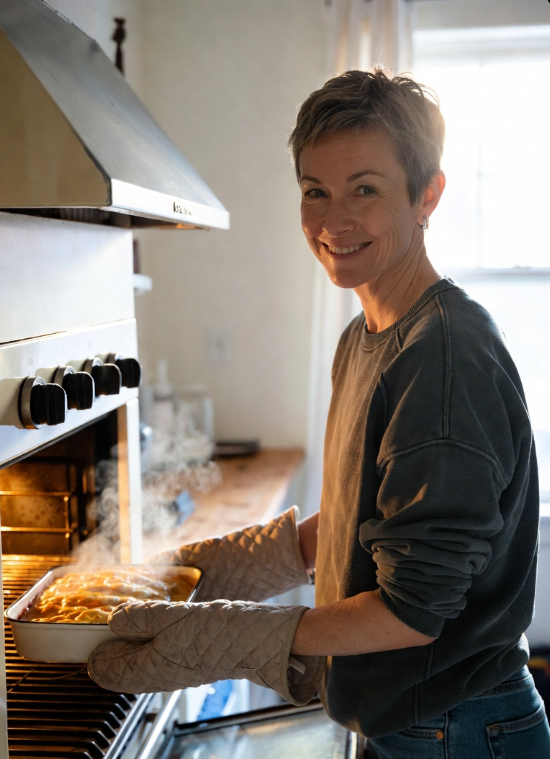
The bread came out. A round loaf, golden-brown crust, soft interior with a slight chew that tells you the gluten developed properly. I sliced it warm and buttered it and stood at the counter and ate a slice and it tasted like the farm kitchen in winter, like Saturday mornings when Mom made bread and the house smelled like yeast and warmth and the certainty that someone was taking care of things. I haven't felt that certainty in a while. The bread brought it back.
Kevin ate four slices with dinner. Noah made toast from it the next morning. Emma said it was "almost as good as bakery bread," which for a kid who thinks the world began when she was born is practically a standing ovation. Jack asked if I'd used my own yeast. I said no, store-bought. He said, "You should grow your own." He means a sourdough starter. He's seven. He wants me to cultivate wild yeast. I told him I'd think about it. I'm already thinking about it. The Weber in me can't resist growing something.
Emma cooked her first meal this week — part of my resolution to teach her. We started simple: grilled cheese sandwiches and canned tomato soup. She buttered the bread, assembled the cheese, and stood at the stove with the spatula, watching the pan the way I taught her — "Don't flip until the bottom is golden. Wait." She waited. She flipped. The grilled cheese was perfect. She served it to Kevin with a flourish and he said, "This is the best grilled cheese I've ever had." She said, "I know." She's nine. She already knows. That's my girl.
Making that round loaf of bread reminded me of something I’d been quietly avoiding: there is a whole category of recipes I gave up not because they were too hard, but because I told myself I didn’t have time—and time was never really the issue. A flaky pie crust is in that category. Marlene made them the same way she made bread, by feel, by hand, without a food processor or a recipe card propped on the counter, and I watched her do it a hundred times. Watching Emma stand at that stove with a spatula, patient enough to wait for the golden bottom, I thought: it’s time to bring the pie crust back too. Some things you learn with your hands, and some things you have to relearn.
Perfect Flaky Pie Crust
Prep Time: 20 minutes | Chill Time: 1 hour | Total Time: 1 hour 20 minutes | Servings: 8 (one 9-inch single crust)
Ingredients
- 1 1/4 cups all-purpose flour, plus more for dusting
- 1/2 teaspoon fine salt
- 1 teaspoon granulated sugar
- 1/2 cup (1 stick / 8 tablespoons) unsalted butter, very cold, cut into 1/2-inch cubes
- 3–5 tablespoons ice water
Instructions
- Combine dry ingredients. In a large bowl, whisk together the flour, salt, and sugar until evenly mixed.
- Cut in the butter. Add the cold butter cubes to the flour mixture. Using a pastry cutter or your fingertips, work the butter into the flour by pressing and smearing until the mixture resembles coarse crumbs with some pea-sized pieces of butter still visible. Those butter pieces are what create the flaky layers—do not overwork.
- Add the ice water. Drizzle in ice water one tablespoon at a time, tossing gently with a fork after each addition. Stop when the dough just begins to hold together when you press a small amount between your fingers. You may not need all 5 tablespoons.
- Form and chill. Turn the dough out onto a lightly floured surface and gently press it into a flat disk about 1 inch thick. Wrap tightly in plastic wrap and refrigerate for at least 1 hour, or up to 2 days.
- Roll out the crust. On a lightly floured surface, roll the chilled dough from the center outward into a circle about 12 inches in diameter and 1/8 inch thick, rotating the dough a quarter turn every few rolls to keep it even.
- Transfer to pie plate. Carefully fold the dough in half, then in half again, and lift it into a 9-inch pie plate. Unfold and gently press it into the bottom and sides without stretching. Trim the overhang to about 1 inch beyond the rim, fold it under, and crimp the edges as desired.
- Chill before filling or blind baking. Refrigerate the formed crust for 15–20 minutes before adding filling or blind baking. For a blind-baked shell, line with parchment, fill with pie weights or dried beans, and bake at 375°F for 15 minutes. Remove weights and bake another 10–12 minutes until golden.
Nutrition (per serving)
Calories: 175 | Protein: 2g | Fat: 12g | Carbs: 15g | Fiber: 0.5g | Sodium: 145mg