
 By
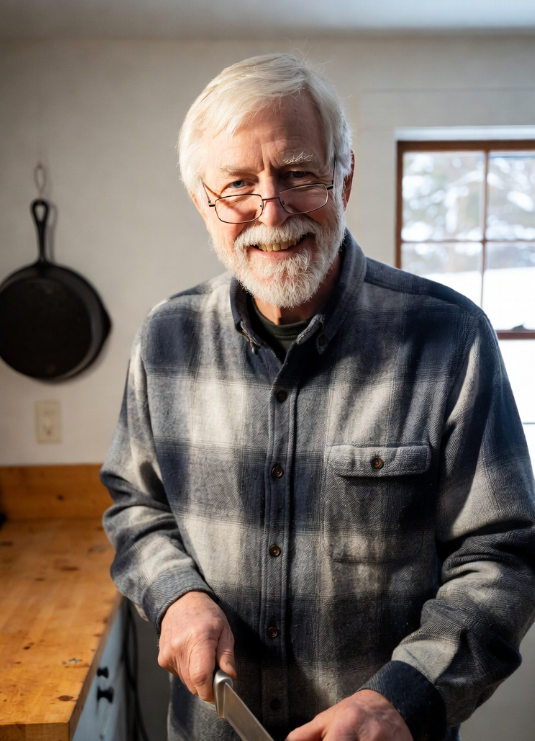
By February is the month that Vermont tries to forget. January has the novelty of cold. March has the promise of maple season. February has nothing — just gray skies, frozen roads, and the suspicion that winter is never going to end. The old-timers call it "cabin fever" month. I call it Tuesday through Tuesday. Same thing.
I reorganized the pantry. This is what happens in February — you run out of productive things to do and you start organizing. Helen found me on Wednesday morning arranging the canned goods by date, with the oldest in front, which is what you do in a pantry and also what you do when you're sixty-four and it's February and the alternative is staring at the wall. She watched me for a moment and said, "Are you alphabetizing the beans?" I said no. I was organizing by color. She left the kitchen. I heard her laugh from the living room. I did not find it funny. The beans needed organizing.
I made shepherd's pie. Ground lamb — real lamb, from the farm outside Williston — browned with onions and garlic, mixed with peas and corn and a bit of Worcestershire sauce and tomato paste, topped with a thick layer of mashed potatoes, and baked until the potatoes are golden and the filling bubbles at the edges. Shepherd's pie is the food equivalent of a warm blanket: it covers everything, it's comforting, and you don't think about it too hard. You just eat it and feel better.
The blog post this week was about soup. Not a specific soup — soup in general. The philosophy of soup. How soup is the oldest food, the most democratic food, the food that says: whatever you have, it's enough. Put it in a pot. Add water. Wait. I wrote about how my mother made soup from almost nothing — the last carrots, a hambone, some dried beans — and how that soup tasted like wealth because when you're feeding a family in Vermont in February with what you've got, what you've got is enough if you know what to do with it.
Seven people wrote to say they made soup after reading it. One man — Gerald, from New Hampshire — said he'd been eating frozen dinners since his wife died three years ago and he made vegetable soup for the first time and "it wasn't bad." Gerald. From New Hampshire. Making vegetable soup in a kitchen that used to belong to someone else. I thought about Gerald all week. I'm still thinking about him. The blog is reaching the people it was supposed to reach, though I didn't know it was supposed to reach anyone. Helen did. Helen always knew.
February. We endure. The soup helps. The pantry is organized. March is coming. Hold on.
The shepherd’s pie got me through the week, but it was the soup post—and thinking about Gerald in New Hampshire—that sent me back to the pantry with different eyes. All those cans I’d just reorganized by color: chickpeas, diced tomatoes, a box of small pasta. That’s pasta e ceci, an Italian dish older than most of our grandmothers’ grandmothers, and the whole philosophy of it is exactly what I’d been writing about. You put what you have in a pot, you add water, you wait, and what comes out is something that tastes like it was meant to be there all along. February calls for this kind of cooking.
Pasta E Ceci (One-Pot Pasta and Chickpeas)
Prep Time: 10 minutes | Cook Time: 25 minutes | Total Time: 35 minutes | Servings: 4
Ingredients
- 3 tablespoons olive oil, plus more for drizzling
- 5 cloves garlic, thinly sliced
- 1/4 teaspoon red pepper flakes
- 2 sprigs fresh rosemary (or 1/2 teaspoon dried)
- 2 tablespoons tomato paste
- 2 (15-oz) cans chickpeas, drained and rinsed
- 4 cups low-sodium chicken or vegetable broth
- 1 cup water
- 1 1/2 cups ditalini or other small pasta (about 6 oz)
- 1 teaspoon kosher salt, plus more to taste
- Black pepper to taste
- Freshly grated Parmesan, for serving
Instructions
- Build the base. Heat olive oil in a large heavy-bottomed pot or Dutch oven over medium heat. Add garlic, red pepper flakes, and rosemary. Cook, stirring occasionally, until the garlic is pale golden and fragrant, about 3–4 minutes. Do not let it brown.
- Add tomato paste. Stir in the tomato paste and cook for 2 minutes, pressing it against the bottom of the pot, until it deepens in color.
- Add chickpeas and liquid. Add the chickpeas, broth, and water. Stir to combine. Bring to a boil over medium-high heat, then reduce to a steady simmer. Cook for 10 minutes to let the flavors come together.
- Mash some chickpeas. Using the back of a spoon or a potato masher, roughly crush about a quarter of the chickpeas directly in the pot. This thickens the broth and gives the dish its characteristic creamy body.
- Cook the pasta. Add the pasta and stir well. Cook, stirring every couple of minutes to prevent sticking, until the pasta is just tender, about 10–12 minutes. The mixture will thicken considerably as the pasta absorbs liquid; add a splash of water if it gets too thick before the pasta is done.
- Season and rest. Remove rosemary sprigs. Season generously with salt and black pepper. Let the pot sit off the heat for 2 minutes—it will thicken further to a stew-like consistency.
- Serve. Ladle into bowls, drizzle with good olive oil, and top with a generous amount of grated Parmesan.
Nutrition (per serving)
Calories: 420 | Protein: 16g | Fat: 12g | Carbs: 62g | Fiber: 9g | Sodium: 610mg