
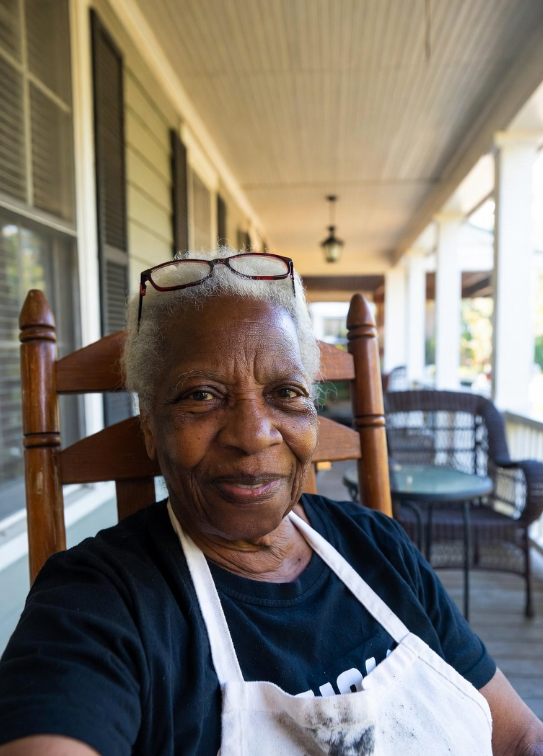
 By
By March. Spring. The tenth spring of this garden and the first spring since Clarence died. The earth doesn't grieve. That's the thing about the earth — it doesn't pause for your losses. It doesn't wait until you're ready. It warms when it warms and it pushes up what it pushes up and the seeds don't know about your brother and the soil doesn't care about your funeral clothes. The earth just does what the earth does: it produces. It feeds. It goes on.
I planted the garden this weekend. Cherokee Purples in the ground, tenth season. Sapelo peppers, seventh generation — though really eighth, if you count the seeds from last year's crop, which I saved in an envelope next to the watermelon seeds. Okra. Butter beans. Herbs. And the watermelon — second-generation watermelon, from the seeds I saved from last year's victory melon, planted in the same sunny corner with the same daily conversation. "Watermelon," I said, "your mother grew. You will too." Talking to watermelons is either gardening wisdom or early dementia. Mrs. Lucille says wisdom. Kayla says concerning. I say: the watermelon grew last year. I'm not changing the method.
Michael came with me to the garden. He is five months old and his Saturday visits now include outdoor time, which means Kayla drops him off and I strap him to my chest in a carrier that makes me look like a marsupial and I garden with a baby attached. The baby watches the dirt. The baby watches my hands. The baby watches the earthworms, which fascinate him the way the steam fascinated him — everything is new, everything is worthy of wide eyes and open mouth and the occasional grab toward something that should not be grabbed (the earthworm was relocated before Michael could complete his plans).
I talked to him while I planted. "Michael, this is a tomato seedling. It looks like nothing right now. It's small and fragile and it doesn't look like it could become anything important. But it will. It will become a Cherokee Purple tomato, which is the finest tomato in the state of Georgia, and it will feed you when you're old enough to eat it, which is not yet but soon, and the feeding is the point. The feeding is always the point."
He reached for the seedling. I moved it away. "Not yet, baby. Soon."
Made garden vegetable soup tonight. The early spring version — pantry vegetables, last winter's frozen greens, the hope of what's coming. Transition food. The food of in-between.
Now go on and feed somebody.
This is the soup I made after Michael and I came in from the garden, him still blinking dirt out of his eyelashes and me still carrying the weight of a first spring without Clarence. It’s pantry soup — the kind you make not from what’s growing yet but from what you saved, what you froze, what you held onto through the winter on faith that spring was coming anyway. That’s transition food. That’s the food of in-between: one hand on what was, one hand reaching toward what’s coming up out of the ground.
Pantry Soup
Prep Time: 15 min | Cook Time: 40 min | Total Time: 55 min | Servings: 6
Ingredients
- 2 tablespoons olive oil
- 1 medium yellow onion, diced
- 3 cloves garlic, minced
- 3 medium carrots, peeled and sliced into coins
- 3 stalks celery, sliced
- 2 medium Yukon Gold potatoes, cubed (about 2 cups)
- 1 can (14.5 oz) diced tomatoes, undrained
- 1 can (15 oz) white beans or cannellini beans, drained and rinsed
- 1 can (15 oz) chickpeas, drained and rinsed
- 6 cups low-sodium vegetable broth
- 2 cups frozen greens (spinach, kale, or collards)
- 1 teaspoon dried thyme
- 1 teaspoon dried oregano
- 1/2 teaspoon smoked paprika
- 1 bay leaf
- Salt and black pepper to taste
- 1 tablespoon apple cider vinegar
- Fresh parsley, chopped, for serving (optional)
Instructions
- Build your base. Heat olive oil in a large heavy-bottomed pot or Dutch oven over medium heat. Add onion and cook, stirring occasionally, until softened and translucent, about 5 minutes. Add garlic and cook 1 minute more until fragrant.
- Add the sturdy vegetables. Stir in carrots, celery, and potatoes. Cook for 3–4 minutes, letting them pick up a little color and get acquainted with the onion.
- Add the pantry. Pour in the diced tomatoes (juice and all), drained beans, chickpeas, vegetable broth, thyme, oregano, smoked paprika, and the bay leaf. Stir everything together.
- Simmer. Bring the pot to a gentle boil, then reduce heat to medium-low. Cover partially and simmer for 25–30 minutes, until the potatoes and carrots are fully tender.
- Add the greens. Stir in the frozen greens and cook 5 more minutes until wilted and heated through. Remove the bay leaf.
- Finish and season. Stir in the apple cider vinegar — it brightens everything. Taste and adjust salt and pepper. Ladle into bowls and scatter fresh parsley over the top if you have it.
Nutrition (per serving)
Calories: 265 | Protein: 11g | Fat: 6g | Carbs: 42g | Fiber: 9g | Sodium: 480mg