
 By
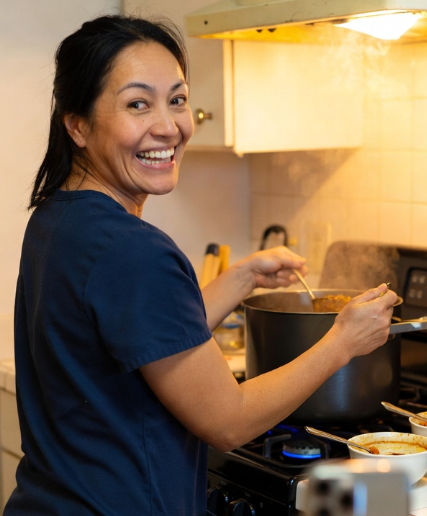
By Jason said "I love you." Wednesday night, in my kitchen, while I was making pancit bihon. Not during a moment of grand romance — during noodle stir-frying, which is the least cinematic setting for a declaration of love but also the most honest, because my kitchen during pancit-making is the room where I'm most myself, hands busy, apron on, soy sauce on the counter, and if someone is going to love me, they should love this version — the cook, the stirrer, the woman with garlic under her fingernails.
He said it simply. "Grace, I love you." The noodles were in the pan. The vegetables were softening. The chicken was sliced. I turned and he was standing by the counter with a look that was equal parts certainty and terror, because saying "I love you" first is always a risk and paramedics understand risk but that doesn't make it easier.
I said, "I love you too." Not because I felt I should. Because I do. The feeling has been growing the way sinigang broth develops — slowly, by accumulation, each day adding a flavor until the whole is richer than any single ingredient. I love him. Not the way I loved the idea of safety when I was on the floor. Not the way I loved the ER before it broke me. This love is different — quieter, realer, the kind that exists between two people who see each other clearly, flaws and sertraline and terrible adobo and all.
We ate the pancit standing at the counter because the moment didn't require a table. Standing in my kitchen, eating noodles, having just said the biggest words available — it was ordinary and enormous and both at once. Both. Always both.
I called Angela later. "He said it." Angela: "Finally." She wasn't surprised. Angela sees things before they happen, the way good sisters do, the way she saw me falling before I hit the floor. She said, "He's good, Grace." I said, "He's good." And the word "good" carried everything — the kindness, the patience, the sinigang he makes that's getting better, the cast-iron skillet he bought me for Valentine's Day, the way he holds silence like it's a living thing that needs gentle hands.
Good. The pancit was good. The love is good. The night was good. I don't need more adjectives. Good is the adjective that covers everything when you've spent two years learning what bad looks like from the inside. Good is the mountain after the valley. Good is enough. Good is everything.
This is the pancit I was making that Wednesday night — the one that was in the pan when Jason said the words, the one we ate standing at the counter because sitting down felt too formal for something that enormous and ordinary all at once. It’s my go-to pancit bihon, the version I’ve made so many times my hands do it from memory, and now it will always taste like the night love showed up in my kitchen between the garlic and the soy sauce.
Pancit Bihon
Prep Time: 15 minutes | Cook Time: 20 minutes | Total Time: 35 minutes | Servings: 6
Ingredients
- 8 oz dried bihon (rice vermicelli) noodles
- 1 lb boneless, skinless chicken thighs, thinly sliced
- 2 tablespoons vegetable oil, divided
- 5 cloves garlic, minced
- 1 medium onion, thinly sliced
- 2 medium carrots, julienned
- 1 small head green cabbage, shredded (about 3 cups)
- 1 cup snap peas or green beans, trimmed and cut into 1-inch pieces
- 3 tablespoons soy sauce
- 1 tablespoon oyster sauce
- 1 cup chicken broth
- 1 teaspoon sesame oil
- Salt and freshly ground black pepper, to taste
- 1 calamansi or 1/2 lemon, cut into wedges, for serving
- Sliced green onions, for garnish
Instructions
- Soak the noodles. Place the bihon noodles in a large bowl and cover with warm water. Let them soak for 8 to 10 minutes until pliable but still slightly firm. Drain and set aside.
- Cook the chicken. Heat 1 tablespoon oil in a large wok or skillet over medium-high heat. Season the sliced chicken with salt and pepper, then cook for 4 to 5 minutes, stirring occasionally, until cooked through. Transfer to a plate.
- Sauté the aromatics. Add the remaining tablespoon of oil to the same wok. Cook the garlic and onion for 1 to 2 minutes until fragrant and softened.
- Add the vegetables. Toss in the carrots and cook for 2 minutes. Add the cabbage and snap peas, stirring for another 2 to 3 minutes until the vegetables begin to soften but still have some crunch.
- Combine the sauce. In a small bowl, whisk together the soy sauce, oyster sauce, and chicken broth.
- Stir-fry the noodles. Return the chicken to the wok. Add the drained noodles and pour the sauce mixture over everything. Toss with tongs, lifting and turning the noodles to coat them evenly. Cook for 3 to 4 minutes until the noodles have absorbed most of the liquid.
- Finish and serve. Drizzle with sesame oil, toss once more, and taste for seasoning. Transfer to a serving platter, garnish with sliced green onions, and serve with calamansi or lemon wedges on the side.
Nutrition (per serving)
Calories: 310 | Protein: 20g | Fat: 9g | Carbs: 38g | Fiber: 3g | Sodium: 680mg