
 By
By Thanksgiving. The great American holiday that Greeks have been doing since before America existed, because gathering a family around a table and eating too much and arguing loudly and then eating more is not an American invention — it is a Greek lifestyle. We have been having Thanksgiving every Sunday for three thousand years. You are welcome, America.
We gathered at my house in Tampa because the production required more kitchen space than Mama's house in Tarpon Springs could provide. Mama arrived at 6 AM to supervise, which means she arrived at 6 AM to take over, which means I spent the day being sous-chef in my own kitchen while Voula Papadopoulos commanded operations like a general who happens to be wielding a spatula instead of a sword. I was assigned the turkey. She handled everything else. This is the division of labor in our family: I do the American part and Mama does the Greek part and together we produce a table that is twice as much food as any human being should consume and exactly the right amount for a Papadopoulos gathering.
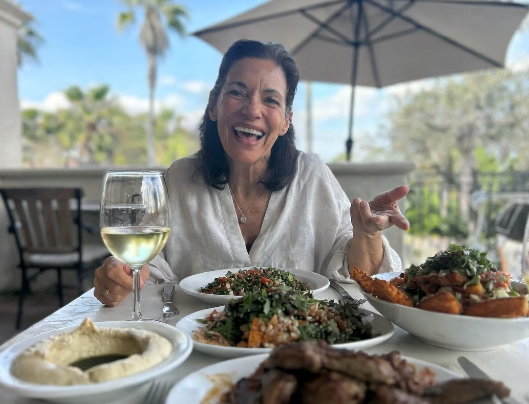
Dimitri came with Maria and the boys. Yia-yia Despina came, moving slowly but arriving with opinions intact. She sat at the head of the table — Baba's chair, which she claimed with the quiet authority of a matriarch who has outlived her son-in-law and earned the right to sit wherever she wants. Nobody argued. You do not argue with Despina. You feed her and you listen.
Alexander carved the turkey because he is sixteen and someone decided it was time for the next generation to hold the knife, and he approached the task with the engineering precision of a boy who has watched YouTube tutorials and made a plan. The turkey was good. The pastitsio was extraordinary. The spanakopita was perfect. The moussaka was Mama's and therefore beyond criticism. The baklava was the exclamation point on a sentence written in olive oil and butter.
After dinner, while the dishes were being argued over, I sat on the back porch with Despina. She was eighty-eight and wrapped in a sweater and drinking Greek coffee from a small cup. She said, in Greek, your Baba would be proud of this table. I said I hope so, Yia-yia. She said he would complain about something. I said of course he would. She said that was his way of saying he loved it. I said I know. She took my hand — her hand small and dry and strong, the hand that wrote the recipe notebook, the hand that turned the lamb for sixty years — and she held it and we sat together and watched the sun go down on Thanksgiving, full of food and grief and gratitude and the stubborn conviction that the table is the only thing that matters.
Yia-yia Despina’s hand holding mine on that back porch reminded me that the table doesn’t have to be a production — it just has to be full of love and something worth eating. Not every night can be pastitsio and moussaka and baklava, but every night can still be something that feels like it came from someone who cared. This orzo recipe is the weeknight version of that feeling: simple, warm, and deeply satisfying in the way that only good olive oil and a little patience can produce. It’s the dish I make when I want the spirit of Mama’s kitchen without the six-hour commitment, and Despina, I think, would find it acceptable — which in our family is the highest possible praise.
Orzo Recipe
Prep Time: 5 minutes | Cook Time: 20 minutes | Total Time: 25 minutes | Servings: 4
Ingredients
- 1 1/2 cups orzo pasta
- 2 tablespoons olive oil, divided
- 3 cloves garlic, minced
- 2 1/2 cups chicken or vegetable broth
- 1/2 cup dry white wine (or additional broth)
- 1/2 teaspoon dried oregano
- 1/4 teaspoon crushed red pepper flakes (optional)
- 1/2 cup cherry tomatoes, halved
- 1/4 cup fresh parsley, roughly chopped
- 1/3 cup crumbled feta cheese
- Salt and black pepper to taste
- Juice of half a lemon
Instructions
- Toast the orzo. Heat 1 tablespoon of olive oil in a medium saucepan or deep skillet over medium heat. Add the orzo and stir frequently for 2–3 minutes until it turns lightly golden and smells nutty. Keep a close eye — it turns quickly.
- Build the base. Add the remaining tablespoon of olive oil and the minced garlic to the pan. Stir and cook for about 30 seconds until fragrant.
- Add the liquid. Pour in the broth and white wine. Add the dried oregano, red pepper flakes if using, and a generous pinch of salt and pepper. Stir to combine and bring to a gentle boil.
- Simmer. Reduce heat to medium-low, cover loosely, and cook for 12–14 minutes, stirring occasionally, until the orzo is tender and has absorbed most of the liquid. If it looks dry before it’s cooked through, add a splash of warm water or broth.
- Finish the dish. Remove from heat. Stir in the cherry tomatoes, fresh parsley, and lemon juice. Taste and adjust salt and pepper as needed.
- Serve. Spoon into a serving bowl or individual plates and top with crumbled feta. Serve warm, with extra lemon on the side if desired.
Nutrition (per serving)
Calories: 320 | Protein: 11g | Fat: 10g | Carbs: 45g | Fiber: 2g | Sodium: 480mg