
 By
By I took the leave of absence. The insurance company approved it — compassionate leave, the paperwork said, which is a corporate way of describing a daughter whose mother is dying and who needs to be in a kitchen in Grinnell instead of at a desk in Des Moines. Kevin said, "Go. We're fine. Take care of your mom." The same sentence he said in March when COVID started. The same gift: go where you need to be. I'll hold this house. The man holds the house. The woman goes to the mother. The story is as old as kitchens.
I moved into the Grinnell house — my old bedroom, the one with the window that faces the fields, the former Weber four hundred acres now corporate soybeans that I can see from the bed where I slept as a girl. The room is smaller than I remember. Everything in this house is smaller than I remember. Or I'm bigger. Or grief makes the walls close in.
Marlene's chemo is working, in the limited way that chemo works against pancreatic cancer — not curing, not reversing, but slowing, buying time, purchasing weeks the way you purchase supplies, one transaction at a time, each purchase smaller than the last. She's tired. She's thinner. She naps in the afternoon, which is new — Marlene Weber has never napped, has viewed napping as a moral failing, and the napping is the concession, the white flag that the body raises when the will can't carry it alone anymore.
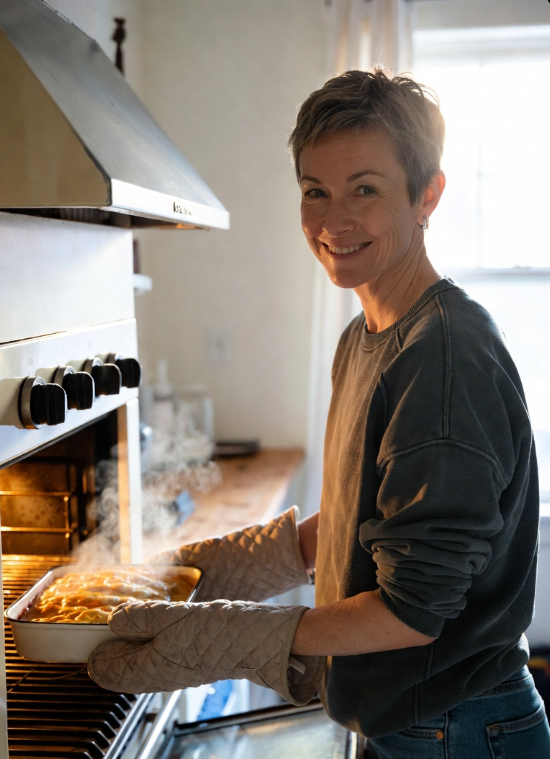
I cook. I cook Marlene's recipes in Marlene's kitchen while Marlene sits at the table and watches. The reversal — the daughter at the stove, the mother at the table — is the thing that undoes me every morning when I first see it. She should be at the stove. I should be at the table. But the cancer rearranged the furniture of our lives and here we are, reversed, and the stove is the same and the recipes are the same and the only difference is who's standing and who's sitting.
She still directs. "More salt." "The rolls need ten more minutes." "Your pie crust is thick on the edges." She can critique my pie crust from six feet away with the x-ray precision of a thousand pies. I adjust. She's right. She's always right. About pie crust and everything else.
Marlene’s rolls were always the thing I associated most with her kitchen—the smell of them, the particular way she’d pull them apart and hand one to me still warm, without a word, the way she expressed everything she couldn’t say out loud. When she told me from her chair that my rolls needed ten more minutes, I nearly cried into the dough, because she was still here and still right. This Orange Dream Pull-Apart Bread is the recipe I’ve been making her every third morning since I moved back into that small bedroom facing the fields—the citrus brightens her appetite on the hard days, and the pulling-apart at the table is something we still do together, even if one of us is sitting down now.
Orange Dream Pull-Apart Bread
Prep Time: 25 min | Cook Time: 35 min | Total Time: 1 hr (plus 1 hr rise) | Servings: 10
Ingredients
- 3/4 cup whole milk, warmed to 110°F
- 2 1/4 teaspoons active dry yeast (1 packet)
- 1/4 cup granulated sugar, divided
- 3 cups all-purpose flour, plus more for dusting
- 1/2 teaspoon salt
- 2 large eggs, room temperature
- 4 tablespoons unsalted butter, melted, plus more for the pan
- 1 tablespoon fresh orange zest (from about 2 oranges)
- For the filling:
- 4 tablespoons unsalted butter, softened
- 1/3 cup granulated sugar
- 2 tablespoons fresh orange zest
- For the glaze:
- 1 cup powdered sugar, sifted
- 2–3 tablespoons fresh orange juice
- 1/2 teaspoon vanilla extract
Instructions
- Activate the yeast. Combine warm milk, yeast, and 1 tablespoon of the granulated sugar in a large bowl or the bowl of a stand mixer. Stir gently and let sit 5–10 minutes until foamy.
- Make the dough. Add the remaining sugar, flour, salt, eggs, melted butter, and orange zest to the yeast mixture. Mix with a dough hook on medium speed (or by hand) for 6–8 minutes until the dough is smooth, soft, and pulls away from the bowl. It will be slightly tacky.
- First rise. Shape the dough into a ball and place in a lightly oiled bowl. Cover with a clean towel or plastic wrap and let rise in a warm spot for 1 hour, or until doubled in size.
- Make the filling. Stir together the softened butter, sugar, and orange zest in a small bowl until combined into a spreadable paste. Set aside.
- Shape the bread. Butter a 9x5-inch loaf pan. Turn the dough out onto a lightly floured surface and roll into a roughly 12x18-inch rectangle. Spread the orange filling evenly over the surface. Cut the dough into 6 equal strips lengthwise, then stack the strips on top of each other. Cut the stacked strips into 6 equal square pieces. Stack the pieces cut-side up in the prepared loaf pan.
- Second rise. Cover loosely and let the shaped loaf rise 30–40 minutes, until puffed and just crowning above the rim of the pan. Preheat the oven to 350°F during this time.
- Bake. Bake 30–35 minutes, until the top is deep golden brown and the center registers 190°F on an instant-read thermometer. If the top browns too quickly, tent loosely with foil after 20 minutes. Let cool in the pan for 10 minutes.
- Glaze and serve. Whisk together powdered sugar, orange juice, and vanilla until smooth and pourable. Turn the bread out onto a wire rack set over a sheet pan, then drizzle the glaze over the top. Pull apart and serve warm.
Nutrition (per serving)
Calories: 310 | Protein: 6g | Fat: 10g | Carbs: 50g | Fiber: 1g | Sodium: 140mg