
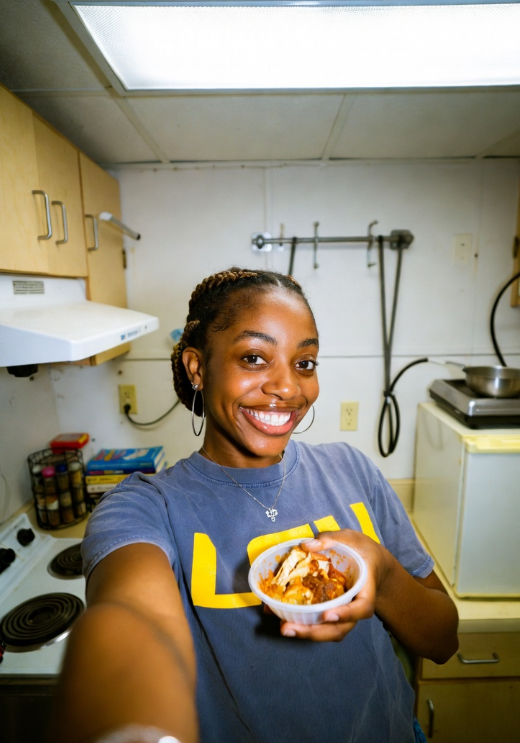
 By
By It is Wednesday night, 10:47 PM, and I have been staring at nucleophilic substitution reactions for six hours. I have consumed two cups of coffee, one granola bar that I found in my backpack from a week ago, and exactly zero vegetables. My study guide has three different colors of highlighter on it, which felt productive when I started and now just looks like a ransom note. Organic chemistry is not trying to see me succeed. I know this. I accept this. I am still not going to fail.
But I am also not going to eat another granola bar.
This is the thing about exam week — and orgo exam week specifically, which is its own category of psychological event — is that you stop eating like a person. You eat like someone who is managing a resource rather than feeding themselves. A granola bar here. A bag of chips there. Maybe a dining hall run if you can justify the twenty-minute round trip, which you usually can’t. I watched my roommate Destiny eat a sleeve of crackers for dinner on Monday and call it a “grazing situation.” I watched our third roommate, Bri, who is also pre-med and also suffering, declare that she wasn’t hungry and then eat half a bag of gummy worms at midnight.
This is not how MawMaw Shirley raised me to live.
MawMaw Shirley, who is seventy-nine and has never once in her life eaten a granola bar as a meal, who made a full pot of red beans the week we were living in a FEMA trailer after the flood because she said the body needs feeding especially when the soul is tired — she would look at my granola-bar dinner and shake her head slow. Not with judgment. With grief. The grief of a woman who has cooked for people her whole life watching someone she loves make bad choices on an empty stomach.
So at 10:47 PM I closed my orgo notes, stood up from my desk, and went to the kitchen to cook something real.
The constraint, as always, was the kitchen itself. I have two burners and a cutting board that has to be balanced on the counter edge because the toaster takes up the other end. I had about forty-five minutes before my brain fully shut down for the night. I had: a box of pasta, a can of diced tomatoes, some chicken broth I keep in a carton in the back of the cabinet, garlic (always garlic, this is non-negotiable), half an onion in a zip-lock bag in the fridge, some Italian seasoning, and a sad little nub of parmesan that I’d been rationing like it was precious, which it was.
One pot pasta.
I know, I know — last week was jambalaya, also one pot. I promise I own more than one pot. I own two. But the one-pot strategy isn’t laziness. It’s philosophy. My mama cooked dinner for five people while working from home and managing three kids with different schedules and she did it efficiently because efficiency is a form of love. You don’t have time to dirty four pots? Then you don’t dirty four pots. You figure out how to make something real and satisfying in the vessel you have, and you do it without apology, and it tastes just as good. Maybe better, because you made it in the margin of your actual life.
The concept is simple enough that it almost feels like cheating, but it’s not cheating, it’s smart: you cook the pasta directly in the broth and aromatics instead of boiling it separately in plain water. The pasta releases its starch as it cooks and the whole thing thickens into this silky, cohesive situation where the noodles taste like the sauce because they were born in it. It’s not magic. It’s chemistry. Which, ironically, is the subject I am currently failing to understand, but at least I understand this.
I texted MawMaw Shirley while the onions were softening. Not a question. Just: making one pot pasta, exam Friday, pray for me. She texted back four minutes later: You’ll do fine. Add more garlic. I had already added more garlic. She knows me.
Destiny materialized from her room around the time the broth was simmering. This is a pattern I’ve noticed: she can smell when something real is happening in the kitchen, and she appears without being summoned, like a very specific kind of ghost. She stood in the doorway — again, generous, calling it a doorway, it is a gap between the wall and the counter — and she said, “Is that… garlic?” like she was identifying a bird she’d only seen in photographs.
“Garlic and tomatoes and pasta,” I said. “It’ll be ready in fifteen minutes.”
“I thought you had orgo.”
“I do.”
“And you’re cooking?”
“I’m feeding myself, Destiny.”
She got out three bowls without being asked. Bri appeared six minutes later, also without being asked. By the time I plated it — pasta into bowls, little shower of parmesan, some red pepper flakes for the people who want heat, which is me and not Bri, who considers black pepper spicy — all three of us were standing in that tiny kitchen and it felt less like an apartment and more like a place where people lived.
It cost me somewhere around six dollars, maybe a little less. The pasta was $1.19. The can of tomatoes was $0.89. The broth, portioned from the carton, was maybe $0.75. The garlic, the onion, the seasonings — these live in my kitchen as permanent residents; I don’t count them anymore because they’re just the infrastructure of cooking. The parmesan was the splurge, and I’m still rationing it, but I shaved enough over three bowls that everyone got some and it mattered.
Six dollars, three people, twenty minutes, and we all ate like humans instead of grad students who’ve lost track of basic needs.
Here’s what I want to say about this, and then I’ll give you the recipe: there is a version of college cooking that is about survival and a version that is about living, and I think you can do both simultaneously with the right approach. The survival part is the budget — yes, six dollars, yes one pot, yes I will always give you the honest time estimate (twenty minutes means twenty minutes, not thirty-five with five of “prep time” that somehow doesn’t count). But the living part is the garlic. The parmesan. The fact that I texted MawMaw Shirley. The fact that Destiny got out three bowls. The fact that we sat on the couch afterward, all three of us with orgo notes and grad school anxieties and whatever else we’re carrying, and for twenty minutes we just ate pasta and didn’t talk about any of it.
MawMaw Shirley would approve. Not of the pasta specifically — she has feelings about Italian food that I respect and do not share, she is seventy-nine and has made gumbo every month for sixty years and she does not need my pasta — but of the act. Of deciding that the body needs feeding especially when the soul is tired. Of making something real in the margin of your actual life.
Orgo exam is Friday. I’m going to be fine. I already added more garlic.
The recipe I kept coming back to that week wasn’t anything fancy — it was the one that let me feel like I was doing something real without asking me for more than I had left. One pot, one pan, twenty minutes, and enough garlic to make MawMaw Shirley at least curious. Here’s exactly how I made it.
One Pot Pasta — The $6 Dinner That Got Me Through Organic Chemistry
Prep Time: 5 minutes | Cook Time: 20 minutes | Total Time: 25 minutes | Servings: 3–4Ingredients
- 12 oz linguine or spaghetti (whatever’s cheapest — store brand is fine)
- 1 can (14.5 oz) diced tomatoes, with the liquid
- 3 1/2 cups chicken broth (or vegetable broth if that’s what you have)
- 1/2 medium onion, thinly sliced
- 4 cloves garlic, minced (MawMaw says more; I agree)
- 1 tsp Italian seasoning
- 1/2 tsp red pepper flakes (optional, but correct)
- 1/2 tsp salt, plus more to taste
- 1/4 tsp black pepper
- 2 tbsp olive oil (or vegetable oil — don’t let anyone make you feel bad about vegetable oil)
- 1/4 cup grated parmesan, for serving (this is not optional; this is the point)
- Fresh basil or parsley if you have it (I didn’t; it’s fine)
Instructions
- Sweat the aromatics. Heat the olive oil in your largest pot over medium heat. Add the sliced onion and cook for about 3–4 minutes, stirring occasionally, until it starts to soften and go translucent. Add the garlic and cook another 60 seconds until it smells like your kitchen is somewhere worth being.
- Add everything to the pot. I mean everything: the dry pasta (uncooked, trust the process), the can of tomatoes with all its liquid, the chicken broth, the Italian seasoning, the red pepper flakes, salt, and pepper. Stir it so the pasta is mostly submerged. It will look wrong. It will be fine.
- Bring it to a boil. Turn the heat up to medium-high. Once it’s boiling, stir it good to make sure nothing is sticking to the bottom. This matters.
- Cook the pasta in the liquid. Reduce to a strong simmer — still bubbling, not a full rolling boil — and cook for 9–11 minutes, stirring every 2 minutes. The pasta will absorb the broth and the starch will thicken the whole thing into a sauce. You want it to look glossy and cohesive, not soupy, not dry. If it looks too dry before the pasta is done, add a splash more broth. If it’s too wet when the pasta is done, cook another minute or two uncovered.
- Taste and adjust. This is non-negotiable. Taste the pasta. Does it need more salt? More pepper? A little more heat? Adjust now. You are the last line of defense between a good dinner and a fine dinner.
- Serve immediately. Divide into bowls. Hit each bowl with a generous amount of parmesan — don’t be stingy, this is not the moment for stinginess — and add red pepper flakes if your roommates can handle it (mine cannot, except me). Eat while it’s hot. This is important. Pasta waits for no one.