
 By
By Negative ten overnight. The car needed a jump. A pediatric burn case Tuesday. I came home and made adobo and did not write a blog post.
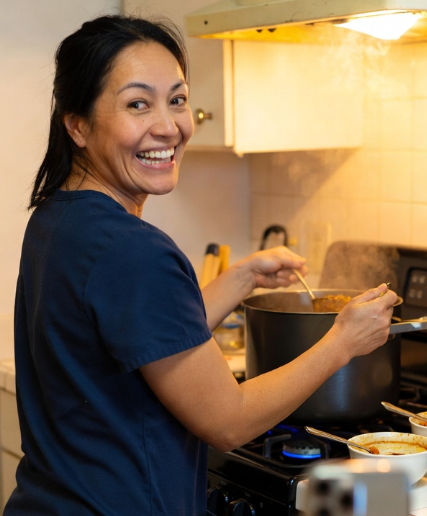
Lourdes is 74. She is in the kitchen. She is luminous.
I made sinigang Sunday. The sour was the right register for the body this week. The tamarind was sharp.
A reader wrote me a long email this week about her grandmother's adobo, which differed from mine in every measurement. The differences were the conversation. I wrote her back. The writing back is the work.
I stood at the counter eating leftovers in my pajamas. The standing was the small luxury. The luxury was the having of leftovers at all.
I took inventory of the freezer Sunday. The freezer had: twelve quarts of broth, eight pounds of adobo in vacuum bags, six pounds of sinigang base, fourteen lumpia trays at fifty rolls each, three pounds of marinated beef for caldereta, and a small bag of pandan leaves Tita Nening had sent me. The inventory was the proof of preparation. The preparation was the proof of love.
Pete and I had a long phone conversation Tuesday. We talked about the family — his and mine. The talking was the keeping.
I made tea late at night. The tea was the small comfort. The comfort was the marker.
The grocery store had no calamansi. I substituted lime. The substitution was acceptable. The acceptable is the working version of perfect.
The neighbors invited us over for a small dinner Thursday. They are an Iñupiaq family — Aana and her grandson Joe. We ate caribou stew and rice. I brought lumpia. The kitchens of Anchorage have always been the small UN. The food is the proof.
I took a walk on the coastal trail Saturday. The light was good. The body was tired but moving.
I taught a Saturday morning Kain Na class on basic adobo proportions for new cooks. Eleven people in the kitchen. Half of them had never cooked Filipino food before. By eleven AM the kitchen smelled the way it should smell. By noon they were all eating. The eating was the lesson landing.
The light was good Saturday morning. I sat on the porch with a cup of coffee and watched the inlet for forty minutes. The watching was the small therapy. The therapy was free.
I cleaned the kitchen Sunday afternoon. I wiped the stove. I scrubbed the sink. I reorganized the spice cabinet. The cleaning was the small reset. The reset was the marker. The marker said: the week is over, the next week begins, the kitchen is ready.
Angela texted me a photo of the kids. I texted back a heart. The exchange took thirty seconds. The thirty seconds was the keeping.
I drove home Tuesday evening and the sun set at three forty-five and the highway was already iced at the bridges and the radio was on a station I did not recognize and I did not change it.
The break room had cake Tuesday. Someone's birthday. We ate the cake. We did not ask whose birthday. The cake was the cake.
A reader from New Jersey wrote in about her grandmother's adobo, which used pineapple. I had never heard of pineapple in adobo. I tried it. It was strange. It was also good. The strange and the good are not opposites.
I sat on the balcony in the cold for ten minutes Sunday night with a cup of broth in my hands. The cold was the cold. The broth was the broth. The body held both.
The salmon in the freezer is from August. Joseph's catch. The bag is labeled in his handwriting — "for Grace." I will use it next week.
Sinigang was Sunday’s meal, and it did what it needed to do — the sour registered exactly where the body needed it. But the recipe I keep returning to on the weeks that look like this one, the weeks with iced bridges and birthday cake nobody claimed and twelve quarts of broth already in the freezer, is something simpler: one pot, one hour, a pound of sausage, something grainy and good to soak it all up. This farro dish has the same logic as a Filipino braise — you put the hard things in together, you let them soften, you eat standing at the counter if you have to. The standing is the small luxury. The pot is ready when you are.
One Pot Farro with Italian Sausage and Tomatoes
Prep Time: 10 minutes | Cook Time: 40 minutes | Total Time: 50 minutes | Servings: 5
Ingredients
- 1 lb Italian sausage (sweet or hot), casings removed
- 1 medium yellow onion, diced
- 4 cloves garlic, minced
- 1 1/2 cups farro, rinsed and drained
- 1 can (14.5 oz) diced tomatoes, with juices
- 1 can (14.5 oz) crushed tomatoes
- 2 1/2 cups low-sodium chicken broth
- 1 tsp dried oregano
- 1/2 tsp crushed red pepper flakes
- 1/2 tsp kosher salt, plus more to taste
- 1/4 tsp black pepper
- 2 cups baby spinach or roughly chopped kale
- 1/2 cup freshly grated Parmesan cheese, for serving
- Fresh basil leaves, for garnish (optional)
Instructions
- Brown the sausage. In a large heavy-bottomed pot or Dutch oven over medium-high heat, cook the sausage, breaking it up with a wooden spoon, until browned and cooked through, about 6–8 minutes. Use a slotted spoon to transfer to a plate, leaving the rendered fat in the pot.
- Soften the aromatics. Reduce heat to medium. Add the onion to the pot and cook, stirring occasionally, until translucent and just beginning to color at the edges, about 5 minutes. Add the garlic and cook 1 minute more, until fragrant.
- Build the base. Return the sausage to the pot. Add the farro, diced tomatoes with their juices, crushed tomatoes, chicken broth, oregano, red pepper flakes, salt, and black pepper. Stir to combine.
- Simmer. Bring the mixture to a boil over medium-high heat, then reduce heat to low. Cover and simmer, stirring once or twice, until the farro is tender and has absorbed most of the liquid, about 28–32 minutes. The finished dish should be thick and saucy, not soupy.
- Finish with greens. Uncover the pot and stir in the spinach or kale. Cook 2–3 minutes, until wilted. Taste and adjust salt and pepper as needed.
- Serve. Ladle into bowls and top each portion with Parmesan and a few fresh basil leaves if using. Serve hot. Leftovers keep well refrigerated for up to 4 days and reheat with a splash of broth.
Nutrition (per serving)
Calories: 445 | Protein: 23g | Fat: 19g | Carbs: 46g | Fiber: 7g | Sodium: 870mg