
 By
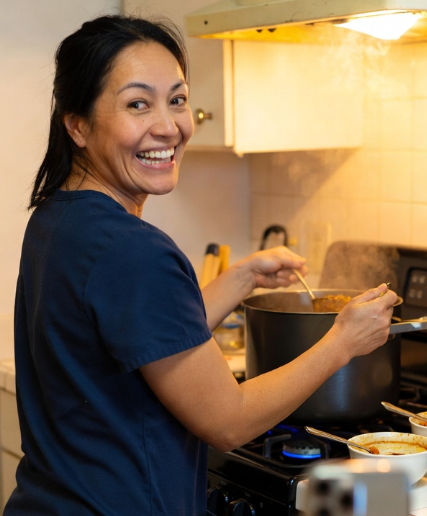
By Halloween approaches and I made kalamay again — the sticky rice cake, the attention-requiring, constantly-stirring, cannot-look-away dessert that I first made two Halloweens ago when the darkness was new and the stirring was therapy. This year the stirring is just stirring. The kalamay is just kalamay. The transformation from "therapy disguised as cooking" to "cooking that happens to be therapeutic" is subtle but real. The cooking is no longer a survival mechanism. The cooking is a life. There's a difference, and the difference is the distance between drowning and swimming — both happen in water, but only one is chosen.
I brought the kalamay to the ER. The night shift devoured it with the grateful intensity of people eating something homemade at 2 AM in a fluorescent break room. Danielle — who is now a solid cook, her adobo significantly improved, her pancit attempts ambitious — brought her own contribution: a Filipino-inspired banana bread made with coconut and macapuno. "I adapted your recipe," she said. My recipe. A white woman from Ohio adapted my Filipino recipe and brought it back to the kitchen where it started, and the circle is beautiful and I didn't plan it and the best things in life are the unplanned circles.
Jason and I went to a pumpkin patch on Saturday — the one in Palmer, forty miles north, where the pumpkins grow enormous in Alaska's twenty-hour summer days, the same phenomenon that produces fifty-pound cabbages and the particular agricultural bragging rights that Alaskans enjoy and everyone else finds suspicious. The pumpkin patch was cold and muddy and the mountains behind it were white with snow and Jason carried a twenty-pound pumpkin to the car with one hand because he's a firefighter and casual strength demonstrations are part of the package.
I didn't carve the pumpkin. I cooked it. Pumpkin ginataang — cubed pumpkin simmered in coconut milk with a little sugar, the Filipino way, the way Lourdes makes it, the pumpkin becoming soft and sweet in the coconut cream. Americans carve pumpkins and throw away the flesh. Filipinos cook the flesh and skip the carving. The cultural difference is: we eat our decorations. Lourdes would say this is practical. I would say it's delicious. Both are true.
The ginataang was warm and sweet and the apartment smelled like coconut and pumpkin and the particular domesticity of a couple who went to a pumpkin patch and cooked the pumpkin instead of carving it. We ate it on the couch. The couch is where we eat things that are too informal for the table and too important for standing. The couch is the middle ground. The ginataang was the middle ground — between dessert and dinner, between American and Filipino, between two people who are learning that the middle ground is where the best meals happen.
The ginataang taught me something I keep re-learning: every culture has a version of “simmer humble ingredients until they become something worth eating on the couch.” Filipinos do it with coconut milk and pumpkin. New Englanders do it with cornmeal and molasses — low heat, long time, the kind of patience that is also a philosophy. After a Halloween week of sticky rice cakes and coconut-simmered pumpkin, I wanted to try the American version of that same idea: something warm, something plain-looking that surprises you, something that rewards the people willing to wait for it.
New England Indian Pudding
Prep Time: 10 minutes | Cook Time: 2 hours | Total Time: 2 hours 10 minutes | Servings: 6
Ingredients
- 4 cups whole milk, divided
- 1/3 cup yellow cornmeal
- 1/3 cup unsulfured molasses
- 1/4 cup granulated sugar
- 2 tablespoons unsalted butter
- 1/2 teaspoon ground ginger
- 1/2 teaspoon ground cinnamon
- 1/4 teaspoon salt
- 2 large eggs, well beaten
- Vanilla ice cream or whipped cream, for serving
Instructions
- Preheat and prep. Preheat your oven to 325°F. Butter a 1.5-quart baking dish and set aside.
- Cook the cornmeal base. In a medium saucepan over medium heat, warm 3 cups of the milk until steaming but not boiling. Whisk in the cornmeal in a slow, steady stream and cook, stirring constantly, until the mixture thickens noticeably, about 5 to 7 minutes.
- Add the flavorings. Remove the pan from heat. Stir in the molasses, sugar, butter, ginger, cinnamon, and salt until the butter melts and everything is combined.
- Temper and add the eggs. Let the mixture cool for 2 minutes, then whisk in the beaten eggs quickly so they don’t scramble. Pour the batter into the prepared baking dish.
- Add the cold milk layer. Slowly pour the remaining 1 cup of cold milk over the top of the batter. Do not stir — this layer creates the pudding’s soft, custardy center as it bakes.
- Bake low and slow. Bake uncovered for 1 hour 45 minutes to 2 hours, until the edges are set and the center is just slightly jiggly. The top will look a little uneven and rustic — that’s correct.
- Rest and serve warm. Let the pudding rest for 10 minutes before spooning into bowls. Serve warm, topped with a scoop of vanilla ice cream or a dollop of whipped cream.
Nutrition (per serving)
Calories: 225 | Protein: 7g | Fat: 8g | Carbs: 32g | Fiber: 1g | Sodium: 175mg