The Edmund Fitzgerald anniversary. November 10. Paul's holy day.
He wore the black tie to school. He lectured. He came home and played the Lightfoot song and read the passage from his favorite book — the one about the final radio transmission: "We are holding our own" — and he sat at the kitchen table and I sat across from him and we observed the silence that Paul gives to the twenty-nine men who died in 1975.
"We are holding our own." That was the last thing the captain said before the ship went down. Paul tells his students this every year and every year his voice catches on the word "own" because Paul hears in those words what he always hears in history: the human in it. A man on a ship in a storm, saying we're okay, and then the ship is gone.
We are holding our own. I thought about that phrase all week. It felt personal in a way it shouldn't. We are holding our own. Paul and I, in this house, in this winter, with his hand and the appointments and the waiting. We are holding our own.
Paul was reflective this week. The Fitzgerald anniversary always makes him reflective, but this year there was an additional layer — something heavier, something that lived underneath the history and the grief for strangers. He read more than usual. He walked more than usual. He stood at the kitchen window looking at the lake for long stretches, and I let him look because sometimes looking at the lake is the closest thing to prayer that a quiet man has.
I made a November meal: venison stew, from a deer Erik shot last weekend. Erik hunts every November — has since he was sixteen — and he shares the meat with the family. The venison is lean and rich and gamey in a way that domesticated meat isn't, and you cook it low and slow with root vegetables and red wine and juniper berries (the Swedish touch, always the Swedish touch) and it's the most November food there is.
Paul ate a bowl and said, "Erik got a good one this year." I said, "He always gets a good one." Erik is the best hunter in the family, which in a family of Scandinavian-Americans from the Iron Range is saying something. Pappa was a hunter. Lars would have been a hunter. The tradition continues through Erik, the brother who stayed.
I sent a text to the Sunday call group — me, Karin, Astrid: "How are we?" Karin in Stockholm: "Cold and dark. Missing you." Astrid in the Cities: "Busy. Tired. Gary has a cold." Me: "Same. Making stew." Three women, three Johansson girls, checking in across distances. The Sunday call will cover the details. The text just says: I'm here. Are you here? We're here.
We are holding our own.
The venison stew carried us through November 10th, but it’s the kind of meal I only make when Erik comes through — when there’s fresh meat and a reason to cook long and slow. For the weeks in between, when Paul is reading by the window and the lake is doing what the lake does in November, I turn to something earthier and quieter: a mushroom pasta that has the same low-and-slow patience, the same depth, the same ability to fill a kitchen with something that smells like staying. It isn’t venison, but it asks the same thing of you — time, attention, and a willingness to let the flavors find each other without rushing.
Mushroom Pasta
Prep Time: 15 minutes | Cook Time: 30 minutes | Total Time: 45 minutes | Servings: 4
Ingredients
- 12 oz pasta (pappardelle, tagliatelle, or rigatoni)
- 1 lb mixed mushrooms (cremini, shiitake, and/or baby bella), sliced
- 3 tablespoons olive oil, divided
- 2 tablespoons unsalted butter
- 4 cloves garlic, minced
- 1 medium shallot, finely diced
- 1/2 cup dry red wine (such as Pinot Noir or Cabernet)
- 3/4 cup heavy cream
- 1/2 cup pasta cooking water, reserved
- 1 teaspoon fresh thyme leaves (or 1/2 teaspoon dried)
- 1 teaspoon fresh rosemary, finely chopped
- 1/2 teaspoon kosher salt, plus more to taste
- 1/4 teaspoon black pepper
- 1/2 cup freshly grated Parmesan cheese, plus more for serving
- 2 tablespoons fresh flat-leaf parsley, chopped
Instructions
- Salt the water. Bring a large pot of generously salted water to a boil. Cook pasta according to package directions until al dente. Before draining, reserve 1/2 cup of the starchy pasta water. Drain and set aside.
- Sear the mushrooms. Heat 2 tablespoons of olive oil in a large, heavy skillet (cast iron works beautifully) over medium-high heat. Add mushrooms in a single layer — do not crowd the pan. Let them sit undisturbed for 3–4 minutes until golden brown on one side, then stir and cook another 2–3 minutes. Season with salt and pepper. Transfer to a plate and set aside.
- Build the base. Reduce heat to medium. Add the remaining 1 tablespoon olive oil and the butter to the same skillet. Add the shallot and cook, stirring occasionally, for 2–3 minutes until softened. Add the garlic, thyme, and rosemary and cook 1 minute more, until fragrant.
- Deglaze with wine. Pour in the red wine and scrape up any browned bits from the bottom of the pan. Let it simmer for 3–4 minutes until the wine reduces by about half and the sharp alcohol smell mellows.
- Add the cream. Pour in the heavy cream and stir to combine. Bring to a gentle simmer and cook for 3–4 minutes, until the sauce thickens slightly and coats the back of a spoon.
- Reunite and finish. Return the seared mushrooms to the pan. Add the drained pasta and toss to coat, adding pasta water a splash at a time to loosen the sauce to your liking. Remove from heat and stir in the Parmesan until melted and silky.
- Taste and serve. Adjust salt and pepper. Divide among bowls, scatter with fresh parsley, and finish with extra Parmesan. Serve immediately.
Nutrition (per serving)
Calories: 580 | Protein: 18g | Fat: 26g | Carbs: 68g | Fiber: 4g | Sodium: 410mg
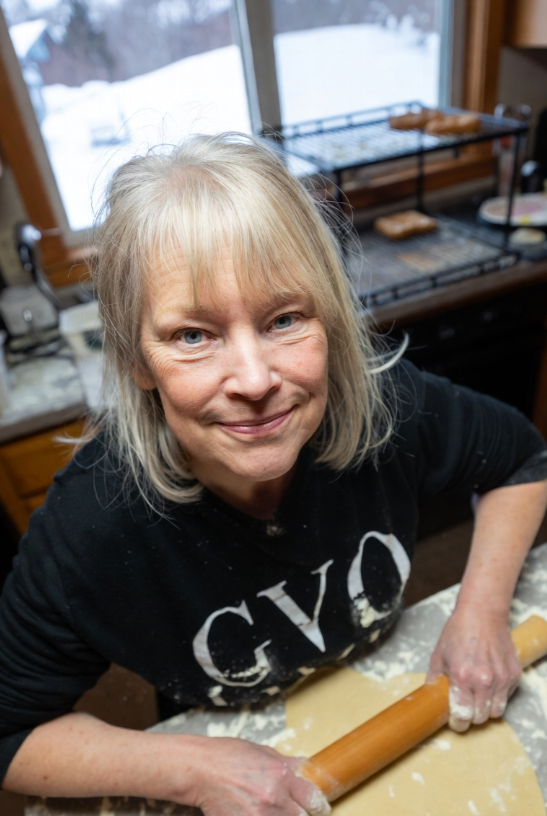
About the cook who shared this
Linda Johansson
Week 85 of Linda’s 30-year story
· Duluth, Minnesota
Linda is a sixty-three-year-old retired nurse from Duluth, Minnesota, living alone in the house where she raised her children and said goodbye to her husband. She lost Paul to ALS in 2020 after two years of watching the kindest man she'd ever known lose everything but his dignity. She cooks Scandinavian comfort food and Minnesota hotdish and the pot roast Paul loved, and she sets two places at the table out of habit because it makes her feel less alone. Every recipe she writes is a person she's loved.
