I made meatballs. Mamma's recipe. I will always make Mamma's recipe. The recipe is Mamma now. I am the recipe carrier. The carrier becomes the recipe. The recipe becomes the carrier. There is no daylight between them anymore.
Karin came from Stockholm for the funeral. She slept in the basement. She drank coffee at Mamma's table (Mamma's table is now in my dining room — Erik moved it over when we cleaned out the Fifth Street house; the Kenwood dining room now has both my dining table and Mamma's, pushed together to make a single longer table). Karin said: "It is so strange that the kitchen still smells like her." I said: "I have been baking her bread." Karin understood.
Erik called Sunday. He said he was thinking about Lars. He said he had not thought about Lars in a long time, not really thought about him, not the actual Lars, the twenty-year-old in 1979. Mamma's death has unlocked the older grief. Both of them at once. We sat on the phone for forty minutes mostly silent. Erik said: "It is too quiet over here, Linda." I said: "It is too quiet over here, too." We hung up. We were both alone in our too-quiet houses. The aloneness was, somehow, shared.
I cooked Wild rice soup this week. The Thursday constant.
I made the soup. Fifty gallons. I served the soup. A hundred and twelve plates. I came home tired. I came home good-tired. The Thursday tired. The right tired. I sat on the couch with Sven and a glass of wine and I did not move for two hours. The body wants this kind of tired. The body has wanted this kind of tired for thirty years.
I thought about Lars this week. He has been gone since 1979. The grief is old, but it is not gone. The dead do not leave. They just become quieter. Lars at twenty was funny in a particular sideways way that nobody else in the family was funny. He could make Pappa laugh, which nobody could make Pappa do. He has been gone forty-five years. I still hear his laugh sometimes, when Erik is laughing in a particular way, or when Peter accidentally tilts his head the way Lars used to.
It is enough. It has to be. And on a morning like this, with the lake doing what the lake does and the dog at my feet and the bread on the counter and the kitchen warm enough to live in, it is.
Mamma used to say: "En människa är vad hon ger." A person is what she gives. She said this in Swedish so often that the phrase still sounds in my head in her voice. I think about it daily. I think about what I have given, and what I have not given, and what is still to give. The accounting is mostly favorable. The accounting is, in some ways, the only accounting that matters.
The Kenwood neighborhood has aged with me. The Bergmans next door (who were a young couple with three kids when Paul and I moved in) are now grandparents themselves; the Larsons across the street have moved to a smaller place; the Andersons three doors down passed away in 2017 and 2019 respectively. The block has filled in with younger families that I am too tired to fully meet. I wave from the porch. They wave back. The wave is the relationship.
It is enough.
When Karin said the kitchen still smelled like Mamma, I knew exactly what she meant — because I had been making sure of it. Baking bread is the simplest way I know to bring her back into a room. This Muenster Bread is not her exact recipe, but it is close enough in warmth, in weight, in the way it fills the house, that it does the work I need it to do. On a week when the grief was compounded and the house was too quiet, it was enough to have something rising on the counter.
Muenster Bread
Prep Time: 25 min | Cook Time: 40 min | Total Time: 1 hr 5 min (plus 1 hr 30 min rise) | Servings: 12
Ingredients
- 1 package (1/4 oz) active dry yeast
- 1 cup warm water (110°F to 115°F)
- 1 teaspoon sugar
- 1 teaspoon salt
- 2 tablespoons butter, softened
- 1 egg, beaten
- 3 cups all-purpose flour, divided
- 2 cups shredded Muenster cheese, divided
- 1 tablespoon sesame seeds (optional)
Instructions
- Activate the yeast. In a large bowl, dissolve the yeast in warm water with the sugar. Let stand for 5 to 10 minutes until foamy and fragrant.
- Build the dough. Stir in the salt, softened butter, and beaten egg. Add 2 cups of flour and mix until a soft dough forms. Gradually incorporate the remaining 1 cup of flour until the dough pulls away from the sides of the bowl.
- Knead. Turn dough out onto a lightly floured surface and knead for 6 to 8 minutes, until smooth and elastic. The dough should feel supple but not sticky.
- First rise. Place dough in a greased bowl, turning once to coat the top. Cover with a clean towel and let rise in a warm place for about 1 hour, or until doubled in size.
- Shape and fill. Punch down the dough. On a lightly floured surface, roll it into a 16x10-inch rectangle. Scatter 1 1/2 cups of shredded Muenster cheese evenly over the surface, leaving a 1/2-inch border. Roll up tightly from the long edge, pinching the seam and ends to seal. Place seam-side down in a greased 9x5-inch loaf pan.
- Second rise. Cover and let rise again for about 30 minutes, until the loaf crests the top of the pan.
- Top and bake. Preheat oven to 375°F. Sprinkle the remaining 1/2 cup of Muenster cheese over the top of the loaf. Add sesame seeds if using. Bake for 35 to 40 minutes, until the top is deep golden and the loaf sounds hollow when tapped. If the cheese browns too quickly, tent loosely with foil for the last 10 minutes.
- Cool. Remove from the pan and let cool on a wire rack for at least 15 minutes before slicing. Best served warm.
Nutrition (per serving)
Calories: 218 | Protein: 9g | Fat: 8g | Carbs: 28g | Fiber: 1g | Sodium: 290mg
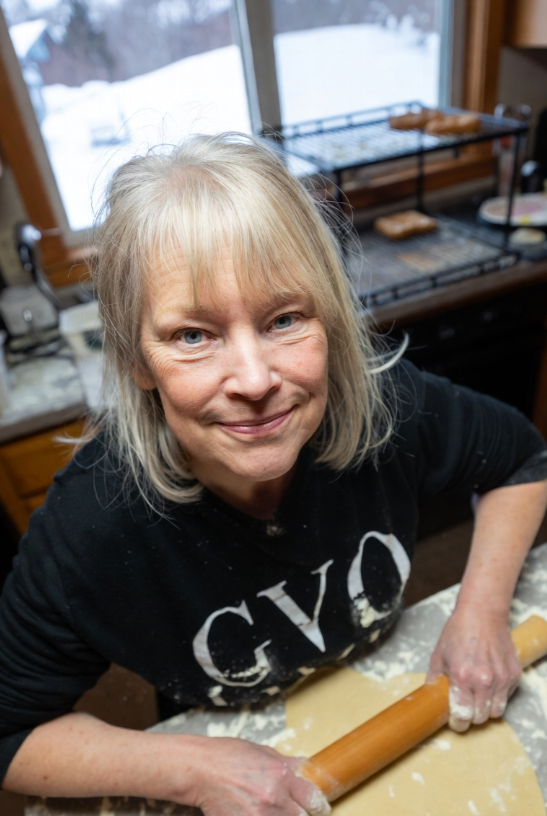
About the cook who shared this
Linda Johansson
Week 448 of Linda’s 30-year story
· Duluth, Minnesota
Linda is a sixty-three-year-old retired nurse from Duluth, Minnesota, living alone in the house where she raised her children and said goodbye to her husband. She lost Paul to ALS in 2020 after two years of watching the kindest man she'd ever known lose everything but his dignity. She cooks Scandinavian comfort food and Minnesota hotdish and the pot roast Paul loved, and she sets two places at the table out of habit because it makes her feel less alone. Every recipe she writes is a person she's loved.
