May. The PEG tube is scheduled for May 15. Two weeks. The countdown is gentler than the neurology countdown was — this isn't a diagnosis, it's a procedure, a practical step, a tool. Like the wheelchair. Like the cane. Like the reading stand. Another tool.
I'm preparing. I've read the manuals. I've talked to the nutritionist at the clinic. I know how to operate the feeding pump, how to clean the site, how to prepare the formula. The nurse in me has the technical knowledge. The cook in me is — grieving, quietly, for the meals that will no longer be meals in the traditional sense. The soups and the purees and the thickened liquids that have been our compromise between food and function will eventually give way to formula through a tube, and the formula will be nutrition without taste, calories without kitchen, feeding without cooking.
But not yet. Paul is still eating by mouth. The swallowing is slower, riskier — the speech therapist has put him on a thickened liquid diet to prevent aspiration — but he's eating. Every spoonful I hold to his lips is a victory, and I will take every victory available until the victories change.
Mamma's birthday was Thursday. Eighty-nine. I drove to Fifth Street with sockerkaka and sat at her kitchen table and she said, "Another year, Linda." The same words. Paul's words. Everyone's words. Another year. She's eighty-nine. She has outlived her husband, her son, and now she's watching her son-in-law disappear, and she's still baking and still sharp and still saying "another year" as if another year is simply what happens when you refuse to do anything else.
She asked about the feeding tube. I told her. She was quiet. Then she said, "My mother fed my father broth through a straw when he was dying. Before tubes. Before hospitals. Just broth and a straw and the kitchen." Her mother. My Mormor. Feeding Morfar. In Sweden. A hundred years ago. The same act. Different century. Different technology. Same love.
I made Mamma's birthday dinner at her house: köttbullar. Her recipe, made in her kitchen, on her stove. I stood at her counter and mixed the beef and pork and cream-soaked bread and allspice, and my hands were in the same bowl her hands are in every time she makes them, and the meatballs came out the same size and the same shape because the bowl knows the recipe even if I don't know the secret.
Mamma tasted one and said, "Closer." Not "good." Not "almost." "Closer." A new word. A promotion. I'll take it.
Two weeks until the tube. Fourteen days of eating by mouth. Fourteen days of spoons and cups and purees and the taste of food on the tongue of the man I love.
Fourteen days. I'm counting. I said I wouldn't count. I'm counting.
I made these in Mamma’s kitchen on her birthday, in her bowl, on her stove — and she said “closer,” which is the highest praise she has given me in thirty years of trying. The mozzarella center is my own addition, a small thing that makes the meatball feel like it holds something warm at its core, which felt right for a Thursday in May when I needed to feel like I was giving something rather than only watching something be taken. If you have a Mamma whose recipe you are still learning, make these. Make them until she says “closer.”
Mozzarella-Stuffed Meatballs
Prep Time: 25 min | Cook Time: 25 min | Total Time: 50 min | Servings: 6 (about 18 meatballs)
Ingredients
- 1 lb ground beef (80/20 blend)
- 1/2 lb ground pork
- 2 slices white bread, crusts removed, torn into pieces
- 1/4 cup heavy cream
- 1 large egg
- 1 small yellow onion, finely grated
- 2 cloves garlic, minced
- 1/2 tsp ground allspice
- 1/4 tsp ground nutmeg
- 1 tsp kosher salt
- 1/2 tsp freshly ground black pepper
- 1/4 cup finely chopped flat-leaf parsley
- 4 oz fresh whole-milk mozzarella, cut into 18 small cubes (about 1/2-inch each)
- 2 tbsp olive oil
- 1 tbsp unsalted butter
- 1 1/2 cups marinara sauce, warmed, for serving
- Fresh parsley or grated Parmesan, for garnish (optional)
Instructions
- Soak the bread. Place the torn bread pieces in a small bowl and pour the heavy cream over them. Let soak for 5 minutes, then use your fingers to mash into a smooth paste. This is the panade — it keeps the meatballs tender.
- Mix the meat. In a large bowl, combine the ground beef, ground pork, soaked bread paste, egg, grated onion, garlic, allspice, nutmeg, salt, pepper, and parsley. Mix gently with your hands just until combined — overworking makes the meatballs tough. The bowl should do most of the remembering.
- Portion and stuff. Scoop out roughly 2 tablespoons of meat mixture and flatten it in your palm. Place one mozzarella cube in the center, then wrap the meat around it and roll into a smooth ball, sealing the cheese inside completely. Repeat with remaining mixture to form about 18 meatballs.
- Sear the meatballs. Heat the olive oil and butter together in a large oven-safe skillet over medium-high heat. Working in batches if needed, add the meatballs and sear without moving for 2–3 minutes per side, turning to brown all surfaces. Do not crowd the pan. Remove seared meatballs to a plate.
- Finish in the oven. Preheat oven to 400°F. Return all meatballs to the skillet, transfer to the oven, and bake for 10–12 minutes, until cooked through (internal temperature 165°F) and the mozzarella center is fully melted.
- Serve. Spoon warm marinara onto a serving platter, nestle the meatballs on top, and garnish with fresh parsley or Parmesan if desired. Serve immediately while the cheese center is still molten.
Nutrition (per serving)
Calories: 390 | Protein: 28g | Fat: 27g | Carbs: 9g | Fiber: 1g | Sodium: 620mg
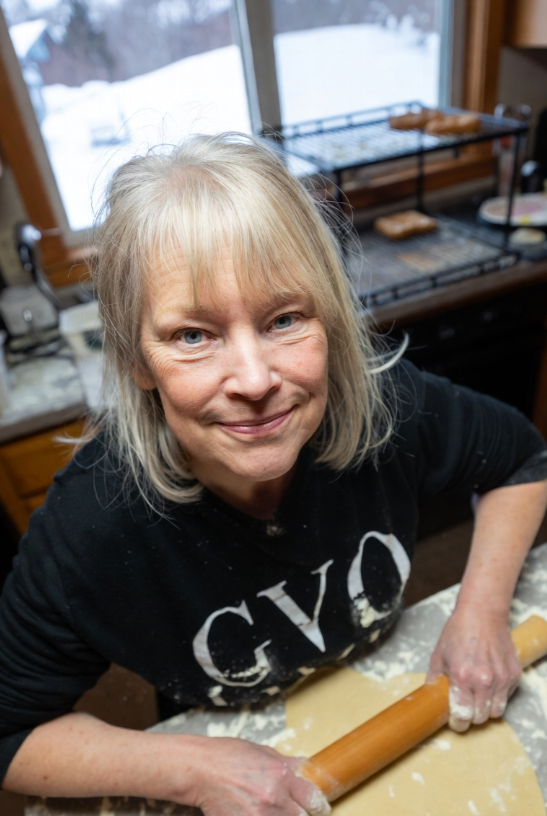
About the cook who shared this
Linda Johansson
Week 161 of Linda’s 30-year story
· Duluth, Minnesota
Linda is a sixty-three-year-old retired nurse from Duluth, Minnesota, living alone in the house where she raised her children and said goodbye to her husband. She lost Paul to ALS in 2020 after two years of watching the kindest man she'd ever known lose everything but his dignity. She cooks Scandinavian comfort food and Minnesota hotdish and the pot roast Paul loved, and she sets two places at the table out of habit because it makes her feel less alone. Every recipe she writes is a person she's loved.
