I told Mom.
Sunday morning, 9 AM, phone call. I sat on the couch in my apartment with a cup of ginger tea (Jen's recommendation for the nausea, which is relentless) and dialed Norfolk.
'Hi, baby. How are you?'
'Mom. I'm pregnant.'
Silence. A long, full silence that contained, I think, every emotion a mother can feel when her twenty-year-old daughter — her baby, her youngest, her military-wife daughter who lives four hours away and whose husband is about to deploy — says those two words.
Then: the sound of Donna Abernathy crying. Not the quiet crying she does after the girls are asleep. The real kind. The loud kind. The kind that comes from a place so deep it doesn't have a name.
'Mom?'
'I'm here. I'm — oh, Rachel. A BABY.'
'A baby.'
'When?'
'November. Late November.'
'Ryan knows?'
'He knows. He's — he's deploying in June, Mom. He'll be in Okinawa.'
Another silence. This one heavier. Because Donna knows what that means. Donna knows what it means to be pregnant and alone because your husband is deployed. Donna did it. Donna was pregnant with ME while Dad was in Afghanistan. She knows the weight of it — the carrying, not just the baby, but everything else. The doctor's appointments alone. The milestones alone. The fear alone.
'I'm coming,' she said. 'When he deploys. I'm coming to stay with you.'
'Mom, you don't have to —'
'I'm COMING, Rachel.'
She's coming. Donna Abernathy is coming to Jacksonville, North Carolina, to do what she's always done: hold the family together when someone leaves.
Dad got on the phone. I heard him say, 'A baby?' in a voice I've never heard — soft, wondering, the voice of a man who survived wars and now gets to be a grandfather. 'A baby, Rachel?'
'A baby, Dad.'
'I'm going to need a bigger garden.'
MOM. MOM, WHAT IS HE TALKING ABOUT.
'He's already planning to grow food for the baby,' Mom said, getting back on the line. 'Your father is growing vegetables for an infant who doesn't have teeth.'
The nausea is constant. The ginger tea helps a little. The saltine crackers help more. Mom called back an hour later with a list of things to eat: bland foods, small portions, ginger, lemon water, and — this is pure Donna — her chicken broth recipe, which she says is 'the only thing that got me through the first trimester with you.'
Chicken broth. Slow-simmered. Clear, golden, warm. The thing that heals everything.
I made it tonight. Just the broth, nothing in it. I sipped it on the couch and thought about my mother, twenty-three years ago, pregnant with me, sipping the same broth, in a different apartment, on a different base, waiting for a different man to come home.
The cycle continues. The broth is the same.
So here it is — Mom’s chicken broth, the one she called back an hour later to dictate to me like it was a matter of national security. Donna’s instructions were precise and very her: low and slow, no shortcuts, skim the foam “or it’ll be cloudy and I’ll know.” I stood in my tiny Jacksonville kitchen with my phone propped against the backsplash and wrote it all down, and when I sipped that first bowl tonight, I understood why she said it was the only thing that got her through. It’s not just broth. It’s twenty-three years of mothers holding on.
Mom’s Slow-Simmered Chicken Broth
Prep Time: 15 minutes | Cook Time: 3 hours | Total Time: 3 hours 15 minutes | Servings: 8
Ingredients
- 3 to 4 pounds bone-in, skin-on chicken pieces (backs, wings, and thighs work best)
- 12 cups cold water
- 2 medium yellow onions, quartered (skin on for color)
- 3 large carrots, scrubbed and cut into large chunks
- 3 celery stalks with leaves, cut into large chunks
- 1 head of garlic, halved crosswise
- 6 whole black peppercorns
- 3 bay leaves
- 4 to 5 sprigs fresh thyme (or 1/2 teaspoon dried)
- 4 to 5 sprigs fresh parsley
- 1 tablespoon apple cider vinegar
- Salt to taste
Instructions
- Start cold. Place the chicken pieces in a large stockpot and cover with 12 cups of cold water. Starting with cold water draws more flavor and gelatin from the bones. Add the apple cider vinegar and let it sit for 10 minutes before turning on the heat.
- Bring up slowly. Set the pot over medium heat and bring to a bare simmer. Do not let it reach a full boil — boiling makes the broth cloudy. This will take about 20 to 25 minutes.
- Skim the foam. As the broth heats, grayish foam will rise to the surface. Use a ladle or large spoon to skim it off and discard it. Mom is very serious about this step.
- Add the vegetables and aromatics. Once skimmed, add the onions, carrots, celery, garlic, peppercorns, bay leaves, thyme, and parsley. Stir gently once.
- Simmer low and slow. Reduce heat to the lowest setting that maintains a gentle simmer — you want lazy, occasional bubbles, not a rolling boil. Cover the pot with the lid slightly ajar. Let it simmer for 2 and 1/2 to 3 hours.
- Strain. Set a fine-mesh strainer over a large bowl or clean pot. Carefully pour or ladle the broth through the strainer, discarding the solids. For extra clarity, line the strainer with cheesecloth.
- Season. Add salt to taste, starting with 1 teaspoon and adjusting from there. The broth should taste clean, golden, and warm.
- Store or sip. Let cool slightly. Sip it straight from a mug, or let it cool completely and refrigerate for up to 5 days. The broth will set into a soft gel in the fridge — that’s the good stuff. It also freezes well for up to 3 months.
Nutrition (per serving)
Calories: 45 | Protein: 5g | Fat: 2g | Carbs: 2g | Fiber: 0g | Sodium: 150mg
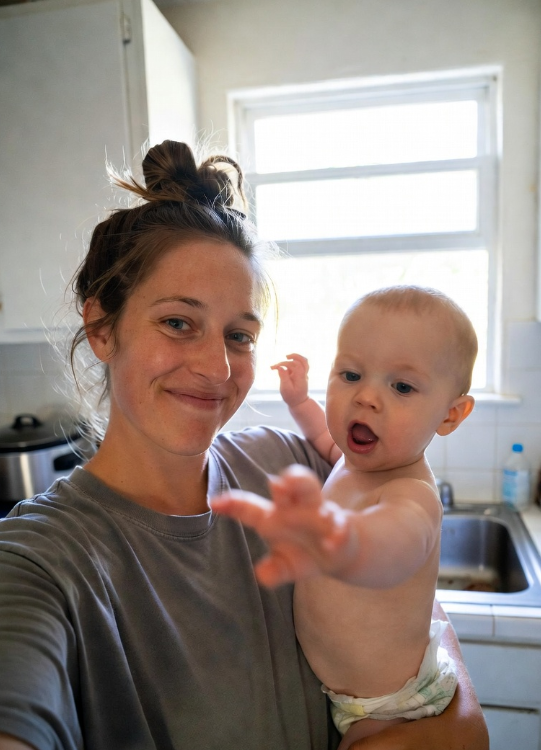
About the cook who shared this
Rachel Abernathy
Week 110 of Rachel’s 30-year story
· San Diego, California
Rachel is a twenty-eight-year-old Marine wife and mom of two who has moved five times in six years and learned to cook a Thanksgiving dinner with half her cookware still in boxes. She married young, survived postpartum depression, and feeds her family of four on a junior Marine's salary with a freezer full of pre-made meals and a crockpot that has never let her down. She writes for the military spouses who are cooking dinner alone in base housing and wondering if they're enough. You are.
