Peter did not call. I called him. He picked up on the third try. He sounded thin — the way he has sounded for months now, the way Pappa used to sound. I told him about the meatballs I was making. He said he wished he was here. I said come for Christmas. He said he would try. I did not push. I did not lecture. I said I loved him. I hung up the phone and I stood at the kitchen sink for a long minute looking at the lake.
Sophie texted a photo of Mira eating cereal. Mira's face was covered in milk. The photo was lit from the side by morning light and the smile in it was uninhibited and full and I could not stop looking at it. I printed the photo. I taped it to the fridge. I have a system on the fridge now: a column for each grandchild, a column for each great-grandchild, photos rotated weekly. The fridge is the gallery. The gallery is the proof.
Peter called from Chicago. He sounded thinner than last week. He said work was fine. I do not believe him. He said his apartment was fine. I do not believe him either. He asked about the dog. He asked about the lake. He told me he loved me. I told him I loved him too. I told him about the bread I was baking. He said he could almost smell it through the phone. We hung up. I stood at the sink for a long minute. I did not know what else to do.
I cooked Glögg and pepparkakor this week. The mulled wine — red wine, port, vodka, citrus peel, cardamom, cinnamon, cloves, ginger, raisins, almonds — simmered low, never boiled, served warm in tiny glasses with a spoon for the raisins and almonds at the bottom. Pepparkakor — thin ginger snaps with the secret pepper — eaten alongside. The Swedish answer to the dark.
I made the soup. Fifty gallons. I served the soup. A hundred and twelve plates. I came home tired. I came home good-tired. The Thursday tired. The right tired. I sat on the couch with Sven and a glass of wine and I did not move for two hours. The body wants this kind of tired. The body has wanted this kind of tired for thirty years.
I thought about Lars this week. He has been gone since 1979. The grief is old, but it is not gone. The dead do not leave. They just become quieter. Lars at twenty was funny in a particular sideways way that nobody else in the family was funny. He could make Pappa laugh, which nobody could make Pappa do. He has been gone forty-five years. I still hear his laugh sometimes, when Erik is laughing in a particular way, or when Peter accidentally tilts his head the way Lars used to.
It is enough. It has to be. And on a morning like this, with the lake doing what the lake does and the dog at my feet and the bread on the counter and the kitchen warm enough to live in, it is.
Mamma used to say: "En människa är vad hon ger." A person is what she gives. She said this in Swedish so often that the phrase still sounds in my head in her voice. I think about it daily. I think about what I have given, and what I have not given, and what is still to give. The accounting is mostly favorable. The accounting is, in some ways, the only accounting that matters.
It is enough.
The Glögg was already simmering — the cloves, the cardamom, the raisins pooling at the bottom of the pot — when I decided I wanted something to eat alongside it, something small enough to hold in one hand while you stand at the window watching the lake go dark. Mince pies have always felt like that to me: a modest thing, a spiced thing, the kind of thing you make not because anyone asked but because the kitchen needs to smell like this right now. I made a dozen. I ate two standing up. I wrapped the rest and thought about Peter, and Lars, and Mira’s face covered in cereal milk, and how the accounting — when you are honest about it — is mostly favorable.
Mince Pies
Prep Time: 30 min | Cook Time: 20 min | Total Time: 50 min (plus 30 min chilling) | Servings: 12 pies
Ingredients
- 1 3/4 cups (225g) all-purpose flour, plus more for dusting
- 1/2 cup (115g) cold unsalted butter, cut into small cubes
- 1/4 tsp fine salt
- 1 tbsp powdered sugar, plus extra for dusting
- 2–3 tbsp ice-cold water
- 1 egg, lightly beaten (for glazing)
- 1 jar (about 14 oz / 400g) prepared mincemeat
- 1 tbsp brandy or orange juice (optional, stirred into mincemeat)
Instructions
- Make the pastry. In a large bowl, combine the flour, salt, and powdered sugar. Add the cold butter and rub it into the flour with your fingertips until the mixture resembles coarse, damp breadcrumbs with no large butter pieces remaining.
- Bind and chill. Add ice-cold water one tablespoon at a time, mixing lightly with a fork after each addition, just until the dough comes together — it should not be sticky. Shape into a disc, wrap in plastic, and refrigerate for at least 30 minutes.
- Preheat and prepare. Heat the oven to 375°F (190°C). Lightly grease a standard 12-cup muffin tin. If using brandy or orange juice, stir it into the mincemeat now.
- Roll and cut. On a lightly floured surface, roll the pastry out to about 1/8-inch thickness. Using a round cutter slightly larger than the muffin cups (about 3 1/2 inches), cut 12 base circles. Re-roll the scraps and cut 12 smaller circles or star shapes for the lids (about 2 1/2 inches).
- Fill. Press the larger circles gently into each muffin cup. Spoon a heaped teaspoon of mincemeat into each — do not overfill or the filling will bubble over the edges.
- Top and seal. Place the smaller pastry rounds or stars on top. Press the edges gently to seal if using full circles. Brush each pie lightly with beaten egg.
- Bake. Bake for 18–20 minutes, until the pastry is golden and just pulling away from the tin edges. Let cool in the tin for 5 minutes before transferring to a wire rack.
- Finish and serve. Dust generously with powdered sugar while still slightly warm. Serve as they are, or alongside a small warm glass of Glögg.
Nutrition (per serving)
Calories: 198 | Protein: 2g | Fat: 9g | Carbs: 27g | Fiber: 1g | Sodium: 82mg
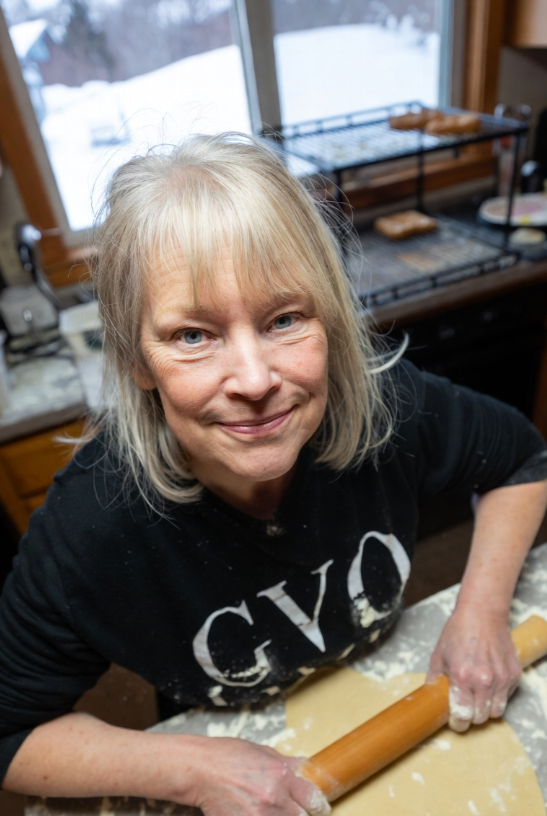
About the cook who shared this
Linda Johansson
Week 358 of Linda’s 30-year story
· Duluth, Minnesota
Linda is a sixty-three-year-old retired nurse from Duluth, Minnesota, living alone in the house where she raised her children and said goodbye to her husband. She lost Paul to ALS in 2020 after two years of watching the kindest man she'd ever known lose everything but his dignity. She cooks Scandinavian comfort food and Minnesota hotdish and the pot roast Paul loved, and she sets two places at the table out of habit because it makes her feel less alone. Every recipe she writes is a person she's loved.
