
 By
By Cycle 5 was the hardest so far. Sean was wrecked Tuesday through Saturday. The nausea was heavier. The anti-emetics were adjusted again on Thursday. He lost two more pounds. He is now six pounds below his baseline. Dr. Pei wants to see him in clinic Monday. I do not know what the plan will be. Probably a small dose reduction for cycle 6. We will see.
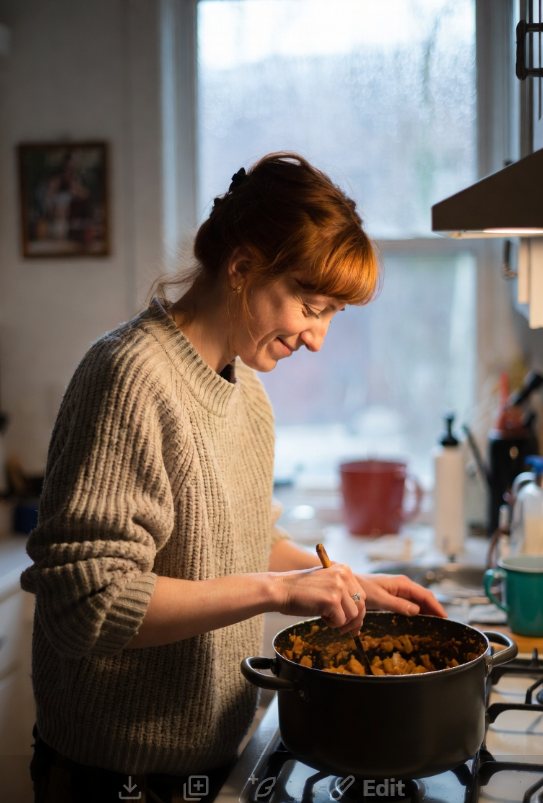
I made the ginger-rice porridge every day. Tuesday through Friday he ate it three times a day. It was the only thing he could tolerate some days. The recipe is now completely internalized. I could make it with my eyes closed. I have been making it for six months. I have refined the ratios four times. I have added variations — a lemon version for when the ginger gets tiring, a miso version for when he craves savory. All are palatable. All stay down.
I have been thinking about something I have not written about. I have been noticing that the soup I am making is a specific thing. It is not generic chicken soup. It is not a recipe from anyone's grandmother. It is a soup I designed for a person who cannot eat anything else. I am going to write down exactly what I am making, with the measurements, with the variations, with the troubleshooting. I started the writing Thursday night. I am calling it what Sean calls it now: "Kate's soup." I do not love the name. It will do for now. The writing is in the same brown leather notebook I started in January.
Liam had a rough week. He bit a kid. He has not bitten since he was two. Miss Alicia called me. The kid was fine. Liam was not. He cried for half an hour after the incident. I picked him up early. I took him home. I took him to the kitchen. I gave him a grilled cheese and a cup of tomato soup. I said "tell me about it." He said "I don't know." I said "that's okay." He said "the kid was being mean to Henry." I said "okay." He said "I got really mad." I said "I understand that." He said "Mommy am I bad." I said "Liam. You are not bad. You had a big feeling and your body acted on it. We are going to figure out other ways for your body to act on big feelings. You are not bad. You are a very good boy who had a very big week." He cried. I held him on my lap at the kitchen table for fifteen minutes. He fell asleep on me. I did not move. I did nothing else for that hour.
I am exhausted. I am more exhausted than I have ever been. I am doing clinic, NP, kids, Sean, cooking, the letters, the notebook. I am holding. I am going to hold. My mother sent me an email Saturday morning that was just the sentence "Katherine, you are doing it. I love you. Ma." I cried at the kitchen table. I wrote back "I love you too." I made coffee. I kept going.
Cycle 5 emptied me out in ways I am still sorting through, and the ginger-rice porridge was Sean’s lifeline — but I also needed something to make for myself, for Liam, for the moments between clinic calls and anti-emetic adjustments when I just needed to stand at the counter and do one quiet, uncomplicated thing. I have been baking this milk and honey white bread since January. It is soft and just barely sweet and it asks nothing of you except time. I made it on Thursday night while I was starting the notebook. Liam had a slice warm from the pan before school Friday. It is the bread I reach for when I need to feel like I am feeding someone, including myself.
Milk And Honey White Bread
Prep Time: 20 minutes | Cook Time: 30 minutes | Total Time: 2 hours 20 minutes (includes rise time) | Servings: 16 slices (1 loaf)
Ingredients
- 1 cup whole milk, warmed to about 110°F
- 2 tablespoons honey
- 2 1/4 teaspoons active dry yeast (1 standard packet)
- 3 cups all-purpose flour, plus more for kneading
- 1 teaspoon fine salt
- 2 tablespoons unsalted butter, softened
- 1 large egg, room temperature
- 1 tablespoon butter, melted (for brushing)
Instructions
- Activate the yeast. Combine the warm milk and honey in a large bowl or the bowl of a stand mixer. Sprinkle the yeast over the top and let it sit for 5–10 minutes until foamy and fragrant. If it does not foam, your milk may be too hot or the yeast may be old — start again.
- Mix the dough. Add the egg and softened butter to the yeast mixture and stir to combine. Add the flour and salt. Mix until a shaggy dough forms, then knead by hand on a lightly floured surface for 8–10 minutes (or 6 minutes with a dough hook on medium speed) until the dough is smooth, elastic, and slightly tacky but not sticky.
- First rise. Shape the dough into a ball and place it in a lightly oiled bowl, turning once to coat. Cover with a clean kitchen towel or plastic wrap and let rise in a warm spot for 1 hour, or until doubled in size.
- Shape the loaf. Punch the dough down gently. Turn it out onto a lightly floured surface and shape it into a log roughly the length of your 9x5-inch loaf pan. Place it seam-side down in a greased pan.
- Second rise. Cover loosely and let rise again for 30–45 minutes, until the dough crowns about 1 inch above the rim of the pan.
- Bake. Preheat the oven to 350°F. Bake the loaf for 28–32 minutes, until deep golden brown on top and the internal temperature reads 190–195°F. If the top is browning too quickly, tent loosely with foil after 20 minutes.
- Finish and cool. Remove from the oven and immediately brush the top with the melted butter. Let the loaf cool in the pan for 10 minutes, then turn it out onto a wire rack. Let it cool for at least 20 minutes before slicing — it will slice more cleanly and the crumb will set.
Nutrition (per serving)
Calories: 130 | Protein: 4g | Fat: 3g | Carbs: 22g | Fiber: 1g | Sodium: 155mg