
 By
By Election week. I voted on Tuesday — walked into the polling station at the community center with my naturalization certificate in my purse, even though I didn't need it, because I carry it everywhere I might need to prove I belong. The certificate is my passport and my shield and my receipt — proof that I paid the price of belonging, which was twenty years of fear and a hundred-question test and an oath I said with tears running down my face, and I will carry the receipt until the day I die because some purchases you never stop verifying.
I stood in line with my neighbors — Mexican, white, Black, the particular rainbow that is El Paso, a border city where everyone is from somewhere else or from right here or from both — and I voted, and I felt the weight of it. The weight of a vote cast by a woman who couldn't vote for thirty-four years, who watched elections from the other side of the bridge and thought: someday. And someday came, and it was a Tuesday in November in a community center that smelled like old carpet and democracy.
Luis Jr. asked who I voted for. I said, "That is between me and the machine." He said, "But Mom—" and I said, "Between me and the machine, mijo," because there are some things a mother keeps, and her ballot is one of them, and privacy in a house of seven people is precious enough to defend even against a fifteen-year-old who is old enough to be curious and young enough to be told no.
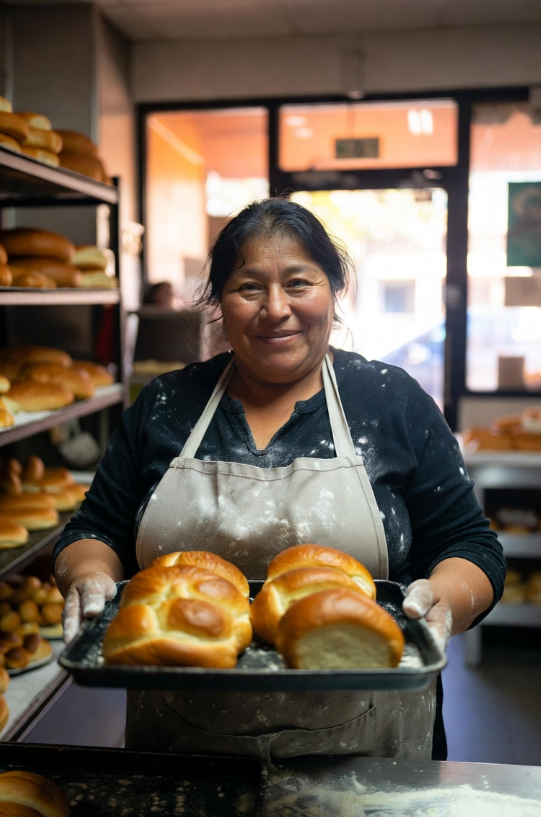
At the bakery, I introduced another Rosa recipe: buñuelos — the thin, crispy fried dough sprinkled with cinnamon sugar that Rosa made every Christmas and that I associate with cold nights and warm kitchens and the sound of oil popping in a pan. I made them early, before the holidays, because I wanted to test the recipe in the bakery setting — larger quantities, commercial ovens — and also because I needed to make them. I needed Rosa's recipes in my hands the way a musician needs their instrument after a long silence. The buñuelos were perfect. Thin, crispy, sweet. The first one out of the oil, I ate standing over the pan, burning my fingers and my tongue, and it tasted exactly right, exactly Rosa, and I said, out loud, to no one: "Mamá, I got it right."
Isabella has started a study group at school — she and three other girls who meet at the library after class to study for honors exams. She organized it herself because Isabella does not wait for things to be organized; she organizes them. She is thirteen and she is already leading, already building structures, already creating the systems that will carry her through nursing school and beyond. I don't know where she gets it. Not from me — I build bakeries, not systems. Not from Luis — Luis builds things with his hands, not his mind. Isabella builds with her mind. Her mind is the strongest tool in this house.
I made migas for dinner on Wednesday — scrambled eggs with strips of fried tortilla and salsa and cheese, the breakfast-for-dinner that Rosa made when there was nothing else, when the pantry was bare and the paycheck was two days away and the only things in the kitchen were eggs and old tortillas and a determination to feed seven children something hot. Migas is poverty food. I say this without shame because poverty food is the best food — it is the food that was invented by women who had nothing and made something, who looked at an empty cupboard and saw a meal, who understood that the difference between hunger and dinner is not ingredients but imagination.
Wednesday night, with Isabella’s color-coded binders still spread across the kitchen table and Luis’s sawdust on the floor and my own tired hands that had been kneading dough since five in the morning, I needed something that asked nothing of me — something that already knew what it was doing. Migas is that food. It doesn’t need a recipe, exactly, but I’m writing it down anyway, because Rosa never did, and I want Isabella to have it when I’m gone, when her pantry is bare and her paycheck is two days away and she needs to remember that imagination is the only ingredient that matters. Here’s how I made it Wednesday, the way Rosa made it, the way I’ll always make it.
Migas (Scrambled Eggs with Crispy Tortilla Strips)
Prep Time: 10 min | Cook Time: 15 min | Total Time: 25 min | Servings: 4
Ingredients
- 6 large eggs
- 3 corn tortillas, cut into 1/2-inch strips
- 3 tablespoons vegetable oil, divided
- 1/2 cup salsa (jarred or fresh)
- 1/2 cup shredded Monterey Jack or cheddar cheese
- 1/4 cup white onion, finely diced
- 1 jalapeño, seeded and minced (optional)
- 2 tablespoons whole milk
- 1/2 teaspoon kosher salt
- 1/4 teaspoon black pepper
- Fresh cilantro and sliced avocado, to serve
Instructions
- Fry the tortilla strips. Heat 2 tablespoons of oil in a large skillet over medium-high heat. Add the tortilla strips in a single layer and fry, turning once, until golden and crisp, about 3–4 minutes. Transfer to a paper-towel-lined plate and season lightly with salt.
- Whisk the eggs. In a bowl, whisk together the eggs, milk, salt, and pepper until just combined. Do not overbeat.
- Sauté the aromatics. Reduce heat to medium. Add the remaining 1 tablespoon of oil to the skillet. Add the onion (and jalapeño if using) and cook, stirring, until softened, about 2 minutes.
- Scramble with the tortillas. Return the fried tortilla strips to the skillet with the onion. Pour the egg mixture over everything. Let the eggs set slightly at the edges, then use a spatula to gently fold—not stir—the eggs into large, soft curds. Cook until just set but still slightly glossy, about 3 minutes.
- Add salsa and cheese. Spoon the salsa over the eggs and scatter the shredded cheese on top. Cover the pan for 30 seconds to let the cheese melt.
- Serve immediately. Plate with fresh cilantro and avocado alongside warm tortillas or toast. Migas wait for no one—eat them the moment they leave the pan.
Nutrition (per serving)
Calories: 280 | Protein: 14g | Fat: 19g | Carbs: 13g | Fiber: 2g | Sodium: 480mg