Summer. The real summer, not the calendar version — the kind where you walk outside and the humidity hits you like a wall and your hair immediately surrenders. New Jersey summer. The air is soup.
Father's Day. A more complicated holiday in the Krishnamurthy family than Mother's Day, because while Amma's mothering is loud and visible and expressed through food, Appa's fathering is quiet and internal and expressed through... showing up. Consistently. Without fanfare. For thirty years.
I went to my parents' house. Raj came because Raj always comes — he has integrated himself into the Krishnamurthy family rhythms with the patience of a man who understands that belonging is earned, not given.
I gave Appa a book — a biography of A.P.J. Abdul Kalam, the former President of India who was also a rocket scientist, which is the kind of person Appa admires: brilliant, humble, and successful in a way that doesn't require talking about feelings. Appa accepted the book, examined the cover, read the back, and said, "Good." This is Appa's five-star review.
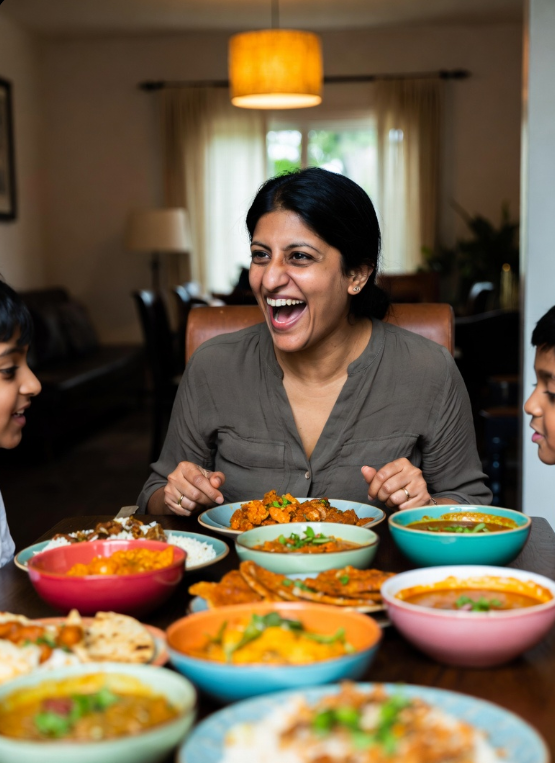
Amma made Appa's favorites: his idli (extra soft, made with a higher proportion of urad dal than standard — Appa has opinions about idli texture that he expresses through pointed silence when the idli are too dense), his particular sambar (heavy on drumstick and shallots, light on tomato), and his after-meal rasam (thin, peppery, more broth than substance — he drinks it from a tumbler like coffee).
Arvind called from Trenton. He and Appa talked for six minutes, which is their longest phone call in years. Appa said "Good, good" approximately forty times, which is his way of filling conversational space without sharing information. But when he hung up, he looked satisfied. Not happy — Venkatesh Krishnamurthy doesn't do happy — but satisfied. His son called. His son has a license. His son is planning a business. The prodigal son is building something.
I watched Appa eat his idli and thought about what kind of father Raj will be. Because we're going to try again. Not yet — Dr. Ramachandran said to wait at least one cycle — but soon. And Raj will be a good father. Not like Appa — not silent and stoic and emotionally constipated — but good in his own way. Present. Verbal. The kind of father who says "I love you" out loud, which is something Appa has said to me approximately twice in thirty years (both times at my wedding, both times while crying, both times pretending he wasn't).
Dinner at home: I made meen kuzhambu — fish curry, the Tamil version, tangy with tamarind and hot with red chilies. It's a summer dish, aggressive and bright, the kind of food that makes you sweat and doesn't apologize for it.
I'm cooking again. I'm eating again. I'm not okay, but I'm not not-okay. I'm somewhere in the middle, which is where most of life happens.
After watching Appa quietly accept his five-star “Good” and drain his peppery rasam from a steel tumbler, I came home craving something that matched the weather — hot, unapologetic, alive. Meen kuzhambu is that dish for me: tamarind-sour and chili-bright, the kind of curry that fills the kitchen with smoke and forces you to be present in your own body. I’m cooking again, and this is what cooking again tastes like.
Meen Kuzhambu (Tamil Fish Curry)
Prep Time: 15 minutes | Cook Time: 30 minutes | Total Time: 45 minutes | Servings: 4
Ingredients
- 1 lb firm white fish (such as kingfish, seer fish, or grouper), cut into 2-inch steaks or chunks
- 1/2 teaspoon turmeric powder
- 1 teaspoon salt, plus more to taste
- 1 lemon-sized ball of tamarind (about 2 tablespoons tamarind paste), soaked in 1 cup warm water and strained
- 3 tablespoons sesame oil (gingelly oil)
- 1 teaspoon mustard seeds
- 1/2 teaspoon fenugreek seeds (methi)
- 2 sprigs fresh curry leaves
- 2 medium onions, sliced thin
- 3 cloves garlic, minced
- 1-inch piece ginger, minced
- 2 medium tomatoes, chopped
- 2 tablespoons Kuzhambu chili powder (or 1 tablespoon Kashmiri chili powder plus 1 tablespoon regular red chili powder)
- 1 teaspoon coriander powder
- 1/4 teaspoon asafoetida (hing)
- Fresh cilantro for garnish
Instructions
- Prep the fish. Pat fish pieces dry and rub with 1/4 teaspoon turmeric and 1/2 teaspoon salt. Set aside for 10 minutes while you prepare the base.
- Extract the tamarind. If using whole tamarind, soak in 1 cup warm water for 10 minutes, then squeeze and strain out the pulp. Discard the fibers. You should have about 1 cup of thick tamarind water.
- Start the tempering. Heat sesame oil in a heavy-bottomed pan or clay pot over medium heat. Add mustard seeds and let them pop, then add fenugreek seeds and curry leaves. Fry for 30 seconds until fragrant.
- Cook the aromatics. Add sliced onions and cook for 5–6 minutes until they soften and turn golden at the edges. Add garlic and ginger, stir for 1 minute.
- Build the gravy. Add tomatoes, remaining 1/4 teaspoon turmeric, chili powder, coriander powder, asafoetida, and remaining 1/2 teaspoon salt. Cook for 4–5 minutes, mashing the tomatoes until they break down into a rough paste.
- Add tamarind water. Pour in the strained tamarind water and stir well. Bring to a boil, then reduce heat to medium-low and simmer uncovered for 10 minutes. The gravy should thicken slightly and the raw tamarind smell should mellow into something tangy and deep.
- Add the fish. Gently slide the fish pieces into the simmering gravy. Spoon some gravy over the tops. Cover and cook on low heat for 8–10 minutes, resisting the urge to stir — the fish will break apart if you handle it too much. The fish is done when it flakes easily and has absorbed the color of the kuzhambu.
- Finish and rest. Remove from heat, scatter fresh curry leaves and cilantro on top, and let the kuzhambu sit covered for 5 minutes before serving. Like most Tamil curries, it tastes even better after it rests. Serve hot with steamed rice.
Nutrition (per serving)
Calories: 265 | Protein: 26g | Fat: 13g | Carbs: 14g | Fiber: 3g | Sodium: 640mg
About the cook who shared this
Priya Krishnamurthy
Week 65 of Priya’s 30-year story
· Edison, New Jersey
Priya is a pharmacist, wife, and mom of two in Edison, New Jersey — the town she grew up in, surrounded by the sights and smells of her mother's South Indian kitchen. These days, she splits her time between the hospital pharmacy, school pickups, and her own kitchen, where she cooks nearly every night. Her style is a blend of the Tamil recipes her mother taught her and the American comfort food her kids actually want to eat. She writes about the beautiful mess of balancing two cultures on one plate — and she wants you to know that ordering pizza is also an act of love.
