
 By
By Jason's therapy is going well. He told me over dinner — adobo, always adobo for the important conversations — that his counselor has helped him develop what she calls "decompression protocols." Which sounds military and is actually quite domestic: a set of practices for after hard calls that help him transition from the fire station to the apartment, from holding emergencies to holding himself. His protocols include: a shower (washing the smoke out of his hair, literally and metaphorically), a meal (cooked if possible, ordered if not), and twenty minutes of quiet before engaging with anyone, including me.
I respect the protocols. I designed my own version three years ago — the ER boundaries, the cooking, the therapy, the not-bringing-work-home. His version looks different but the architecture is the same: build a transition between the job and the life, because without the transition, the job becomes the life, and the life becomes the job, and you end up on a kitchen floor at 2 AM unable to stand because the distinction between patient and person has dissolved completely.
I wrote a blog post about cooking as decompression — "The After-Shift Kitchen: Recipes for Coming Home." Not the floor post, not the dramatic version, but the practical version: what to cook when you walk in the door exhausted and need to do something with your hands. Quick recipes. Ten-minute meals. The sinangag that takes seven minutes. The fried egg that takes three. The combination that takes ten minutes and constitutes a full Filipino breakfast at midnight, which is when healthcare workers and firefighters eat their dinners because the clock is an abstraction when your shift ends at 11 PM.
The post was well-received. The practical posts always are — people need recipes more than they need stories, sometimes. They need to know what to make at midnight with a tired body and a buzzing brain. They need sinangag. They need the ten minutes of chopping and frying that stand between them and the spiral. They need the kitchen to do what the kitchen does: give the hands something to do while the brain comes down.
I made Jason's sinigang for him when he came home from a hard shift on Thursday. He walked in, smelled the tamarind, and his shoulders dropped — visibly, physically, the tension releasing like a valve opening. He ate two bowls without speaking. After the second bowl, he said, "Thank you." The "thank you" was for the sinigang and for the not-asking and for the understanding that sometimes a bowl of sour soup is more therapeutic than a conversation, and the knowing-when-to-cook is the knowing-when-to-hold, and both are love.
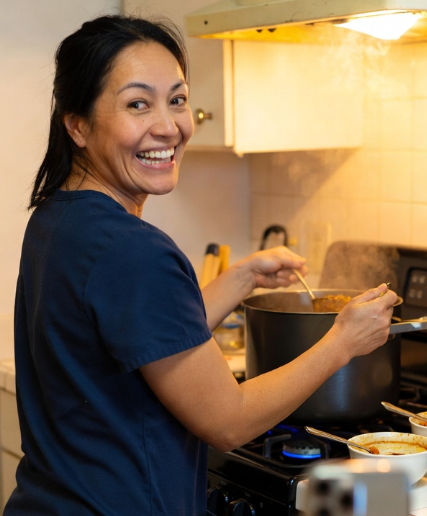
The sinigang I made Jason that Thursday was built from what I had — tamarind broth, pork ribs, a bunch of kangkong I’d bought without a plan — but the principle behind it is the same as this Market Basket Soup: you gather what the kitchen offers, you add heat and time, and something quietly miraculous happens in the pot. I’ve written the sinangag recipes and the ten-minute egg dishes, but if you asked me what I actually cooked when it mattered most, it was always a soup. Something that simmers while you wait, something that smells like someone thought of you before you walked in the door. This is the version that works with any pantry, any season, any person coming home from a shift that required more than they had to give.
Market Basket Soup
Prep Time: 15 min | Cook Time: 35 min | Total Time: 50 min | Servings: 6
Ingredients
- 1 lb boneless chicken thighs or pork shoulder, cut into 1-inch cubes
- 2 tablespoons olive oil
- 1 medium yellow onion, diced
- 3 cloves garlic, minced
- 3 medium carrots, sliced into rounds
- 3 stalks celery, sliced
- 2 medium potatoes, peeled and cubed
- 1 cup green beans, trimmed and cut into 1-inch pieces
- 1 can (14.5 oz) diced tomatoes, with juices
- 6 cups low-sodium chicken or vegetable broth
- 1 teaspoon dried thyme
- 1 teaspoon dried parsley
- 1/2 teaspoon black pepper
- 1 teaspoon salt, or to taste
- 1 bay leaf
- 1 cup fresh spinach or kale, roughly chopped (optional, added at end)
Instructions
- Brown the protein. Heat olive oil in a large pot or Dutch oven over medium-high heat. Add the cubed chicken or pork and cook, stirring occasionally, until lightly browned on the outside, about 4–5 minutes. Remove and set aside.
- Build the base. In the same pot, reduce heat to medium. Add the onion and cook until softened and translucent, about 3 minutes. Add the garlic and cook 1 minute more, stirring constantly so it doesn’t burn.
- Add the vegetables. Stir in the carrots, celery, and potatoes. Cook for 2 minutes, letting them pick up the fond from the bottom of the pot.
- Add liquid and seasonings. Pour in the diced tomatoes with their juices and the broth. Return the browned protein to the pot. Add thyme, parsley, black pepper, salt, and the bay leaf. Stir to combine.
- Simmer. Bring the soup to a boil, then reduce heat to low. Cover and simmer for 20–25 minutes, until the potatoes and carrots are tender and the protein is cooked through.
- Add green beans and greens. Stir in the green beans and cook uncovered for 5 minutes. If using spinach or kale, stir it in during the final 2 minutes. Remove the bay leaf.
- Taste and serve. Adjust salt and pepper as needed. Ladle into deep bowls. Serve with crusty bread or steamed rice. Let it cool slightly before eating — it’s better when you have to wait a moment for it.
Nutrition (per serving)
Calories: 240 | Protein: 22g | Fat: 7g | Carbs: 22g | Fiber: 4g | Sodium: 580mg