
 By
By September. Fall. The kabocha returns. The light shifts. The wheel turns. The eleventh autumn of the blog, the eleventh year of the practice, the first autumn of the forties. I buy the kabocha from Carol's booth and the weight in my hands is familiar and the color is familiar and the anticipation is familiar: the cut, the scoop, the cube, the simmer. The familiarity is the comfort. The comfort is the home. I am home. I have been home since 2016, since the first blog post, since the first bowl of miso soup. The home is not the apartment. The home is the practice.
Miya started fifth grade. She is nine, reading voraciously in both languages, writing stories that her teacher calls "remarkable," cooking dinner once a week by herself. The once-a-week dinner is the newest milestone: every Wednesday, Miya cooks. I sit at the table. She stands at the stove. The reversal is the inheritance in action, the daughter becoming the cook, the mother becoming the audience. The audience is grateful. The audience is enormous (it is me, one person, but one person can be an enormous audience when the one person is the mother and the cook is the daughter).
I made the first kabocha nimono of the season — Miya's version. She made it. I watched. Her nimono was: perfect. The word is not hyperbole. The word is not a mother's generous assessment. The word is the objective evaluation of a woman who has been making this dish for eleven years and who can recognize perfection when she tastes it. Miya's nimono was perfect. The kabocha was tender. The broth was balanced. The irregular cuts (Fumiko's instruction: "the uneven pieces cook differently and that is correct") were irregular in exactly the way Fumiko specified. The perfection is not the end. The perfection is the beginning: the beginning of the stage where the dish is Miya's, not mine, not Fumiko's, but Miya's, the same dish from a different set of hands, the same love in a different generation.
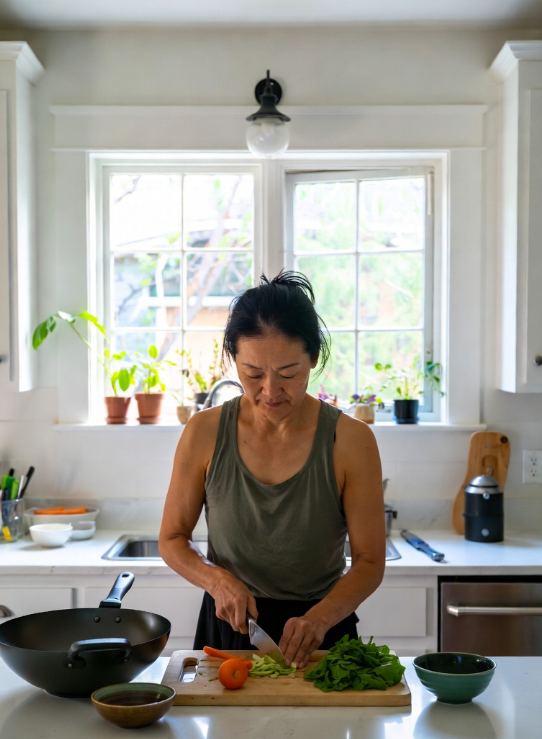
Watching Miya stand at the stove and cook something perfectly — not approximately, not adequately, but perfectly — made me want to cook something that honored the season’s produce the way she honored the nimono: with patience, with attention, and with trust that the ingredients themselves know what they need. This marinated fresh vegetable salad is what I made the following Wednesday, while she watched from the table and it was my turn to be the cook again. The marinade does most of the work; you just have to respect the vegetables enough to let it.
Marinated Fresh Vegetable Salad
Prep Time: 20 minutes | Cook Time: 0 minutes | Total Time: 2 hours 20 minutes (includes marinating) | Servings: 8
Ingredients
- 2 cups broccoli florets, cut small
- 2 cups cauliflower florets, cut small
- 1 cup cherry tomatoes, halved
- 1 medium cucumber, quartered lengthwise and sliced
- 1 medium red bell pepper, seeded and cut into 1-inch pieces
- 1 medium yellow bell pepper, seeded and cut into 1-inch pieces
- 1/2 small red onion, thinly sliced
- 1/2 cup pitted black olives, drained
- 1/2 cup pitted green olives, drained
- 3/4 cup Italian dressing (store-bought or homemade)
- 2 tablespoons red wine vinegar
- 1 teaspoon dried oregano
- 1/2 teaspoon garlic powder
- 1/2 teaspoon freshly ground black pepper
- 1/4 teaspoon kosher salt, plus more to taste
- 2 tablespoons fresh parsley, roughly chopped, for garnish
Instructions
- Prepare the vegetables. Cut all vegetables into similar-sized bite-sized pieces so they marinate evenly. Place broccoli, cauliflower, cherry tomatoes, cucumber, red and yellow bell pepper, red onion, and olives into a large bowl.
- Make the marinade. In a small bowl or measuring cup, whisk together the Italian dressing, red wine vinegar, oregano, garlic powder, black pepper, and salt until combined.
- Combine and toss. Pour the marinade over the vegetables and toss thoroughly to coat every piece. The bowl will seem full — keep tossing until the dressing reaches the bottom.
- Marinate. Cover the bowl tightly with plastic wrap or transfer to a lidded container. Refrigerate for at least 2 hours, or up to 24 hours. Toss once or twice during marinating if possible.
- Taste and adjust. Before serving, taste the salad and adjust salt, pepper, or a splash of red wine vinegar as needed. The vegetables will have softened slightly and absorbed the dressing.
- Serve. Transfer to a serving bowl or platter, garnish with fresh parsley, and serve cold or at room temperature. This salad holds well for 3 days in the refrigerator.
Nutrition (per serving)
Calories: 120 | Protein: 2g | Fat: 9g | Carbs: 9g | Fiber: 2g | Sodium: 430mg