
 By
By First week alone. The apartment is the same size it was last week and somehow twice as large — the physics of absence, the way empty space expands when you remove the person who filled it. Jason's side of the closet is bare. The bathroom has one toothbrush. The couch has one indent instead of two. I am learning the geography of solitude, which is different from loneliness — solitude is chosen, loneliness is inflicted, and I am choosing this, I remind myself, I chose Anchorage, I chose my recovery, I chose the kitchen and the blog and the ER and the proximity to Lourdes and Angela, and the choosing is the thing that keeps the solitude from becoming loneliness.
Jason called every night this week, as promised. The calls are strange — intimate and distant simultaneously, his voice in my ear from three hundred sixty miles away, telling me about the new station, the crew, the apartment in Fairbanks that he's furnishing with the minimum a man needs: a bed, a table, a pan. One pan. I told him one pan is not enough. He said, "It's enough if you only cook adobo." He's been making adobo. My recipe. In Fairbanks. The recipe traveling north, the way immigrants' recipes always travel — in the memory of someone who loved the cook.
I went to the Mountain View house on Saturday. Lourdes didn't ask about Jason. She asked about my appetite. "Are you eating?" "Yes, Mama." "Are you eating enough?" "Yes." "Are you eating standing up?" The woman is a detective. I am, in fact, eating standing up again — the stress position, the regression, the body's way of saying I'm coping but I'm not relaxed. I lied. "No, I'm sitting." Lourdes looked at me with the expression that says I know you're lying and I love you anyway and here is more adobo.
We made kare-kare — oxtail peanut stew, the rich, complicated, labor-intensive dish that Lourdes makes when someone needs to be occupied. The recipe takes hours. Boiling the oxtail until it's tender, making the peanut sauce, blanching the vegetables — banana blossoms, eggplant, bok choy, string beans. The hours are the point. The hours are the medicine. You can't think about a man in Fairbanks when you're watching oxtail simmer and checking the peanut sauce for consistency.
The kare-kare was extraordinary. Rich and nutty and deep, the oxtail falling off the bone, the bagoong (shrimp paste) on the side adding its funky, salty counterpoint. I ate it at Lourdes's table. Seated. Not standing. In Lourdes's kitchen, I always sit. In Lourdes's kitchen, I am always held.
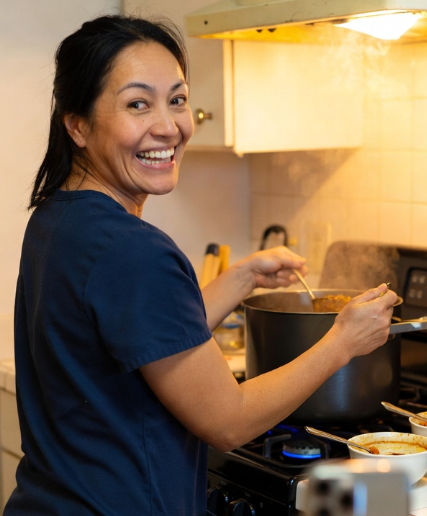
Kare-kare is Lourdes’s recipe — those hours belong to her kitchen, her hands, her instinct for when someone needs to be occupied. What I can bring to my own table, in my too-large apartment with its one toothbrush and its new geography of solitude, is something that borrows the same logic: warmth, depth, and enough fragrance to fill the rooms. This Mango & Coconut Chicken Soup is the dish I made the following week, alone but not lonely, because it carries a little of the same spirit — the tropical sweetness, the richness, the reminder that there are flavors in the world worth sitting down for.
Mango & Coconut Chicken Soup
Prep Time: 15 min | Cook Time: 35 min | Total Time: 50 min | Servings: 6
Ingredients
- 1 1/2 lbs boneless, skinless chicken thighs, cut into 1-inch pieces
- 1 can (13.5 oz) full-fat coconut milk
- 2 cups low-sodium chicken broth
- 1 large ripe mango, peeled and diced (about 1 1/2 cups)
- 1 medium yellow onion, finely diced
- 3 cloves garlic, minced
- 1 tablespoon fresh ginger, grated
- 1 tablespoon fish sauce
- 1 tablespoon fresh lime juice
- 1 teaspoon ground turmeric
- 1/2 teaspoon crushed red pepper flakes
- 1 tablespoon neutral oil (such as avocado or canola)
- Salt and black pepper to taste
- Fresh cilantro and thinly sliced scallions, for serving
- Cooked jasmine rice, for serving (optional)
Instructions
- Build the base. Heat oil in a large, heavy-bottomed pot or Dutch oven over medium heat. Add onion and cook, stirring occasionally, until softened and translucent, about 5 minutes. Add garlic and ginger and cook until fragrant, about 1 minute more.
- Toast the spices. Add turmeric and red pepper flakes to the pot and stir to coat the aromatics. Cook for 30 seconds, letting the spices bloom in the oil.
- Brown the chicken. Add the chicken pieces in a single layer, season with salt and pepper, and cook undisturbed for 3–4 minutes until lightly golden on one side. Stir and cook 2 minutes more.
- Add the liquids. Pour in the coconut milk and chicken broth, scraping up any browned bits from the bottom of the pot. Stir in the fish sauce. Bring to a gentle boil, then reduce heat to medium-low and simmer uncovered for 20 minutes, until the chicken is cooked through and the broth has deepened in color.
- Add the mango. Stir in the diced mango and simmer for 5 minutes more — just long enough to warm it through and let it soften slightly into the broth without losing its shape.
- Finish and serve. Stir in the lime juice. Taste and adjust seasoning with additional fish sauce, lime, or salt as needed. Ladle into bowls over jasmine rice if using, and top with fresh cilantro and scallions.
Nutrition (per serving)
Calories: 318 | Protein: 27g | Fat: 17g | Carbs: 16g | Fiber: 2g | Sodium: 540mg