
 By
By Reynaldo's death anniversary. February. Sixteen years. I am now thirty-four, which means I am older than he was when the diabetes was diagnosed. The math has crossed a threshold — the daughter now older than the father was at the beginning of the end. The crossing doesn't feel like a moment. The crossing feels like weather — a slow shift, a degree change, the kind of change you notice only when you stop and calculate and realize the temperature has moved.
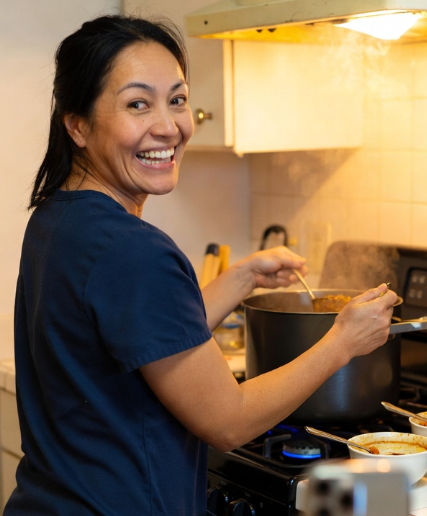
Lourdes and I at the Mountain View kitchen. The ritual. The sinigang. But this year I brought Mia, and Mia brought the word "cook," and the word filled the kitchen the way garlic fills a kitchen — completely, unavoidably, the aroma of the future mixing with the aroma of the past. Mia sat in her high chair and watched us cook and said "cook" and "Lola" and "Ate" and the words were the new sounds in the old ritual, the next generation entering the memorial, the baby making the dead man's kitchen live.
I wrote a blog post this week about preventive health in Filipino families — about the diabetes that runs through us like a river, about the kidney disease that took Reynaldo, about how loving your family means getting your blood work done. The post was not my most poetic. It was my most important. The post said: get checked. The getting-checked is the love. The love is the blood draw. The blood draw is the information. The information is the fighting-back that Reynaldo didn't have because the checking happened too late. Don't let it be too late. Get checked. The post got eight thousand views. Eight thousand potential blood draws. Eight thousand potential lives saved by the information that a dead man's daughter shared on a blog about food.
After we put the sinigang on the stove and Mia said “cook” for the hundredth time, I started thinking about what we would make together when she is old enough to understand why we make it. I want her to grow up knowing that love in our family looks like blood work and label-reading and choosing the low-carb cookie on purpose — not as deprivation, but as a quiet, daily act of staying. These peanut butter cookies are what I made the next morning: three ingredients, no flour, no refined sugar spiral, and enough sweetness to feel like a celebration rather than a compromise. Reynaldo never got the information in time. Mia will grow up in a kitchen that already knows.
Low Carb Peanut Butter Cookies
Prep Time: 10 minutes | Cook Time: 12 minutes | Total Time: 22 minutes | Servings: 24 cookies
Ingredients
- 1 cup natural creamy peanut butter (no added sugar)
- 3/4 cup granulated erythritol or monk fruit sweetener
- 1 large egg
- 1 teaspoon pure vanilla extract
- 1/2 teaspoon baking soda
- 1/4 teaspoon fine sea salt
Instructions
- Preheat. Heat oven to 350°F (175°C). Line two baking sheets with parchment paper.
- Mix the dough. In a medium bowl, stir together peanut butter, sweetener, egg, vanilla extract, baking soda, and salt until a cohesive dough forms. It will be thick and slightly sticky.
- Portion the cookies. Scoop dough by the tablespoon and roll into balls. Place about 2 inches apart on the prepared baking sheets.
- Press and score. Use a fork to gently flatten each ball, pressing a crosshatch pattern into the top.
- Bake. Bake for 10 to 12 minutes, until the edges are just set and the tops look dry. The cookies will still feel soft at the center — that is correct.
- Cool completely. Let cookies rest on the baking sheet for 5 minutes before transferring to a wire rack. They firm up as they cool. Do not rush this step or they will crumble.
Nutrition (per serving)
Calories: 80 | Protein: 3g | Fat: 7g | Carbs: 3g | Fiber: 1g | Sodium: 75mg