The week after. The first full week of living in the new world — the world where Paul has ALS, where the word has been said, where the diagnosis is a fact rather than a fear.
Facts are what I'm working with now. The nurse in me has taken over, and the nurse deals in facts. Fact: ALS is a progressive neurodegenerative disease that affects motor neurons. Fact: the average life expectancy after diagnosis is two to five years. Fact: there is no cure. Fact: there are medications that can slow progression — riluzole, approved by the FDA. Fact: Paul has started riluzole.
Fact: Paul is still Paul. He went to school on Monday. He taught American history. He came home and ate dinner and read about shipwrecks and went to bed and his left hand doesn't work well but the rest of him — his mind, his voice, his humor, his kindness — is intact. The disease hasn't taken those yet. It will. But not yet.
I called Mamma. I drove to Fifth Street and sat at her kitchen table and told her. Face to face, because some words can't be delivered by phone. She listened. She didn't interrupt. When I was done, she got up and went to the stove and put the kettle on and made coffee and brought it to me in the cup I've been drinking from since I was six — the blue cup with the chip on the handle — and she sat down and said, "We will take care of him."
Not: "I'm sorry." Not: "How terrible." Not: "What will you do?" We will take care of him. Mamma. Eighty-seven years old. The woman who took care of five children, a drinking husband, a dead son, and a fifty-five-year-old house. The woman who takes care of everyone. She said "we" because she meant it. She's part of the team.
I cried at Mamma's table. The first time I've cried since the diagnosis. Not in front of Paul — never in front of Paul, not yet, because he needs me to be steady and I will be steady — but in Mamma's kitchen, in the kitchen where I grew up, at the table where I learned to eat and cook and be a person, I cried. And Mamma sat across from me and didn't touch me because Johanssons don't touch when you're crying, they sit with you, and the sitting is the touch.
I haven't told Peter or Elsa yet. Soon. Not this week. This week I need to let the word settle inside me before I carry it to anyone else.
I made bread. Limpa rye. The recipe. The kneading. The two hours of work. The smell. The bread came out of the oven at four PM and I sliced it warm and ate a piece with butter and the taste was the same as it's always been and will always be, and that constancy — the fact that bread doesn't change even when everything else does — was the most comforting thing in the world.
Paul had two slices. With butter. At the kitchen table. Under the advent star that is still in the window.
The bread holds. The bread always holds.
This is the bread I made that afternoon — the limpa rye that Mamma taught me, the one that takes two hours and fills the whole house with that dark, sweet smell of molasses and orange and caraway. It’s the bread I’ve been making since I was tall enough to reach the counter, and it’s the bread I needed my hands in after sitting at Mamma’s table and crying into the blue cup with the chipped handle. The kneading is the thing. Ten minutes of pushing dough against the counter, and your body remembers that it knows how to do something, even when your mind has forgotten how to hold a single thought. Here is the recipe, exactly as I make it.
Limpa Rye Bread
Prep Time: 30 minutes | Cook Time: 40 minutes | Total Time: 2 hours 30 minutes (includes rising) | Servings: 2 loaves (about 12 slices each)
Ingredients
- 2 1/4 teaspoons active dry yeast (1 packet)
- 1 1/2 cups warm water (110°F)
- 1/4 cup molasses
- 2 tablespoons butter, softened
- 2 tablespoons brown sugar
- 1 1/2 teaspoons salt
- Zest of 1 orange
- 1 tablespoon caraway seeds
- 1 teaspoon fennel seeds
- 2 cups medium rye flour
- 2 1/2 to 3 cups bread flour
Instructions
- Bloom the yeast. Stir yeast into warm water in a large bowl. Let stand 5 to 10 minutes until foamy.
- Mix the dough. Add molasses, softened butter, brown sugar, salt, orange zest, caraway seeds, and fennel seeds to the yeast mixture. Stir to combine. Add rye flour and stir until smooth. Add bread flour, 1/2 cup at a time, until a shaggy dough forms that pulls away from the sides of the bowl.
- Knead. Turn dough out onto a lightly floured surface. Knead for 10 minutes, adding bread flour as needed, until dough is smooth and slightly tacky but not sticky. Rye dough will never feel as elastic as white bread dough — that’s normal.
- First rise. Place dough in a lightly greased bowl, turning once to coat. Cover with a clean towel and let rise in a warm spot for 1 to 1 1/2 hours, until doubled in size.
- Shape the loaves. Punch dough down and divide in half. Shape each piece into a round or oval loaf. Place on a parchment-lined baking sheet. Cover loosely and let rise 30 to 40 minutes, until puffy.
- Preheat. Heat oven to 375°F during the second rise.
- Bake. Score the tops of the loaves with a sharp knife. Bake 35 to 40 minutes, until loaves are deep brown and sound hollow when tapped on the bottom. Internal temperature should reach 200°F.
- Cool. Transfer to a wire rack. Let cool at least 15 minutes before slicing — or slice warm with butter, the way it’s meant to be eaten.
Nutrition (per serving)
Calories: 145 | Protein: 4g | Fat: 2g | Carbs: 28g | Fiber: 3g | Sodium: 180mg
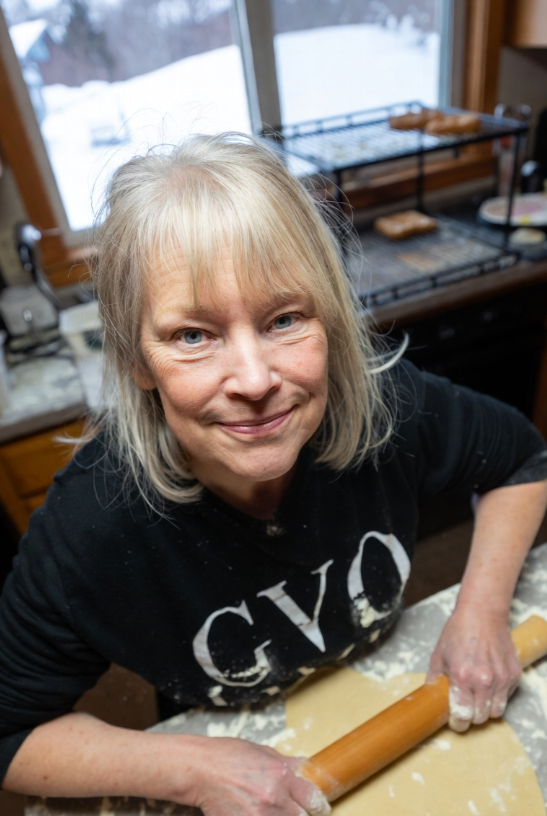
About the cook who shared this
Linda Johansson
Week 96 of Linda’s 30-year story
· Duluth, Minnesota
Linda is a sixty-three-year-old retired nurse from Duluth, Minnesota, living alone in the house where she raised her children and said goodbye to her husband. She lost Paul to ALS in 2020 after two years of watching the kindest man she'd ever known lose everything but his dignity. She cooks Scandinavian comfort food and Minnesota hotdish and the pot roast Paul loved, and she sets two places at the table out of habit because it makes her feel less alone. Every recipe she writes is a person she's loved.
