
 By
By End of August. The termination dust appeared on the Chugach this week — that first dusting of snow on the mountain peaks that signals summer is over. In Alaska, we call it termination dust because it terminates summer, which is both poetic and brutal, which is Alaska's entire aesthetic. The mountains went from green and brown to white-capped overnight, and the air has that crisp edge to it, the one that smells like fall everywhere else but here smells like a warning.
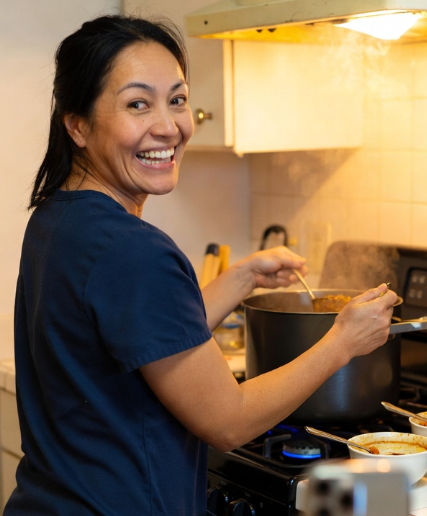
I'm thinking about writing. Not the journal — that's therapy homework, private, the place where I put the ER cases and the nightmares and the grief that Dr. Reeves helps me untangle twice a week. I mean writing for other people. About cooking. About Filipino food in Alaska. About what it means to stand in a kitchen in the most remote state in America and make the food your mother brought from an island in the Pacific that most Americans couldn't find on a map.
The idea came from Angela, who reads food blogs the way some people read novels — hungrily, with opinions. "You should write about this," she said, watching me make sinigang last week. "Not the recipe. The story. Why you make it. What it means." I told her nobody wants to read about a Filipino nurse in Alaska making soup. She said, "You'd be surprised."
Maybe I would be. Maybe there's an audience for what I have to say, which is this: cooking saved my life. Not metaphorically — literally. When I was on the floor, when the PTSD had me pinned, when the nightmares were every night and the only thing I could do was breathe, the first thing that brought me back was cooking. My hands remembered how to mince garlic before my brain remembered how to function. The smell of adobo was the first thing that felt real. The kitchen was the first room that felt safe.
I'm not ready to write that yet. I'm not ready to be that honest in public. But I made embotido tonight — Filipino meatloaf, which sounds terrible and is actually wonderful. Ground pork mixed with raisins, bell pepper, pickle relish, and hard-boiled eggs, wrapped in foil and steamed. It's weird and sweet and savory and entirely Filipino, and when you slice it, the eggs make perfect white-and-yellow circles in the cross-section, like suns embedded in meat. Lourdes makes it for Christmas. I made it because I wanted something complicated to keep my hands busy while my brain considered what it might be like to tell the truth about the floor. About the food. About the distance between the two.
The embotido was already sliced and cooling by the time I started thinking about all the other recipes that have held me together — the ones that ask something physical of you, that make you roll and press and layer until the work itself becomes the point. Lidia’s pizza rolls are like that for me: not Filipino, not what Lourdes would make, but requiring the same kind of patient, repetitive attention that slows the brain down and lets the hands lead. Some nights that’s exactly what you need — not comfort food that comes easy, but comfort food you have to build.
Lidia’s Pizza Rolls
Prep Time: 20 minutes | Cook Time: 20 minutes | Total Time: 40 minutes | Servings: 12 rolls
Ingredients
- 1 lb pizza dough, homemade or store-bought, at room temperature
- 1/2 cup pizza sauce, plus extra for dipping
- 1 1/2 cups shredded low-moisture mozzarella
- 1/4 cup grated Parmesan
- 3 oz sliced pepperoni or Italian sausage, crumbled and cooked
- 1 tsp dried Italian seasoning
- 1/2 tsp garlic powder
- 1 egg, beaten (for egg wash)
- 1 tbsp olive oil, for brushing the pan
- Pinch of flaky salt, for finishing
Instructions
- Preheat. Heat your oven to 400°F. Lightly grease a 9x13-inch baking dish or rimmed sheet pan with olive oil.
- Roll the dough. On a lightly floured surface, roll the pizza dough into a roughly 12x16-inch rectangle, keeping the thickness even throughout.
- Layer the filling. Spread pizza sauce evenly over the dough, leaving a 1-inch border along one long edge. Scatter the mozzarella, Parmesan, pepperoni or sausage, Italian seasoning, and garlic powder across the sauced surface.
- Roll it up. Starting from the long edge closest to you, roll the dough tightly into a log, pressing gently as you go to keep it snug. Pinch the seam closed and set the log seam-side down.
- Slice. Using a sharp serrated knife, cut the log into 12 equal rounds, about 1 1/4 inches thick. Arrange them cut-side up in the prepared pan, leaving a little space between each roll.
- Egg wash. Brush the tops and sides of the rolls with the beaten egg. Finish with a pinch of flaky salt.
- Bake. Bake for 18 to 22 minutes, until the tops are deep golden brown and the cheese is bubbling. Let rest 5 minutes before serving.
- Serve. Arrange on a plate with warm pizza sauce alongside for dipping. Best eaten the same day, but leftovers reheat well in a 350°F oven for 8 minutes.
Nutrition (per serving)
Calories: 185 | Protein: 9g | Fat: 8g | Carbs: 19g | Fiber: 1g | Sodium: 390mg